

Table of Contents
- Quick Summary
- What Is Crowdfunding and How Is It Related to Charity?
- How Does Crowdfunding Help Charity in India?
- What’s the Difference Between Crowdfunding and Charity Donation?
- Best Online Crowdfunding Sites for Charity
- Is Crowdfunding for Charity Tax Deductible in India?
- How to Donate to Charity Through Online Crowdfunding
- What Should You Check Before Donating to a Crowdfunding Campaign?
- Conclusion
- Frequently Asked Questions
Quick Summary
- Crowdfunding and charity come together when people raise money online for a person, an organisation, or a specific cause.
- A crowdfunding campaign usually has one defined goal. A charity, more often, uses donations across its wider work.
- Online crowdfunding lets a fundraiser reach people well beyond their existing circle of donors.
- Donating through a crowdfunding platform doesn’t automatically make that donation eligible for an 80G tax deduction.
- Before you donate, check the fundraiser, the purpose, the documents on offer, the platform’s terms, and whether the tax benefit actually applies.
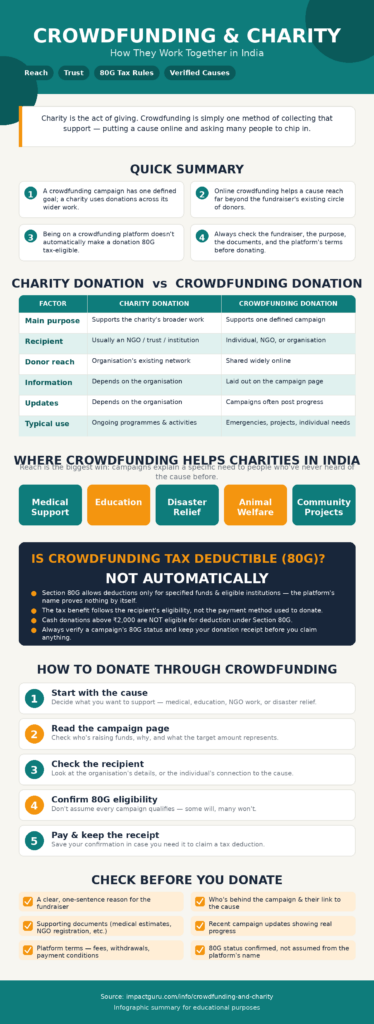
Crowdfunding and charity get mentioned in the same breath a lot. They’re not the same thing, though. Charity is the act of giving to a person, an organisation, or a cause. Crowdfunding is just one way of collecting that support: someone puts a cause online and asks a large number of people to chip in.
The distinction actually matters when you’re deciding where your money goes. A crowdfunding campaign might be raising funds for one patient’s surgery, an NGO’s new education drive, or relief after a disaster. A traditional donation, on the other hand, often goes straight into an organisation’s account and gets used across its broader programmes, with no single campaign attached to it.
So where does crowdfunding actually fit into charitable giving in India? And can you claim a tax deduction if you donate through one of these platforms? That’s what this piece walks through.
What Is Crowdfunding and How Is It Related to Charity?
Say, an NGO is trying to fund a new education programme. It has a few options:
- Go to a handful of large donors
- Apply for a grant
- Lean on its existing donor base
- Or put the cause online and ask a much bigger group of people to give whatever they’re comfortable with.
Individuals also use crowdfunding for specific needs. Someone facing a big medical bill will often set up a campaign and send it to relatives, friends, coworkers, anyone who might be willing to help.
That’s really where crowdfunding and charity meet. Crowdfunding is the method. Charity is the giving itself, or the cause behind it.
One thing worth flagging early: not every crowdfunding campaign counts as a charitable donation in the eyes of the tax department. Who’s receiving the money, and what it’s actually for, decides that, especially once tax benefits enter the picture.
Read More : Crowdfunding Founders in India: Who Built the Platforms
How Does Crowdfunding Help Charity in India?
Reach. That’s the biggest practical win crowdfunding gives to charities.
Most NGOs have a set of regular supporters, but that group can’t fund every new project that comes up. Putting a campaign online gives the organisation a second door, a way to explain a specific, current need to people who’ve never heard of it before.
It also makes the ask clearer. Instead of a general appeal for support, the organisation can say exactly what it’s raising money for, how much it needs, and post updates as the campaign moves along.
This works well for:
- medical support
- education
- disaster relief
- animal welfare
- and smaller community projects, the kind of needs that don’t always fit neatly into a grant application.
None of this replaces grants or CSR money or the donors an NGO already has. For most organisations, crowdfunding is simply one more channel, sitting alongside the rest.
What’s the Difference Between Crowdfunding and Charity Donation?
Here’s the short version: crowdfunding is how the money gets raised. A charity donation is the money itself, given to support a cause or an organisation.
A regular donation often lands in an NGO’s general fund, to be used across whatever falls under its charitable objectives. A crowdfunding donation is usually tied to one specific campaign, with a stated target and a stated purpose.
| Factor | Charity donation | Crowdfunding donation |
| Main purpose | Supports a charity or its broader work | Supports one defined fundraising campaign |
| Recipient | Usually an NGO, trust, or eligible institution | Could be an individual, NGO, or organisation |
| Donor reach | Built around the organisation’s existing network | Shared and spread more widely online |
| Information available | Depends on the organisation | Usually laid out on the campaign page itself |
| Updates | Depends on the organisation | Campaigns often post progress updates |
| Typical use | Ongoing programmes and activities | Specific projects, emergencies, individual needs |
There’s no real reason to treat these as rivals. An NGO can keep taking regular donations and still run a crowdfunding campaign for one particular project at the same time. Plenty do exactly that.
Best Online Crowdfunding Sites for Charity
There’s no single “best” platform; instead, it depends on what the fundraiser needs and what the donor is comfortable with.
If you’re choosing a platform to raise funds on, don’t just look at how many campaigns are listed on the homepage. Look at:
- how fundraisers get verified
- what donors are actually shown
- what fees apply
- how withdrawals work
- and what kind of support you’ll get if something goes wrong.
For donors, the individual campaign deserves at least as much attention as the platform.
- Who’s raising the money?
- Why is it needed?
- What’s actually been shared about how the funds will be used?
ImpactGuru, for instance, is a donation-based crowdfunding platform with campaigns spanning medical treatment, NGO work, emergencies, and other causes.
- It runs a due diligence process for fundraisers and asks them to submit relevant documents before a campaign goes live.
- It also offers a Self Driven plan with a 0% platform fee option, alongside paid plans that come with added support.
- Payment-processing charges can vary, so it’s worth checking the current terms before starting anything.
One point donors shouldn’t skip: appearing on a crowdfunding platform doesn’t, by itself, make a donation eligible for 80G. That eligibility has to be checked for the specific campaign and recipient.
Is Crowdfunding for Charity Tax Deductible in India?
Not automatically, no.
Section 80G of the Income Tax Act allows deductions for donations made to specified funds and eligible charitable institutions, within certain conditions and limits that vary by recipient. So the name of the platform tells you almost nothing about whether your specific donation qualifies.
Say someone starts a crowdfunding campaign to cover their own personal expenses. Don’t assume a contribution to that campaign is 80G-eligible just because it went through a crowdfunding site. The tax benefit follows the recipient’s eligibility and not the payment method.
A couple of other things to keep in mind:
- Cash donations above ₹2,000 aren’t eligible for deduction under Section 80Gaccording to the Income Tax Department.
- Donors planning to claim the benefit should hold on to proper documentation and confirm the recipient’s eligibility themselves, rather than assuming it.
If the tax deduction matters to you, check a campaign’s 80G status before you pay, not after.
How to Donate to Charity Through Online Crowdfunding
The actual donation is usually quick. The part worth slowing down for is picking the campaign.
- Start with the cause: What do you actually want your money to support- a medical fundraiser, an education initiative, an NGO’s programme, disaster relief?
- Read the campaign page properly: Who’s raising the funds, why, and what does the target amount actually represent? Check whatever documents or updates are available.
- Look at who’s receiving the money: If it’s an organisation, check its details. If it’s an individual, try to understand their connection to the person or cause the campaign is actually supporting.
- Confirm tax eligibility, if that matters to you: Don’t assume every campaign on a crowdfunding platform qualifies for 80G; some will, many won’t.
- Make the payment, and keep the receipt: Save the confirmation. If you ever need to substantiate a tax deduction, this is what you’ll need.
And if the campaign keeps posting updates, it’s worth checking back; you’ll get a better sense of where the money actually went.
What Should You Check Before Donating to a Crowdfunding Campaign?
A few minutes of reading usually answers most of what a donor needs to know.
- A clear reason for the fundraiser: you should be able to say, in one sentence, what the money is for.
- Who’s behind the campaign: and, where it’s relevant, their relationship to the person actually benefiting.
- Supporting documents: medical estimates, NGO registration details, or other proof, depending on the type of campaign.
- Campaign updates: these tend to say a lot about how a fundraiser is actually progressing.
- Platform terms: fees, payment conditions, withdrawal rules, all worth a quick check.
- 80G status: if a tax deduction is part of your reason for giving, confirm it. Don’t take the platform’s name as proof.
Verification from the platform helps, but it isn’t a substitute for reading the campaign yourself before you contribute.

Conclusion
Crowdfunding has changed how people come together for a cause; an NGO can use it for one project, and an individual can use it to ask a much wider circle for help with a specific need. For donors, none of this has to be complicated. Read the campaign properly, understand who’s raising the money, check what’s actually on offer, and keep your receipt. If an 80G deduction is part of the plan, verify it before you donate, not after. A little checking upfront tells you exactly what your money is going toward.
Frequently Asked Questions
It can be convenient, but donors should still check the campaign before contributing: who’s behind it, why the money is needed, and what’s actually been shared about it. Platform verification adds a layer of checking, not a replacement for your own.
Yes. An NGO can crowdfund for one project while still taking regular donations, grants, or CSR funding for everything else. The two sit fine side by side.
No. Crowdfunding works because many people give small amounts. No rule says your contribution has to be big; just whatever the platform’s minimum payment allows.
A crowdfunding donation is usually tied to one specific campaign with a stated purpose and target. A bank transfer often goes straight into an NGO’s account for its general or designated work. Either way, tax treatment comes down to the recipient’s eligibility, not the payment method itself.
No. Only donations that meet the actual Section 80G requirements qualify. The Income Tax Department’s guidance is clear on this; verify the recipient’s eligibility before you claim anything.