

Table of Contents
- Quick Summary
- Introduction
- Bone Marrow Transplant Cost in India
- Understanding Bone Marrow Transplant & Why It Is Needed
- Why Bone Marrow Transplant Costs Are So High in India
- The Biggest Challenge is Finding a Matching Donor
- Pre-Transplant Expenses Families Often Underestimate
- ICU & Post-Transplant Recovery: The Most Financially Draining Phase
- How Medical Crowdfunding Helps Bone Marrow, Transplant Patients
- Why Transparency Matters in Fundraising
- NGOs & Charities Supporting Bone Marrow Transplant Patients
- Government Schemes That May Help Reduce Transplant Costs
- Emotional Reality Families Face During Transplant Treatment
- Why Most Families Use Multiple Funding Sources Together
- Conclusion
- FAQs
Quick Summary
- A bone marrow transplant (BMT) is one of the most complex and expensive treatments in modern medicine. For patients suffering from leukaemia, lymphoma, aplastic anaemia, thalassemia, multiple myeloma, and other severe blood disorders, a transplant is often the only hope for survival. But while the treatment can save lives, the financial burden attached to it can overwhelm even financially stable families.
- In India, bone marrow transplant costs can range anywhere between ₹15 lakh and ₹50 lakh or more, depending on the hospital, donor type, complications, ICU stay, medicines, and recovery duration.
- Many families exhaust their savings within weeks and are forced to look for additional support through crowdfunding, NGOs, donor registries, hospital assistance programs, and government schemes
- Today, thousands of patients are successfully raising transplant funds online through platforms like ImpactGuru while combining support from charities, communities, and healthcare programs to continue life-saving treatment without interruption.
Introduction
When doctors say a patient urgently needs a bone marrow transplant, families often experience two shocks at the same time.
The first is medical, the fear of a life-threatening disease.
The second is financial, the realisation that survival itself may cost tens of lakhs.
For patients battling blood cancers and severe bone marrow disorders, treatment usually begins long before the transplant procedure itself. Families enter a long journey filled with chemotherapy cycles, blood transfusions, infections, repeated hospital admissions, donor searches, and constant medical uncertainty.
In many cases, families have only a short window to arrange treatment before the disease progresses further.
This urgency creates enormous emotional pressure. Parents, spouses, and caregivers often find themselves trying to arrange lakhs of rupees while simultaneously caring for a critically ill loved one.
Many families initially depend on:
- Savings
- Gold loans
- Borrowing from relatives
- Insurance claims
But transplant treatment frequently becomes too expensive for personal resources alone.
This is why medical crowdfunding and financial support systems have become increasingly important in India’s healthcare ecosystem.
Bone Marrow Transplant Cost in India
| Transplant Type | Approximate Cost (INR) | Approximate Cost (USD) |
| Autologous (patient’s own stem cells) | ₹10–18 lakh | $12,000–$22,000 |
| Allogeneic – matched sibling/related donor | ₹15–28 lakh | $18,000–$34,000 |
| Haploidentical (half-matched, e.g. parent) | ₹25–40 lakh | $30,000–$48,000 |
| Matched Unrelated Donor (MUD) via registry | ₹28–50 lakh+ (registry fees add ₹3–20 lakh, higher for international donors) | $34,000–$60,000+ |
Understanding Bone Marrow Transplant & Why It Is Needed
Bone marrow is the soft tissue inside bones responsible for producing blood cells. When bone marrow becomes damaged due to cancer, genetic disorders, or immune diseases, the body can no longer produce healthy blood cells properly.
A bone marrow transplant replaces diseased or damaged marrow with healthy stem cells to help rebuild the patient’s blood-forming system.
Doctors may recommend a transplant for conditions such as:
- Leukemia
- Lymphoma
- Aplastic anemia
- Multiple myeloma
- Thalassemia
- Sickle cell disease
- Severe immune deficiencies
For many patients, transplantation becomes the final and most critical stage of treatment.
Why Bone Marrow Transplant Costs Are So High in India
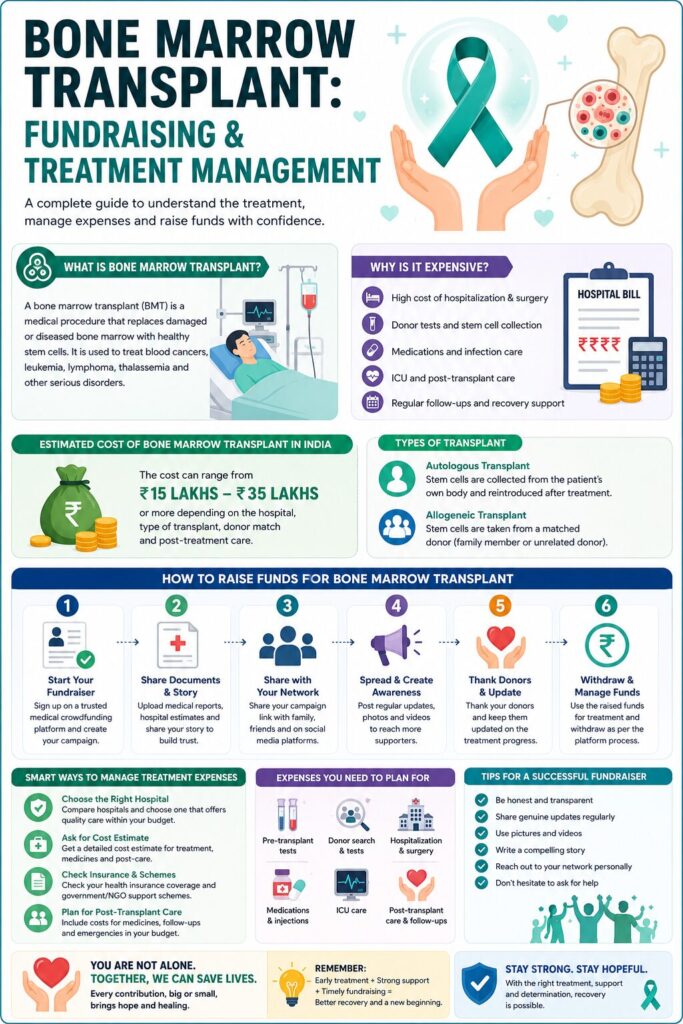
Most people think the transplant surgery itself is the main expense. In reality, the procedure is only one part of a very long and expensive treatment process.
Bone marrow transplant treatment involves:
- Pre-transplant testing
- Donor matching
- Chemotherapy or radiation therapy
- Isolation care
- ICU support
- Long-term medicines
- Infection management
- Recovery monitoring
Unlike many surgeries, where patients recover within days, transplant patients often require weeks or months of hospitalisation because their immune system becomes extremely weak during treatment.
Even small infections can become life-threatening after transplant, which is why hospitals maintain strict monitoring and isolation protocols.
The total treatment cost increases further when:
- A donor is difficult to find
- Complications develop
- ICU stay becomes prolonged
- Repeat hospital admissions are required
This is why many families struggle financially even after the transplant is completed.
The Biggest Challenge is Finding a Matching Donor
One of the most stressful parts of bone marrow transplant treatment is finding a suitable donor.
According to Narayana Health, donor matching depends heavily on Human Leukocyte Antigen (HLA) compatibility. Siblings are usually tested first because they have the highest likelihood of compatibility.
However, many patients do not find a match within their family.
In such cases, hospitals may search:
- National donor registries
- International stem cell donor databases
- Volunteer donor networks
Unfortunately, India still has relatively low awareness about stem cell donation, which makes donor searches more difficult for many patients.
The donor search process itself can become expensive because it may involve:
- HLA typing tests
- Registry search charges
- Stem cell collection costs
- International coordination fees
For some families, arranging donor-related expenses becomes almost as stressful as arranging treatment costs.
Pre-Transplant Expenses Families Often Underestimate
Before the actual transplant begins, patients usually undergo several weeks of preparation.
This stage may include:
- Chemotherapy
- Radiation therapy
- Bone marrow biopsies
- Infection screening
- Blood tests
- Organ function testing
The purpose of this phase is to prepare the body for transplantation and reduce the risk of rejection or complications.
Many families underestimate how expensive this stage can become because costs begin accumulating long before the transplant date.
Repeated blood transfusions and prolonged hospitalisation can quickly drain savings during this period.
ICU & Post-Transplant Recovery: The Most Financially Draining Phase
After transplantation, patients usually remain under extremely close medical observation.
The immune system becomes temporarily weak or completely suppressed, leaving patients vulnerable to infections that healthy individuals could normally fight easily.
This is why post-transplant care often requires:
- Isolation rooms
- ICU care
- Continuous monitoring
- High-end antibiotics
- Blood products
- Nutritional therapy
Some patients recover smoothly, while others may develop complications such as:
- Graft-versus-host disease (GVHD)
- Severe infections
- Organ complications
- Rejection issues
When complications arise, hospital stays become longer, and treatment costs rise rapidly.
For many families, the recovery phase becomes financially harder than the transplant itself.

How Medical Crowdfunding Helps Bone Marrow, Transplant Patients
Over the last few years, medical crowdfunding has transformed how families manage expensive transplant treatment in India.
Instead of depending only on relatives or loans, patients can now raise funds online from:
- Friends
- Colleagues
- Social media communities
- Philanthropic donors
- Complete strangers willing to help
Families create fundraising campaigns explaining:
- The patient’s diagnosis
- Treatment urgency
- Hospital estimate
- Donor search progress
- Financial condition
These campaigns are then shared across platforms like WhatsApp, Instagram, Facebook, and LinkedIn.
Platforms like ImpactGuru have become especially important for transplant patients because they help families:
- Launch campaigns quickly
- Reach larger audiences
- Receive digital donations
- Access fundraising guidance
For many patients, crowdfunding becomes the difference between delayed treatment and immediate hospitalisation.
Why Transparency Matters in Fundraising
People donate when they emotionally understand the urgency of the situation.
Successful transplant campaigns usually provide:
- Medical reports
- Cost breakdowns
- Doctor recommendations
- Donor search updates
- Recovery progress
Families who regularly post updates often build stronger donor trust and raise funds faster.
Authenticity is one of the most important parts of successful medical fundraising.
NGOs & Registries Supporting BMT Patients
| Organization | Focus Area | Notes |
| DATRI Blood Stem Cell Donors Registry | Donor matching and registry search (not direct funding) | India’s leading stem cell donor registry; helps patients locate matching donors, which is a prerequisite before allogeneic/MUD transplant costs can even be estimated |
| CanKids KidsCan | Childhood cancer, including paediatric BMT | Provides financial assistance, donor identification support, and post-transplant care coordination; active across 141 hospitals in 22 states |
| Cancer Patients Aid Association (CPAA) | Cancer patients broadly, including BMT-eligible blood cancers | Offers treatment assistance, counselling, medicines, and rehabilitation support |
| Indian Cancer Society (ICS) | Cancer patients, including BMT cases at empanelled hospitals | Fund sanctions typically capped per patient, with a higher cap (up to ~₹8 lakh) specifically for bone marrow transplant cases; income-based eligibility applies |
| Leukaemia Crusaders | Blood cancer patients | Financial help, awareness initiatives, and emotional support programmes for leukaemia and related blood disorders |
Government Schemes
| Scheme | Who It’s For | What It Covers |
| Ayushman Bharat (PM-JAY) | Eligible low-income families under the SECC database | Cashless hospitalisation and select transplant-related treatment at empanelled hospitals, up to the scheme’s annual limit |
| PM National Relief Fund (PMNRF) | Patients with life-threatening conditions, income-based | Financial aid for BMT, cancer treatment, and organ transplant procedures; application via the PMNRF portal or a Member of Parliament |
| Rashtriya Arogya Nidhi (RAN) / Health Ministry’s Cancer Patient Fund | Below-poverty-line patients needing life-threatening treatment | Grants for major treatment, including blood cancer and BMT, at government hospitals |
| State Chief Minister’s Relief Funds | Residents of the respective state, income-based | Many states sanction partial BMT costs on a case-by-case basis; processing time varies by state |
NGOs & Charities Supporting Bone Marrow Transplant Patients
Several NGOs and charitable organisations in India help patients undergoing blood cancer and transplant treatment.
These organisations may support:
- Partial treatment costs
- Blood donation drives
- Medicines
- Accommodation support
- Nutritional care
- Emotional counselling
Some notable organisations include:
DATRI Blood Stem Cell Donors Registry
India’s leading stem cell donor registry is helping patients find matching donors for bone marrow transplants.
Cancer Patients Aid Association
Supports cancer patients with treatment assistance, counselling, medicines, and rehabilitation services.
Indian Cancer Society
Provides financial aid, awareness programs, and patient support services for individuals battling cancer.
Leukaemia Crusaders
Works to support blood cancer patients through financial help, awareness initiatives, and emotional support programs.
DATRI, in particular, plays an important role in stem cell donor awareness and matching support in India.
While NGOs rarely cover the full transplant cost, they often reduce a major portion of the financial burden.
Government Schemes That May Help Reduce Transplant Costs
Several government schemes offer financial assistance for life-threatening illnesses.
Provides eligible families with health coverage for hospitalisation and certain transplant-related treatments at empanelled hospitals.
PM National Relief Fund (PMNRF)
Offers financial aid for severe medical conditions, including:
- Bone marrow transplant
- Cancer treatment
- Organ transplant procedures
- State Medical Assistance Schemes
Many states provide additional financial aid for low-income patients requiring expensive treatment.
Families should apply early because approvals and documentation may take time.
Emotional Reality Families Face During Transplant Treatment
Bone marrow transplant treatment affects entire families emotionally.
Caregivers often experience:
- Constant anxiety
- Sleep deprivation
- Financial panic
- Fear of complications
- Emotional exhaustion from prolonged hospitalisation
Parents frequently stop working temporarily to care for children undergoing treatment, leading to further income loss.
This emotional burden is one reason why support systems matter beyond finances alone.
Why Most Families Use Multiple Funding Sources Together
In real-life treatment journeys, very few patients manage transplant expenses through one source alone.
Most families combine:
- Savings
- Crowdfunding
- NGO support
- Insurance
- Government assistance
- Community fundraising
Using multiple support systems together improves the chances of completing treatment without dangerous delays.
Conclusion
A bone marrow transplant is not just a medical procedure; it is an emotional, financial, and psychological battle for patients and families alike.
The cost of treatment, donor searches, prolonged hospitalisation, ICU care, and post-transplant recovery can feel impossible to manage alone. But today, thousands of families across India are successfully accessing life-saving care through crowdfunding, NGOs, donor registries, government schemes, and community support.
Platforms like ImpactGuru are helping patients begin treatment faster while giving families a way to seek financial help without waiting until resources are exhausted.
The earlier families begin exploring support systems, the better their chances of continuing treatment without interruption, and focusing fully on recovery instead of financial fear.
FAQs
Bone marrow transplant fundraising is the process of raising money online or offline to cover expensive treatment costs such as hospital bills, medicines, surgery, ICU care, and post-transplant recovery. Medical crowdfunding platforms like ImpactGuru.
Costs vary by transplant type: autologous transplants cost ₹10–18 lakh, matched-sibling allogeneic transplants cost ₹15–28 lakh, haploidentical (half-matched) transplants cost ₹25–40 lakh, and matched-unrelated-donor (MUD) transplants via registry cost ₹28–50 lakh or more, with registry and donor-search fees adding ₹3–20 lakh depending on whether the donor is domestic or international.
You can start a medical fundraiser, upload medical documents, share your story on social media, and ask friends and family to spread the campaign link. Frequent updates and emotional storytelling can help increase donations.
Yes, verified crowdfunding platforms use document verification and secure payment systems to ensure transparency and donor trust.
Usually, you need medical reports, hospital estimates, identity proof, PAN card, Aadhaar card, and beneficiary bank details.
Yes — CanKids KidsCan provides financial assistance and donor-identification support specifically for children with cancer, including paediatric BMT cases, across a network of 141 partner hospitals in 22 states. Indian Cancer Society also sanctions a higher funding cap specifically for BMT cases relative to other cancer treatments, subject to income eligibility.
Ayushman Bharat (PM-JAY) covers eligible hospitalisation and select transplant-related costs at empanelled hospitals; the PM National Relief Fund and Rashtriya Arogya Nidhi both offer income-based financial aid specifically for BMT and other life-threatening conditions; and several state Chief Minister’s Relief Funds sanction partial BMT costs case by case.