
Among all forms of giving, organ donation stands out as the purest gift of life. It is a selfless act that offers someone not just help but a second chance at life. In fact, one organ donor can save up to eight lives, making the benefits of organ donation both deeply personal and profoundly far-reaching. Yet, despite medical advancements, there is a huge gap between the demand for organ transplants and the number of willing donors, leaving countless patients waiting in hope.
Beyond the medical aspect, it’s essential to acknowledge the emotional, ethical, and social implications of organ donation. In this blog, we will walk you through what organ donation means, the criteria for organ donation, its wide-ranging benefits, and why there is a growing need for organ donation today.
For recipients and families going through this journey, crowdfunding platforms like ImpactGuru Foundation can help you with online fundraising and be financially prepared while waiting for a match.
Read More: How to Become a Kidney Transplant Donor in India?
Read More: Find Hospitals near you.
Table of Contents
What is Organ Donation?
Organ donation is the voluntary process of giving healthy organs and tissues for transplantation to people with organ failure. Donation can happen:
- After death (deceased donation), typically after brain death is declared;
- During life (living donation), where individuals donate organs like one kidney or part of the liver.
In India, organ transplantation is regulated under the Transplantation of Human Organs and Tissues Act (THOTA), ensuring ethical, legal, and transparent transplant practices.
Read More: Liver Transplant Waiting List: Registration & Criteria
Read More: Calculate the Cost of your Treatment.
Why Organ Donation Is Critical — Key Benefits
1. Save Multiple Lives With One Donor
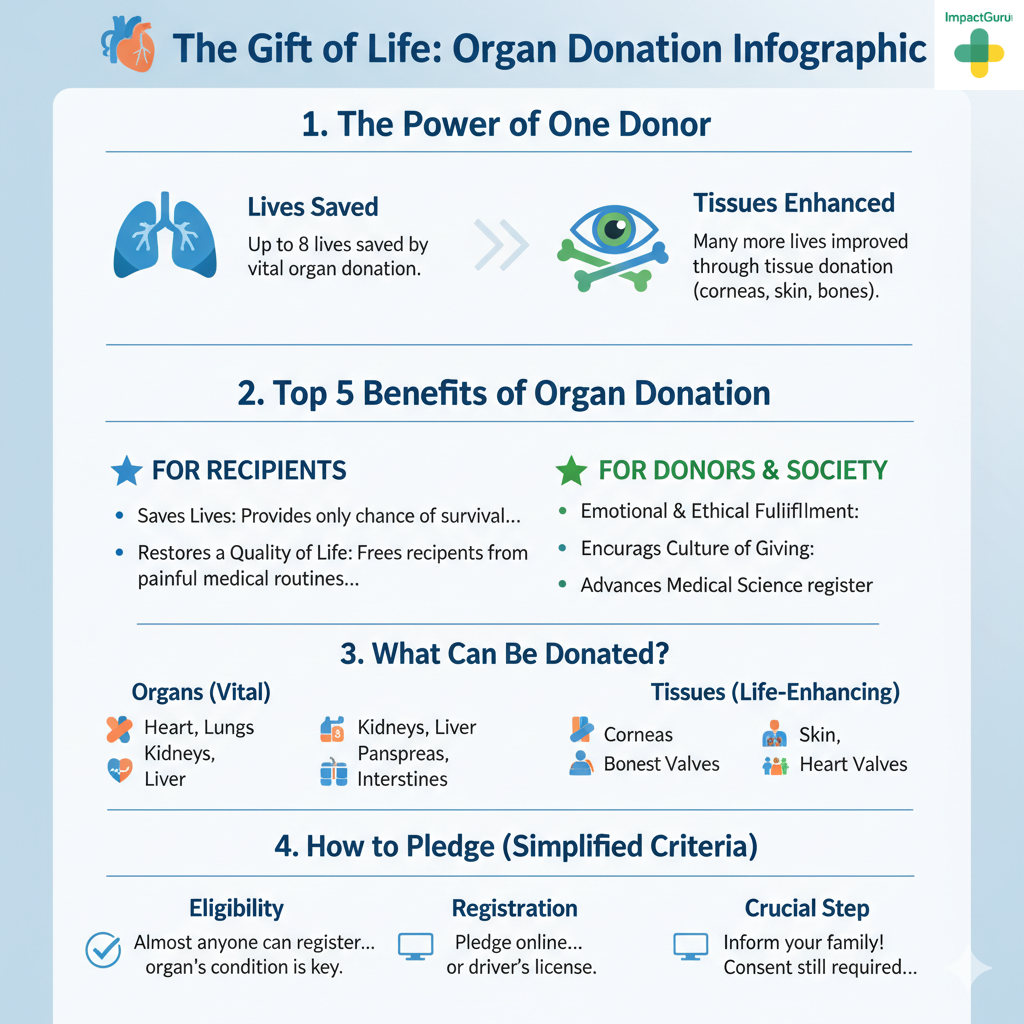
A single organ donor can save up to 8 lives through vital organ transplants — including heart, liver, kidneys, lungs, and pancreas. Tissues like corneas, skin, and heart valves also restore vision and quality of life for many more.
2. Improves Quality of Life
Transplant recipients often return to daily life activities, regain independence, and avoid long-term treatments like dialysis in kidney failure.
3. Relieves Families and Strengthens Communities
For donor families, knowing a loved one’s organs helped others can be a profound source of comfort and meaning — helping with emotional closure and community solidarity.
4. Addresses the Organ Shortage Crisis in India
Although demand far outstrips supply, India has made historic progress in organ donation in recent years. In 2025 alone, more than 1200 families donated organs after death, directly saving or improving thousands of lives, and nearly 20,000 transplants were performed nationwide.
5. Supports Medical Advancement & Research
Organ and tissue donations foster learning, surgical technique improvements, and advanced transplant outcomes — helping treat complex conditions with better success rates.
Organ & Tissue Benefits — What Can Be Donated?
| Organ / Tissue | Life-Saving & Quality of Life Impact |
|---|---|
| Kidneys | Ends dialysis and restores kidney function. |
| Liver | Treats chronic liver disease; a portion can also help living donors. |
| Heart | Saves lives in end-stage cardiac failure. |
| Lungs | Life-saving for severe respiratory failure. |
| Pancreas | Improves glucose control for diabetics. |
| Cornea & Tissues | Restores vision and mobility. |
What Is The Criteria For Organ Donation?
Understanding the criteria for organ donation is essential for anyone considering becoming a donor, whether during their lifetime or after death. Organ donation is a carefully regulated medical process that ensures the safety of both donors and recipients while adhering to ethical and legal standards.
1. General Eligibility for Organ Donation
Almost anyone can register to be an organ donor, regardless of age, gender, or background. The most important factor is the condition of the organs at the time of donation. In many cases, even individuals with certain medical conditions may still be eligible to donate specific organs or tissues.
You may be eligible to donate if:
- You are 18 years or older (minors may donate with parental or legal consent).
- You are in good physical and mental health (for living donation).
- Your organs are functioning well at the time of evaluation.
- You pass the required medical assessments (especially for deceased donation after brain death).
It’s equally important to inform your family about your decision, as they may be asked to give consent in certain cases.
2. Living Organ Donation Criteria
Living donors voluntarily donate an organ or part of an organ, typically one kidney or a portion of the liver. This type of donation is highly regulated and involves extensive screening to protect the donor’s health and safety.
Criteria for living donors include:
- The age of the donor should fall between 18 and 65 years.
- Good overall physical and mental health is essential
- No history of major medical conditions such as uncontrolled diabetes, hypertension, or organ failure
- Must be a close relative or spouse, as per the Transplantation of Human Organs and Tissues Act (THOTA), 1994
- If the organ is donated by a stranger, it is ensured that there are no monetary benefits of organ donation.
Those considering liver donation must meet additional medical and anatomical criteria, including liver size and normal liver weight, to ensure safety and transplant success.
3. Deceased Donation Criteria
Most organ donations in India happen after death, typically from patients declared brain-dead in a hospital. Brain death is a legally and medically accepted form of death where all brain functions have stopped, but other organs remain viable with life support.
Organs that can be donated after death include:
- Liver, kidneys, heart, lungs, pancreas, intestines
- Tissues such as corneas, skin, heart valves, and bones
Eligibility for deceased donation includes:
- Confirmed diagnosis of brain death by a certified medical board
- Organ viability is preserved under hospital-based ICU conditions
- No active infections such as HIV, cancer, or sepsis
How Organ Donation Works in India (2026)
Step 1: Registration & Pledge
You can register to donate your organs and tissues through the National Organ & Tissue Transplant Organisation (NOTTO) or state registries. Inform family members about your decision — their consent is legally required at the time of donation.
Step 2: Brain Death Declaration
Organ donation after death generally happens when a qualified medical board declares brain stem death, allowing vital organs to be viable for transplant.
Step 3: Matching & Allocation
Organ allocation is coordinated through national and state networks to find the best match for recipients based on urgency, compatibility, and waiting time.
Step 4: Transplantation Surgery
Specialized surgical teams perform the transplant procedures, followed by post-operative care to ensure the best outcomes.
Why You Need to Consider Organ Donation?
The growing need for organ donation in India is a critical concern, with thousands of patients still waiting on the liver transplant waiting list and for other vital organs. In such a reality, choosing to become a donor is a practical and powerful way to offer someone a second chance at life. Organ donation saves lives, supports families, and brings renewed hope to those in need. By understanding the criteria for organ donation, almost anyone can step forward and pledge. The benefits of organ donation go beyond medical outcomes; they create emotional fulfillment, positive social impact, and a lasting legacy that continues to inspire.

Conclusion
The benefits of organ donation go beyond statistics; it’s an act of compassion that offers a second chance at life. As the need for organ donation rises, each donor brings renewed hope to patients and families. By understanding the criteria for organ donation, registering, and informing your loved ones, you create a real impact. Organ donation saves lives, restores futures, and strengthens human bonds. For those awaiting transplants, online donation in India like Impact Guru can help raise money online for surgeries and medical care, making life-saving treatment more accessible
FAQs
Any patient with organ failure and matching tissue criteria may receive an organ donation once clinical suitability is confirmed.
Living donors typically maintain full health after donating organs like a kidney or a portion of liver, with minimal long-term risks under proper medical care.
Yes — one organ donor can save up to eight lives and enhance many more through tissue donation.
No — major medical costs of donation are generally borne by the recipient’s side; donors are not charged for the organ itself.
Absolutely — organ transplantation often restores function, reduces dependency on treatments (like dialysis), and improves overall health and life expectancy.
Organ donation saves lives, improves the quality of life for recipients, offers emotional fulfillment for donors and their families, builds a culture of giving, and supports medical advancements.
A single organ donor can save up to eight lives by donating vital organs like the heart, liver, kidneys, lungs, and pancreas.
Yes, living individuals can donate kidneys, parts of the liver, lungs, and other tissues, often to family members or close friends.
Organs such as the heart, lungs, kidneys, liver, pancreas, and intestines, along with tissues like corneas, skin, heart valves, and bones, can be donated.
Individuals can register as organ donors through platforms like the National Organ and Tissue Transplant Organization (NOTTO) or by signing up at hospitals and authorized centers.