


Colorectal cancer is one of the most common cancers worldwide, but it is also among the most preventable when detected early. Regular colorectal cancer screening plays a crucial role in identifying precancerous polyps and early-stage cancers before symptoms appear. While colonoscopy is widely regarded as the gold standard for screening, many people seek alternatives to colonoscopy due to concerns about invasiveness, preparation requirements, sedation, cost, or personal preferences.
Fortunately, advances in medical technology have introduced several effective alternatives to colonoscopy that can help detect colorectal cancer and improve patient compliance with screening recommendations. These options range from stool-based tests and imaging techniques to emerging blood-based screening methods. Understanding the benefits, limitations, and suitability of each screening approach can help individuals make informed healthcare decisions.
In this guide, we explore the most reliable alternatives to colonoscopy, compare their effectiveness, and explain who may benefit from each screening method.
Table of Contents
- Why Is Colorectal Cancer Screening Important?
- Is Colonoscopy Still the Gold Standard?
- 1. Fecal Immunochemical Test (FIT)
- 2. Stool DNA Test (Cologuard)
- 3. Flexible Sigmoidoscopy
- 4. CT Colonography (Virtual Colonoscopy)
- 5. Capsule Endoscopy
- 6. Blood Biomarker Tests
- 7. Digital Rectal Exam (DRE)
- 8. Double-Contrast Barium Enema
- 9. Single-Specimen Guaiac Fecal Occult Blood Test (gFOBT)
- Colonoscopy vs Alternatives: Comparison Table
- Who Should Consider Alternatives to Colonoscopy?
- Cost of Colorectal Cancer Screening in India
- Conclusion
- FAQs
Why Is Colorectal Cancer Screening Important?
Colorectal cancer often develops slowly over several years, beginning as small growths called polyps inside the colon or rectum. In many cases, these polyps can be detected and removed before they become cancerous.
Early screening can:
- Detect cancer before symptoms develop
- Identify precancerous polyps
- Improve treatment outcomes
- Increase survival rates
- Reduce the overall burden of cancer treatment
According to global cancer statistics, early-stage colorectal cancer has significantly higher survival rates than cancer diagnosed at advanced stages. This makes routine screening one of the most effective preventive healthcare measures available today.
Is Colonoscopy Still the Gold Standard?
Colonoscopy remains the most comprehensive screening test because it allows doctors to:
- Examine the entire colon and rectum
- Detect small polyps and abnormalities
- Remove polyps during the same procedure
- Collect tissue samples for biopsy
However, despite its effectiveness, some individuals avoid screening due to:
- Fear of discomfort
- Sedation concerns
- Extensive bowel preparation
- Time off work
- Higher costs
For these individuals, several effective alternatives to colonoscopy may provide a practical solution
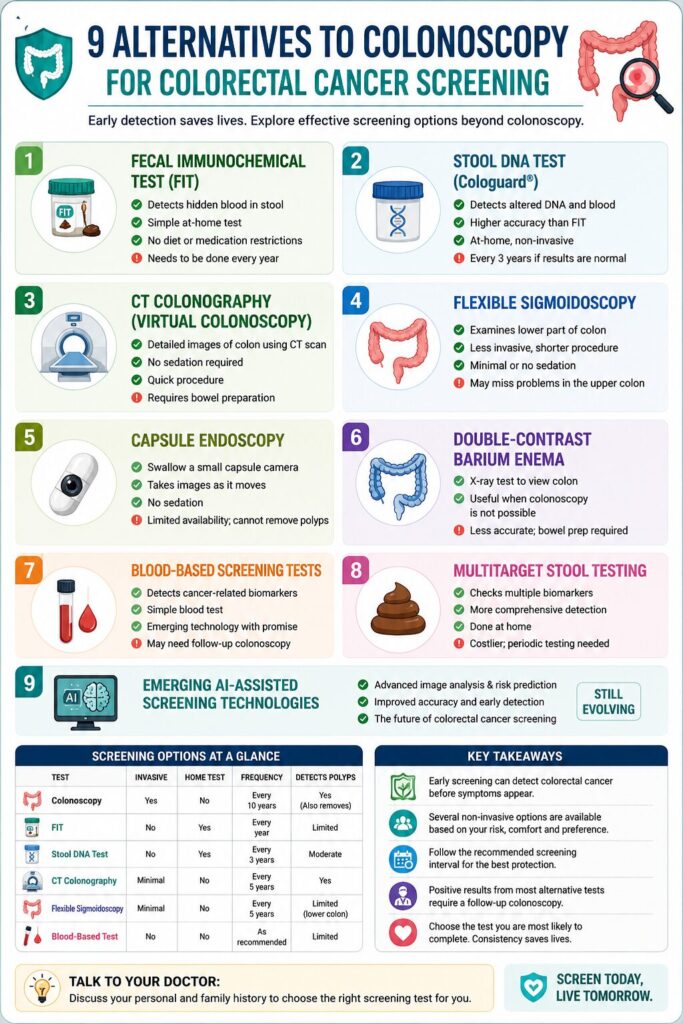
Here’s a detailed overview of 9 alternatives to a colonoscopy for colorectal cancer screening:
1. Fecal Immunochemical Test (FIT)
A. Description of the FIT and How It Works
The Fecal Immunochemical Test (FIT) is a non-invasive test that inspects for hidden blood in your stool, which can be a cancer symptom or large polyps (abnormal growths). It detects hemoglobin, a protein found in red blood cells. To take the test, you use a small tool (provided in a kit) to collect a sample of your stool at home and send it to a lab. The lab will then analyze the sample for traces of blood that you can’t see with your eyes.
B. Advantages of Using FIT as a Screening Tool
– Ease of Use: The test is simple and can be done at home; no need for a hospital visit.
– No Special Prep: Unlike a colonoscopy, you don’t have to change your diet or take laxatives to prepare for the test.
– Affordable: FIT is one of the least expensive options for colorectal cancer screening.
– No Risks: It doesn’t involve any instruments entering your body, so there’s no risk of injury, infection, or other complications.
C. Limitations & Considerations
– Must Be Done Yearly: The FIT only detects blood in the stool at the time of the test, so it must be repeated every year.
– Misses Some Polyps and Cancers: If a polyp or cancer isn’t bleeding when you take the test, it might not be detected.
– Follow-Up Required: A positive result (finding blood) means you’ll need a colonoscopy to investigate further.
2. Stool DNA Test (Cologuard)
A. Explanation of How the Stool DNA Test Detects Cancer
The stool DNA test (also called Cologuard) checks your stool for both blood and abnormal DNA from cancer or precancerous polyps. Cells in the colon shed their DNA, and if there are cancerous or precancerous changes in the cells, this test can pick up specific genetic mutations or markers that indicate cancer.
B. Pros and Cons of Choosing This Method
Pros:
– Non-Invasive: Like FIT, you can do this test at home without needing a doctor to perform a procedure.
– Covers More than FIT: In addition to looking for blood, it also detects abnormal DNA, giving it a broader range of detection for cancers and polyps.
Cons:
– More Expensive: Stool DNA tests are generally more expensive than the FIT test.
– False Positives: There’s a higher chance the test will indicate you have cancer when you don’t, leading to unnecessary colonoscopies.
– Still Requires Follow-Up: Just like FIT, if your results return positive, you’ll need a colonoscopy for further examination.
C. Accuracy and Frequency of Testing
The stool DNA test is more precise than the FIT in detecting cancer and advanced polyps. It’s typically done once every three years, making it less frequent than the FIT. However, you’ll still need a colonoscopy to confirm if the test detects something.
3. Flexible Sigmoidoscopy
A. Overview of the Procedure and What It Entails
Flexible sigmoidoscopy is a procedure in which a physician utilizes a thin, flexible tube with a camera (also known as a sigmoidoscope) to look inside the lower portion of your colon (the sigmoid colon). The doctor can look for polyps or abnormal tissue and even take small tissue samples for a biopsy if needed.
B. Comparison with Colonoscopy in Terms of Invasiveness and Preparation
Less Invasive: A sigmoidoscopy only examines the last part of the colon, not the entire colon, like a colonoscopy. This makes it quicker and less invasive.
– Easier Prep: The preparation for this test is simpler. You usually need a light bowel to cleanse, but it’s not as extensive as the prep for a colonoscopy.
– Shorter Procedure: The actual test takes less time—usually around 10 to 20 minutes.
C. Situations Where Flexible Sigmoidoscopy Is Preferred
This test is often recommended for people at lower risk for colorectal cancer or those who only need screening of the lower part of the colon. It’s also preferred for patients who may not be able to undergo the full sedation required for a colonoscopy.
4. CT Colonography (Virtual Colonoscopy)
A. Understanding CT Colonography and Its Technology
CT colonography, or virtual colonoscopy, uses a CT scanner to take detailed, 3D images of your colon and rectum. The test creates a virtual image that allows doctors to “see” inside your colon without using a camera or inserting a scope. Just like a regular colonoscopy, you still need to take a bowel preparation to clear the colon.
B. Benefits of Opting for a Virtual Colonoscopy
– Non-Invasive: There’s no tube going into your colon, which makes it less uncomfortable than a traditional colonoscopy.
– Quick: The procedure only takes 10 to 15 minutes, and there’s no recovery time like with sedatives used in regular colonoscopies.
– Effective at Detecting Large Polyps: Virtual colonoscopy is good at detecting large polyps and cancers.
C. Considerations Regarding Radiation Exposure and Follow-Up Procedures
– Radiation: This test uses X-rays, which means there is some radiation exposure, although the levels are generally low.
– Follow-Up Colonoscopy: If the virtual colonoscopy finds anything suspicious, you’ll need a traditional colonoscopy to remove the polyps or take a biopsy, which means going through a second procedure.
5. Capsule Endoscopy
A. The Innovative Approach of Using a Capsule-Sized Camera
Capsule endoscopy involves ingesting a small, pill-sized camera that takes thousands of photos as it passes through your digestive system. The camera sends these images to a device worn by the patient, allowing doctors to see the inside of the colon without inserting any instruments.
B. How Capsule Endoscopy Is Performed and Its Effectiveness
After swallowing the capsule, it travels through your intestines, taking images later reviewed by doctors. The procedure is non-invasive, and you can perform normal activities while the capsule works. Capsule endoscopy is particularly effective in some regions of the small intestine that are hard to reach with traditional colonoscopy.
C. Potential Drawbacks and Patient Eligibility
– Can’t Remove Polyps: Unlike a traditional colonoscopy, capsule endoscopy only provides images and can’t remove polyps or take tissue samples.
– Not for Everyone: The test is not recommended for people with strictures or blockages in their intestines, as the capsule can get stuck.
– Cost and Availability: Capsule endoscopy may not be available everywhere and can be expensive.
6. Blood Biomarker Tests
A. Insight into Blood Tests That Detect Biomarkers for Colorectal Cancer
Blood biomarker tests look for specific markers in the blood that indicate the presence of cancer. These tests focus on substances like proteins or DNA fragments discharged by cancer cells into the bloodstream.
B. Discussion on the Types of Biomarkers and Their Significance
Common biomarkers for colorectal cancer include CEA (Carcinoembryonic Antigen) and certain types of methylated DNA. If these markers are elevated, it could be a symptom of colorectal cancer or precancerous conditions.
C. Current Research and Future Prospects of Blood Biomarker Tests
Blood biomarker tests are still being researched and aren’t widely used for routine screening yet. However, the future looks promising. These tests could one day offer a simple, non-invasive way to detect cancer early, without the need for stool samples or invasive procedures.
7. Digital Rectal Exam (DRE)
A. The Role of DRE in Colorectal Cancer Screening
A Digital Rectal Exam is a medical procedure where a physician uses a gloved finger to check inside the rectum for unusual lumps or growths. This is a quick, low-risk test that helps detect abnormalities in the lower part of the rectum.
B. Procedure and Limitations of DRE
The doctor checks for any irregularities in the rectum. However, DRE has limitations because it can only detect problems in the lower part of the rectum and may miss cancers higher up in the colon.
C. How DRE Complements Other Screening Methods
DRE is often used as a quick check-up and is sometimes combined with other tests like FIT or colonoscopy. While it’s ineffective for full colorectal cancer screening, it can be helpful in a broader screening approach.
8. Double-Contrast Barium Enema
A. Outlining the Double-Contrast Barium Enema Process
This is a procedure where a special liquid called barium is inserted into your colon through a tube. Barium helps the colon show up better on X-ray images. After that, air is also pumped in to expand the colon so doctors can take clear pictures of its lining. The goal is to spot any abnormalities, such as growths or tumors.
B. Situations Where Double-Contrast Barium Enema Is Preferred
This test may be used if a colonoscopy isn’t possible or safe due to medical reasons or the person can’t handle sedation. It is also sometimes chosen when a full view of the colon is needed, but other screening methods aren’t available.
C. Discussing the Effectiveness of This Method for Cancer Screening
While this method can detect large tumors or growths, it’s not as accurate as a colonoscopy. It may miss smaller polyps or abnormalities that could eventually turn into cancer. As a result, it’s less commonly used today for cancer screening.
9. Single-Specimen Guaiac Fecal Occult Blood Test (gFOBT)
A. Detailing the gFOBT and Its Application
The gFOBT is a test that checks for hidden blood in your stool, which might be a sign of colorectal cancer. You provide a small stool sample, which is then tested for traces of blood that you can’t see with your eyes.
B. How gFOBT Stands Out from Other Fecal Tests
What makes gFOBT unique is that it looks for a chemical reaction between the stool and a special test substance (guaiac). Other tests might check for blood in different ways or even test for DNA changes in the stool, but gFOBT is one of the oldest and simplest methods.
C. Frequency & Reliability of gFOBT for Cancer Detection
gFOBT is typically done once a year. While it can help detect colorectal cancer early, it’s not the most reliable test. False positives (where it shows blood, but there’s no cancer) or false negatives (where it misses cancer) can happen. Because of this, it’s often recommended as part of regular screening but may be followed up with more precise tests like colonoscopy if blood is detected.
Colonoscopy vs Alternatives: Comparison Table
| Screening Test | Invasive | Home Test | Frequency |
|---|---|---|---|
| Colonoscopy | Yes | No | Every 10 Years |
| FIT | No | Yes | Every Year |
| Stool DNA Test | No | Yes | Every 3 Years |
| CT Colonography | Minimal | No | Every 5 Years |
| Flexible Sigmoidoscopy | Minimal | No | Every 5 Years |
| Blood-Based Test | No | No | As Recommended |
Who Should Consider Alternatives to Colonoscopy?
Alternative screening methods may be suitable for:
- Adults aged 45 and above
- Individuals with low-to-average colorectal cancer risk
- Patients unable to tolerate sedation
- People seeking non-invasive screening options
- Individuals hesitant about traditional colonoscopy procedures
However, people with a strong family history of colorectal cancer or inflammatory bowel disease should consult a healthcare professional regarding the most appropriate screening strategy.
Cost of Colorectal Cancer Screening in India
The cost of colorectal cancer screening varies depending on the test selected:
| Screening Method | Approximate Cost |
| FIT Test | ₹500 – ₹2,000 |
| Stool DNA Test | ₹15,000 – ₹40,000 |
| CT Colonography | ₹5,000 – ₹15,000 |
| Colonoscopy | ₹8,000 – ₹30,000 |
Patients diagnosed with colorectal cancer may face significantly higher treatment expenses, including surgery, chemotherapy, targeted therapy, and hospitalization.
In such situations, many families turn to medical crowdfunding platforms like ImpactGuru to raise donation online and manage cancer treatment costs more effectively.
Conclusion
Regular colorectal cancer screening saves lives by identifying cancer at an early, more treatable stage. While colonoscopy remains the gold standard, several effective alternatives to colonoscopy now provide patients with more choices than ever before. From FIT tests and stool DNA analysis to virtual colonoscopy and emerging blood-based technologies, these screening options can improve participation rates and help detect colorectal cancer before it becomes life-threatening.
The most important step is not choosing the perfect screening test—it is ensuring that screening happens consistently and according to medical recommendations. Consult your healthcare provider to determine which colorectal cancer screening method best suits your health needs, risk factors, and personal preferences.
FAQs
The FIT test and stool DNA test are among the most commonly recommended alternatives due to their convenience and non-invasive nature.
Yes. Several screening methods, including FIT, stool DNA testing, CT colonography, and blood-based tests, can help detect colorectal cancer.
While many alternatives are effective, colonoscopy remains the most comprehensive method because it allows both detection and removal of polyps.
Most medical organizations recommend starting routine screening at age 45 for adults at average risk.
Yes. Positive findings from most alternative screening methods generally require follow-up colonoscopy for confirmation and treatment.