

Table of Contents
- Quick Takeaways
- Introduction
- Defining Credibility in Medical Fundraising
- Verified Hospitals and Doctors: Leverage Institutional Weight
- Transparency in Action: Itemized Costs and Fund Usage
- Why is Trust Important in Online Donations?
- How Social Credibility is The Seed of Trust?
- Common Credibility Gaps: Why Donors Hesitate
- Quick Checklist
- The Identity Factor: Treat Donors as Partners
- Conclusion
- FAQs
Quick Takeaways
- Medical fundraiser credibility determines whether donors give or hesitate.
- Verified hospitals, transparent costs, and regular updates are the strongest donor trust factors.
- Online crowdfunding campaigns succeed when accountability is visible, not just emotional.
- Donors respond best to specificity, consistency, and proof of real-world impact.
Introduction
Medical emergencies naturally bring out empathy. People want to help when they see someone struggling with illness or rising treatment costs. However, in 2026, that emotional response is often followed by a crucial question: Can I trust this fundraiser? As online donations grow and people become more cautious about fraud, medical fundraiser credibility often decides whether people donate or scroll past. Today’s donors are reassurance-seeking: they want proof, clarity, and visible accountability before they take action.
In this blog, we explain what makes a medical fundraiser feel trustworthy to donors. We will also talk about how trust is built through clear medical documentation, verified hospitals, transparent costs, consistent updates, and visible accountability. By the end, you’ll understand exactly how credible medical fundraisers are built, sustained, and trusted.
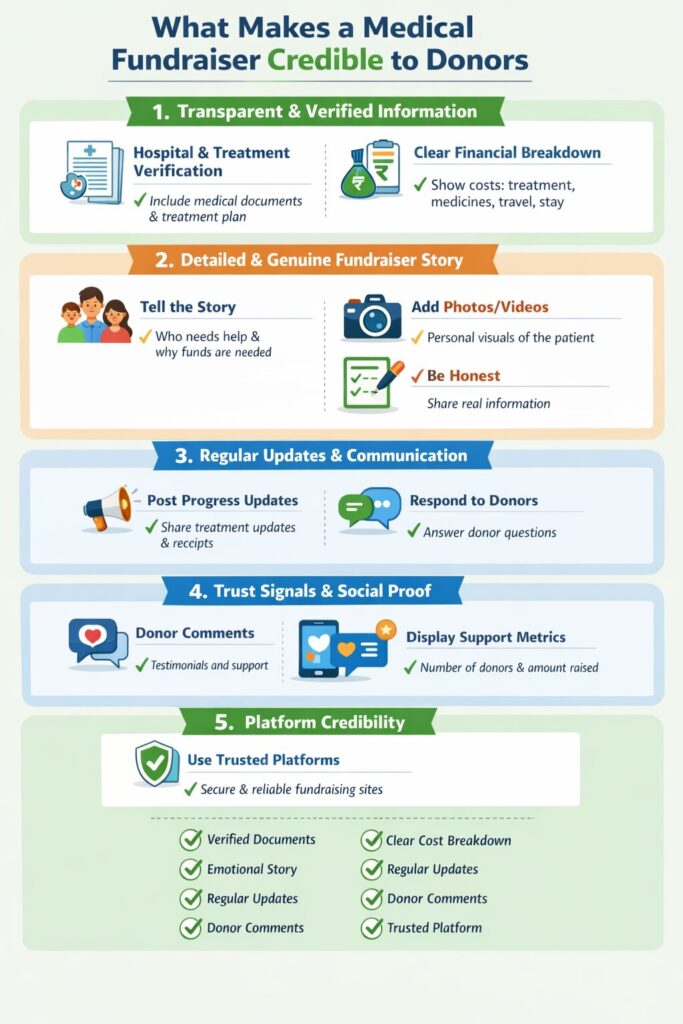
Defining Credibility in Medical Fundraising
Medical fundraiser credibility is the bridge between a stranger’s empathy and their decision to donate. It is all about letting the donors feel 100% confident that their support will reach the right person and be used for the intended purpose. Credibility does not replace the emotional heart of your story; rather, it allows a donor to act on that emotion safely. Here are the three main pillars to help you with it:
The Core Pillars of a Credible Campaign
A credible fundraiser isn’t just “honest,” it is visibly accountable. To build donor trust, every campaign should be built on three specific markers:
- Clarity: A clear explanation of the medical condition without using confusing jargon.
- Transparency: A line-by-line breakdown of why the specific fundraising goal was set.
- Accountability: A visible plan for how the funds are handled, whether through a verified crowdfunding platform or direct-to-hospital payments.
By prioritizing transparent medical fundraising, you remove the “friction” that causes donors to hesitate.
Quick Answer: Medical fundraiser credibility means providing clear medical proof, verified hospital details, transparent costs, and regular updates so donors feel confident their donation will be used responsibly.
Verified Hospitals and Doctors: Leverage Institutional Weight
In medical crowdfunding, a donor’s trust often shifts from the individual to the institution. While a patient is a stranger to most donors, a reputable hospital is a known entity. By linking your campaign to established medical centers, you move the burden of proof from your own words to the shoulders of experts. This “institutional weight” is one of the strongest donor trust factors available.
The Power of Authority Bias
Donors are naturally inclined to trust recognizable medical institutions over individual claims. This is known as “authority bias.” When a fundraiser mentions a well-known hospital, such as AIIMS, Tata Memorial, or Apollo Hospitals, it immediately validates the severity of the case. It tells the donor that a professional team has reviewed the medical records, confirmed the diagnosis, and determined that the treatment is necessary.
Naming Experts and Specialized Departments
Vague descriptions like “the doctors say” can trigger skepticism. To build medical fundraiser credibility, you should be specific:
- Identify the Specialists: Mentioning a “Consultant Oncologist” or a “Pediatric Cardiologist” by name adds a layer of human expertise.
- Specify the Department: Stating that a patient is in the “Intensive Care Unit (ICU)” or the “Hematology Department” provides a clear picture of the level of care required.
- Why it works: Specificity is the enemy of fraud. Fraudulent campaigns rarely include specific doctor names or niche departments because they can be easily fact-checked.
Platform Badges: The Digital Seal of Approval
In 2026, the platform you choose acts as a primary verifier. Credible crowdfunding campaigns often feature verification badges from trusted platforms like ImpactGuru.
These badges aren’t just icons; they represent a rigorous “due diligence” process where the platform:
- Verifies the patient’s identity.
- Confirms the medical bills with the hospital.
- Ensures funds are transferred directly to the medical institution.
When a donor sees a “Verified” badge, their internal “fraud filter” relaxes. They no longer have to wonder if the hospital is real or if the costs are inflated; the platform has already done the heavy lifting of verification for them.

Transparency in Action: Itemized Costs and Fund Usage
When donors see a large fundraising goal, their first question is often “Where will this money go?” Clear cost breakdowns answer that question before doubt has a chance to form.
Break Costs Into Understandable Parts
Instead of presenting one large amount, divide the goal into specific, medical-related expenses. For example, surgery costs, hospital stay, medicines, diagnostics, or post-treatment care. This helps donors understand the urgency and shows that the amount requested is based on real needs, not estimates.
Use a simple budget format like this:
- ₹15,000 for Pre-Surgery Diagnostics/Scans
- ₹80,000 for the Surgery (Hospital Fee, Surgeon Fee, Anesthesia)
- ₹25,000 for 5 Days of Post-Op ICU Stay
- ₹5,000 for Post-Operative Medication & Transport
- Total Goal: ₹1,25,000
This level of detail moves your campaign from a vague appeal to a professional financial plan, directly boosting your medical fundraiser’s credibility.
Direct Payments Build Stronger Trust
Fundraisers that route donations directly to the hospital or treatment provider often feel more credible to donors. It reassures them that funds are being used strictly for medical care, reducing concerns about misuse or delays.
Be Open About Changing Medical Costs
Medical expenses can change due to treatment complications, longer hospital stays, or inflation. Being honest about possible cost increases and explaining why the fundraising goal may need adjustment strengthens trust rather than weakening it. Donors appreciate transparency more than fixed promises that feel unrealistic.
Quick Answer: Itemised medical costs help donors understand exactly where their money goes, reducing hesitation and increasing trust.
Why is Trust Important in Online Donations?
- Many families make the mistake of thinking that once the goal is reached, the “work” of the fundraiser is over.
- However, donors view their contribution as an investment in a human life.
- If a campaign goes silent after the funds are raised, it creates a “black hole” of information that can damage the organizer’s reputation and discourage future giving.
- Constant updates prove that the funds are actively being used for their intended purpose, reinforcing donor trust factors over the long term.
Content That Works: Beyond Text Updates
In a mobile-first world, donors respond more strongly to visual and “real-time” evidence. To build transparent medical fundraising, consider moving beyond simple text blocks:
- The Hospital Journal Style: Brief, dated entries (e.g., “Day 4: Recovery is slow but stable”) provide a sense of chronological truth.
- Short Progress Videos: A 30-second video of a patient walking for the first time post-surgery or a family member thanking donors from the hospital waiting room is worth more than a thousand words. It provides visceral, undeniable proof of impact.
- Documenting Milestones: Sharing photos of pharmacy receipts or “Discharge Summaries” (with sensitive info redacted) acts as a physical audit of the donor’s money in action.
Dealing with Setbacks: Turning Bad News into Trust
- Medical journeys are not linear. Complications, delayed surgeries, or unexpected reactions to medication are common. While it may feel discouraging to share “bad news,” transparency during these hurdles is actually one of the strongest ways to build trust in medical fundraising.
- When you are honest about a setback, you show donors that you aren’t just presenting a “polished” marketing version of the story; you are sharing the reality.
- Example: “Surgery was delayed because the patient’s hemoglobin levels were too low. We are waiting for a blood transfusion before rescheduling.”
- This level of honesty prevents donors from feeling misled if the timeline changes and often inspires a second wave of support because it highlights the ongoing urgency of the situation. In the eyes of a donor, an honest setback is always better than a suspicious silence.
Quick Answer: Trust keeps donors engaged even after they contribute, encouraging repeat donations and long-term credibility.
How Social Credibility is The Seed of Trust?
The most successful fundraisers in 2026 don’t start with strangers; they start with the inner circle. Early donations from friends, family, and colleagues act as a “seed of trust.”
- The 10% Rule: A fundraiser with 0 % raise looks risky. A fundraiser that has already reached 10% of its goal through known associates signals to the public that those who know the patient best already believe in the cause.
- The Validation Effect: When a donor sees that 50 people have already contributed, their brain registers the campaign as “vetted” by a community, significantly boosting medical fundraiser credibility.
Digital Footprints: Linking to Reality
Anonymity is the enemy of trust. One of the most effective donor trust factors is a clear link between the fundraiser and a real-world digital footprint.
- Social Media Integration: Linking the campaign to active, established Facebook, LinkedIn, or Instagram profiles allows donors to see that the organizer is a real person with a history, a network, and a reputation to protect.
- Reducing Fraud Suspicion: A brand-new social media account created on the same day as the fundraiser is a major red flag. By contrast, an account with years of activity provides the “social history” donors need to feel secure.
Testimonials as Objective Character Proof
While the patient’s story is central, external voices provide the objective validation that a campaign is genuine. This is where Authenticity beats Virality.
- Community Statements: A short quote or video from a local community leader, a religious head, or a long-time family friend acts as a character reference.
- Colleague Endorsements: If a workplace rallies behind an employee, it signals that the individual is a trusted member of a professional environment.
- The Role of Mentions: In transparent medical fundraising, having a local NGO or a verified community page share the link provides a “third-party seal of approval” that is far more valuable than a viral post from a random account.

Common Credibility Gaps: Why Donors Hesitate
In today’s digital economy, a donor’s decision to give is often a “yes” until they hit a “red flag.” These red flags, or credibility gaps, create friction that stops a donation in its tracks. Understanding why donors hesitate is the first step toward building a more transparent medical fundraising campaign.
1. Vague Narratives: The “Emotion Without Evidence” Trap
While emotion is a powerful motivator, over-relying on “heartbreaking” adjectives without providing a specific medical context is a major red flag.
- The Gap: A story that says, “He is very sick and needs a miracle,” is moving, but it doesn’t answer the donor’s logical questions.
- The Fix: Replace vagueness with precision. Instead of “very sick,” use “Stage 3 Chronic Kidney Disease.” Instead of “a miracle,” use “a kidney transplant at [Hospital Name].” Specificity is the hallmark of a credible crowdfunding campaign.
2. The Digital Ghost Problem: Missing Links and Abandoned Pages
Donors often perform a “mini-audit” before giving. They click on the organizer’s profile or the “Contact” button to see if there is a real human on the other side.
- The Gap: Broken links, social media profiles with no activity, or “empty” organizer bios make a campaign look like a generic template or a scam.
- The Fix: Ensure all links work and your social media presence is “alive.” An active digital footprint is a vital donor trust factor because it proves the fundraiser is attached to a person with a reputation to protect.
3. The One-and-Done Error
Perhaps the biggest gap in medical fundraiser credibility is starting a campaign with high energy and then never posting an update.
The Gap: When a campaign hasn’t been updated in 15 days, a donor wonders: Is the patient okay? Has the goal been met elsewhere? Is this campaign still active?
The Fix: Consistency is key. Even if the update is simply, “We are still waiting for the test results,” it shows the donor that the campaign is being actively managed. Silence creates suspicion; communication creates community.
4. Unrealistic or Unexplained Goals
If a fundraiser asks for a massive amount of money (e.g., ₹ 10,00,000) for a procedure that typically costs much less, donors will hesitate.
- The Gap: A lack of “math” behind the goal. If the numbers don’t add up to the medical reality, donors assume the funds are being padded.
- The Fix: Always attach a hospital-issued cost estimate. If you are also raising money for post-op care or travel, state that clearly so the total goal makes logical sense.
Quick Checklist
Building trust shouldn’t be an afterthought. To ensure your campaign stands out as a credible crowdfunding campaign, use this 5-step preparation checklist before you hit “Publish.”
The 5-Step Checklist
- Gather Valid Medical Documents: Have your latest hospital-stamped diagnosis, treatment plan, and cost estimate ready. Ensure the hospital’s contact details are visible for verification.
- Choose Clear, Authentic Photos: Use high-quality, recent photos of the patient. Avoid overly filtered images or stock photos; donors connect with real people in real settings.
- Realistic Goal: Ensure your total goal matches the sum of your itemized costs. If you are including recovery or travel expenses, explain them clearly so the numbers make sense.
- Designate an Active Spokesperson: Identify who will manage the fundraiser. Whether it’s a family member or a close friend, this person must be ready to answer donor comments and post updates at least twice a week.
- Select a Reputable Platform: Use a platform known for its transparent medical fundraising practices and security. Look for sites that offer direct-to-hospital transfers and “Verified” badges to provide an extra layer of donor trust.
The Identity Factor: Treat Donors as Partners
Lastly, beyond the paperwork, the most credible fundraisers succeed because they shift the donor’s role. Don’t treat your audience as a “source of funds”; treat them as partners in recovery.
When donors feel like they are part of a team fighting for a life, their commitment deepens. You can achieve this by:
- Using Inclusive Language: Say “Together, we can help [Name] walk again” instead of just “Give us money for the surgery.”
- Sharing the “Small Wins”: Tell donors when a fever breaks or when a patient smiles for the first time in days. These updates make donors feel informed and valued their efforts.
- Honoring Their Support: Acknowledging donors by name in updates shows that you see the person behind the payment.
By focusing on the “Identity Factor,” you transform your campaign from a plea for help into a shared mission. This is the ultimate way to build trust in medical fundraising: by making the donor’s presence as important as their contribution.
Conclusion
Medical fundraiser credibility is the vital foundation of every successful campaign. As we have explored, donors are no longer moved by emotion alone. They are looking for a clear path towards trustworthy fundraisers through transparent medical fundraising, institutional verification, and consistent accountability.
By providing clear medical documentation, itemizing your costs, and maintaining an active digital presence, you remove the friction that causes donors to hesitate. Remember, you aren’t just asking for a donation; you are inviting a community to become partners in a life-saving mission. When you prioritize donor trust factors, you transform a simple plea for help into a credible crowdfunding campaign that people feel proud to support.
Author’s Bio:
Navpreet Kaur is a Healthcare Research Analyst at ImpactGuru, creating educational and informational content focused on healthcare awareness, medical fundraising, and patient support in India.
FAQs
A credible fundraiser clearly shows verified hospital/treatment information, transparent cost breakdowns, a genuine patient story, and regular updates, so donors trust where their money goes.
Transparency — like sharing medical documents and expense details — reassures donors that funds are used for legitimate treatment needs, increasing confidence and support.
For credibility, post frequent updates on treatment progress, milestones, and expenses, as regular communication keeps donors informed and engaged.
Yes — donor comments, shares, and number of supporters act as social proof that the cause is genuine, prompting more people to contribute.
A trusted crowdfunding platform with strong verification and secure payment systems signals reliability to donors and boosts campaign legitimacy.