


Table of Contents
- Quick Summary
- Introduction
- What Is Vitamin B12 (Cobalamin) and Why Is It Essential for Neurological Health?
- Daily Requirement and Physiological Needs
- Early Neurological Signs of Vitamin B12 Deficiency
- Can Vitamin B12 Deficiency Cause Nerve Damage?
- How Vitamin B12 Deficiency Leads to Megaloblastic Anaemia
- Symptoms of Megaloblastic Anaemia
- Difference Between Folate and Vitamin B12 Deficiency Anaemia
- Vitamin B12 Absorption Issues: Why Deficiency Occurs Despite Adequate Intake
- Best Foods to Improve Vitamin B12 Levels Naturally
- Vitamin B12 Sources and Dosage: Treatment Options Based on Severity
- Diagnosis and Treatment Options for Severe B12 Deficiency
- Clinical Management and Access to Care
- Conclusion
- FAQs
Quick Summary
- Vitamin B12 deficiency is a clinically significant nutritional disorder that affects both neurological function and red blood cell formation.
- If left untreated, it can lead to irreversible nerve damage and a specific type of anaemia known as megaloblastic anaemia.
- Vitamin B12 (cobalamin) is essential for DNA synthesis, myelin integrity, and effective oxygen transport in the body.
- Early recognition of symptoms and appropriate treatment are critical to prevent long-term complications.
Introduction
Vitamin B12 deficiency is increasingly recognised across diverse populations, particularly among vegetarians, older adults, and individuals with gastrointestinal disorders. Unlike some micronutrient deficiencies that remain mild, B12 deficiency has direct implications for neurological health and haematological stability.
Because symptoms often develop gradually, early neurological signs may be overlooked. However, delayed diagnosis can result in progressive nerve injury and megaloblastic anaemia. A structured understanding of its causes, symptoms, diagnosis, and management is essential for effective prevention and treatment.
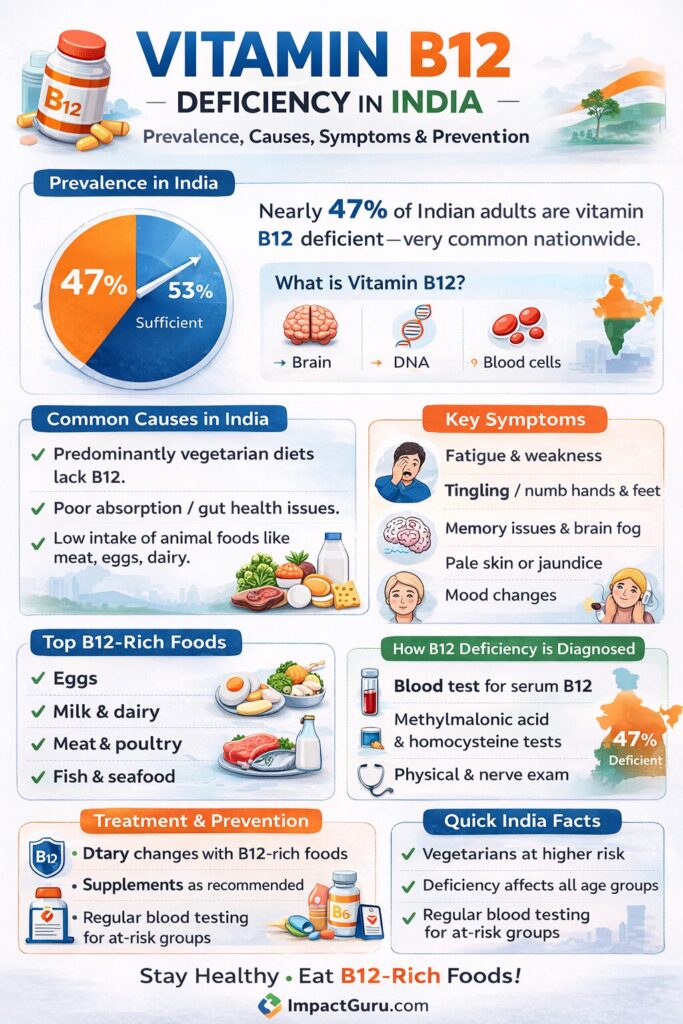
What Is Vitamin B12 (Cobalamin) and Why Is It Essential for Neurological Health?
Vitamin B12, also referred to as cobalamin, is a water-soluble vitamin required for:
- DNA synthesis
- Red blood cell maturation
- Myelin sheath maintenance
- Neurotransmitter function
Cobalamin and Neurological Health
Vitamin B12 plays a central role in maintaining the myelin sheath, which is the protective covering surrounding nerve fibres. This sheath ensures efficient transmission of nerve impulses.
When B12 levels decline, myelin integrity is compromised. As a result, nerve signalling becomes impaired, leading to sensory and motor disturbances. Prolonged deficiency may result in permanent neurological damage.
Read More : Complete Guide to Vitamin Deficiencies in India
Daily Requirement and Physiological Needs
The recommended daily intake is:
- Adults: 2.4 mcg
- Pregnant women: 2.6 mcg
- Lactating women: 2.8 mcg
Although required in small quantities, adequate absorption is essential for maintaining normal physiological function.
Early Neurological Signs of Vitamin B12 Deficiency
Neurological manifestations may appear before blood abnormalities are detected.
Common early signs include:
- Paraesthesia (tingling or numbness in extremities)
- Impaired balance
- Mild cognitive changes
- Fatigue not explained by lifestyle factors
- Mood disturbances
These symptoms reflect early demyelination, damage to the protective nerve covering.
Can Vitamin B12 Deficiency Cause Nerve Damage?
Yes. Persistent deficiency can lead to progressive nerve injury.
Advanced neurological manifestations may include:
- Gait instability
- Severe memory impairment
- Peripheral neuropathy
- Muscle weakness
If treatment is delayed, neurological deficits may become irreversible.
How Vitamin B12 Deficiency Leads to Megaloblastic Anaemia
Vitamin B12 is essential for DNA production in the bone marrow, where red blood cells are formed.
When B12 is insufficient:
- DNA synthesis becomes defective
- Red blood cells grow larger than normal
- Cells fail to mature properly
- Oxygen delivery becomes inefficient
This condition is termed megaloblastic anaemia.
Megaloblastic Anaemia Causes
The primary mechanism involves impaired DNA replication, resulting in large, structurally abnormal red blood cells that cannot function effectively.
Symptoms of Megaloblastic Anaemia
Patients may experience:
- Profound fatigue
- Pallor
- Shortness of breath
- Tachycardia (rapid heartbeat)
- Generalised weakness
Neurological symptoms may coexist in cases of Vitamin B12 deficiency.

Difference Between Folate and Vitamin B12 Deficiency Anaemia
Both deficiencies can result in megaloblastic anaemia. However, a critical distinction exists:
- Folate deficiency primarily affects red blood cells.
- Vitamin B12 deficiency affects both red blood cells and the nervous system.
Treating folate deficiency alone without correcting underlying B12 deficiency may improve blood parameters while neurological damage continues.
Vitamin B12 Absorption Issues: Why Deficiency Occurs Despite Adequate Intake
Vitamin B12 absorption is complex and requires:
- Adequate stomach acid
- Intrinsic factor (a protein produced in the stomach)
- Healthy small intestine function
Disruption at any stage can lead to a deficiency
Common causes include:
- Pernicious anaemia (autoimmune destruction of intrinsic factor)
- Chronic gastritis
- Gastrointestinal surgery
- Long-term proton pump inhibitor use
- Malabsorption syndromes
In such cases, dietary intake alone may not correct the deficiency.
Best Foods to Improve Vitamin B12 Levels Naturally
Vitamin B12 is primarily found in animal-based sources.
Non-Vegetarian Sources
- Fish
- Poultry
- Red meat
- Liver
- Eggs
Dairy Sources
- Milk
- Curd
- Cheese
Strict vegetarians and vegans are at increased risk and may require supplementation.
Vitamin B12 Sources and Dosage: Treatment Options Based on Severity
Mild to Moderate Deficiency
- Oral supplementation (1000–2000 mcg daily initially)
- Maintenance dosing once levels stabilise
Severe Deficiency or Absorption Disorders
- Intramuscular B12 injections
- High-dose replacement followed by maintenance therapy
Dosage should always be determined based on laboratory findings and clinical presentation.
Diagnosis and Treatment Options for Severe B12 Deficiency
Diagnosis typically involves:
- Complete blood count (CBC)
- Serum Vitamin B12 levels
- Peripheral smear examination
- Methylmalonic acid testing in complex cases
Early detection is essential to prevent irreversible neurological injury.
“Health is a state of complete physical, mental and social well-being and not merely the absence of disease or infirmity.” – World Health Organization
Clinical Management and Access to Care
Severe Vitamin B12 deficiency may require prolonged medical management, especially when neurological involvement is present. Hospitalisation, neurological evaluation, and long-term follow-up may be necessary in advanced cases.
In situations where extended treatment creates financial strain, healthcare crowdfunding platforms such as ImpactGuru serve as supportive mechanisms within the broader healthcare ecosystem, enabling patients to access timely medical care when needed.
Access to treatment should not be compromised by financial limitations.

Conclusion
Vitamin B12 deficiency is a medically significant condition that affects neurological integrity and blood cell production. Early recognition of symptoms, appropriate laboratory evaluation, and timely treatment are essential to prevent permanent complications.
With structured clinical care, nutritional planning, and proper supplementation, the condition is entirely manageable. Proactive awareness remains the most effective strategy in preventing long-term neurological and haematological consequences.
FAQs
Vitamin B12 deficiency occurs when your body lacks enough B12 to support red blood cell production and nerve function.
Common signs include fatigue, weakness, numbness/tingling, memory issues, mood changes, and pale skin.
Vegetarians, elderly adults, people with gut issues, and those on certain medications have higher risk of Vitamin B12 deficiency.
Doctors diagnose it using blood tests to measure B12 levels and related markers like methylmalonic acid or homocysteine.
Prevention includes eating B12-rich foods (meat, dairy, eggs) or fortified products and taking supplements if needed.
Sources:
Britannica – Vitamin B12 Deficiency Overview
Cleveland Clinic – Vitamin B12 Deficiency: Symptoms & Causes
NHS – Vitamin B12 or Folate Deficiency Anaemia (Complications)
NIH NHLBI – Vitamin B12–Deficiency Anaemia