
Table of Contents
- Quick Summary
- Introduction
- How Does Neonatal Treatment in India Work for Premature Babies
- What Are the Biggest Challenges in Newborn Care in India
- How Much Does NICU Care Cost in India
- What Government Schemes Support Neonatal Treatment in India
- How Medical Crowdfunding Is Helping Families Afford Neonatal Care in India
- Practical Steps for Parents Facing Neonatal Treatment in India Right Now
- How to Fund Neonatal Treatment Costs Through Online Fundraising in India
- Conclusion
- Frequently Asked Questions
Quick Summary
- Neonatal treatment in India has advanced significantly, but gaps in access between urban hospitals and rural areas remain wide.
- Premature births and low birth weight are the leading drivers of neonatal mortality in India.
- NICU care costs in India can range from ₹5,000 to ₹50,000+ per day, creating severe financial strain on families
- Government schemes like NHM and Janani Suraksha Yojana provide partial relief but often fall short.
- Medical crowdfunding and online fundraising in India are emerging as critical lifelines for neonatal treatment costs.
- Early intervention, skin-to-skin care, and breastfeeding support dramatically improve neonatal health outcomes.
Introduction
Every year, thousands of Indian newborns don’t make it past their first 28 days. For the parents who go through it, nothing prepares them for what comes next. Neonatal treatment in India holds two parallel realities: hospitals in metros where dedicated neonatologists work through the night to give premature babies a fighting chance, and under-resourced district facilities where the same baby’s outcome might have been different. For parents sitting outside a NICU, watching, waiting, and feeling completely helpless, the hardest thing is not knowing what to do next. That helplessness has an answer. This guide walks you through exactly what neonatal care in India looks like, what questions to ask doctors, what government support you are entitled to, and how other families in your exact situation have found ways to fund treatment and bring their babies home.
How Does Neonatal Treatment in India Work for Premature Babies
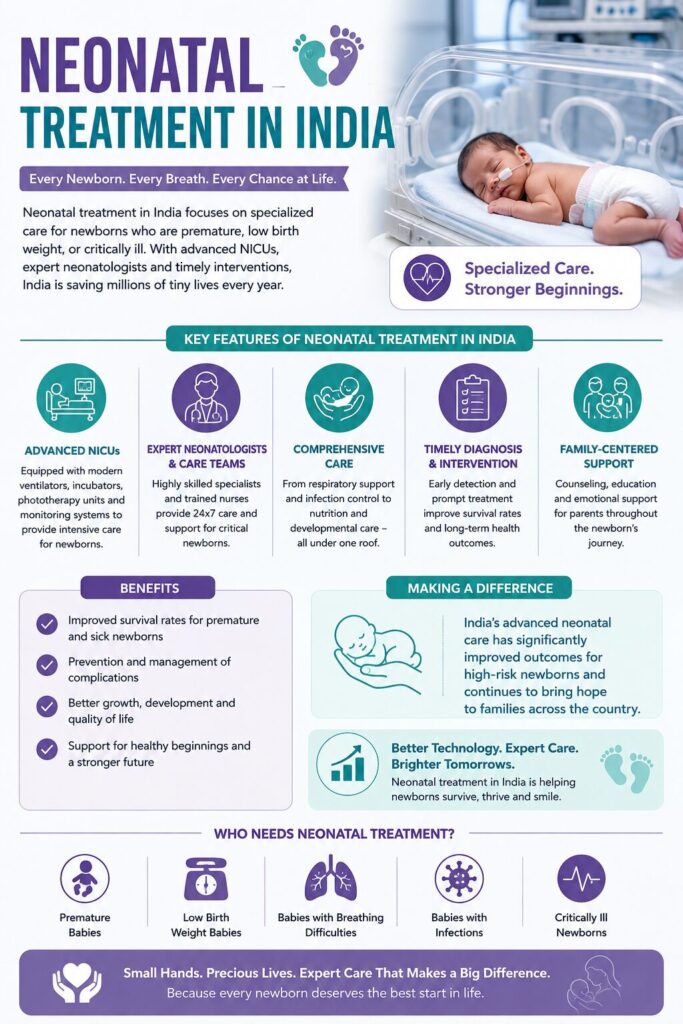
Premature babies, those born before 37 weeks, require specialised neonatal intensive care that goes far beyond standard newborn support. In India, NICUs (Neonatal Intensive Care Units) are on the front lines of this care, equipped with incubators, ventilators, phototherapy units, and continuous monitoring systems.
Treatment for premature babies typically involves:
- Thermoregulation – maintaining body temperature through incubators or Kangaroo Mother Care (KMC), a skin-to-skin method proven to reduce mortality in low-resource settings
- Respiratory support – many premature babies have underdeveloped lungs and require CPAP (Continuous Positive Airway Pressure) or mechanical ventilation
- Nutritional support – via nasogastric tubes or IV feeding until the baby can breastfeed independently
- Infection management – premature babies have immature immune systems, making antibiotic protocols critical
- Jaundice treatment – phototherapy is one of the most common interventions in Indian NICUs
India has made significant strides in expanding NICU infrastructure, particularly under the Facility-Based Newborn Care (FBNC) programme, which has established Special Newborn Care Units (SNCUs) across district hospitals. However, access remains highly unequal; a Level III NICU with advanced life support is far more accessible in Mumbai or Delhi than in rural Bihar or Odisha.
What Are the Biggest Challenges in Newborn Care in India
Despite policy progress, newborn care in India faces structural challenges that affect outcomes at scale.
1. The Urban-Rural Divide
Tier-1 cities have well-equipped NICUs in both public and private hospitals. Rural and semi-urban areas often lack even Level II newborn care. Referral delays, the time it takes to transfer a critical newborn to a better-equipped facility, remain a significant cause of preventable deaths.
2. Shortage of Trained Neonatologists
India sees over 25 million births annually, yet the number of trained neonatologists remains critically low relative to this scale. This deficit means that even where NICU equipment exists, specialist oversight is often absent, particularly outside metro cities.
3. Infection and Sepsis
Neonatal sepsis, a bloodstream infection, is one of the top killers of newborns in India. Hygiene gaps in delivery environments, combined with antibiotic resistance, make this a persistent challenge.
4. Low Breastfeeding Rates
Early and exclusive breastfeeding is the single most cost-effective intervention in neonatal health. Yet initiation rates in India remain below global recommendations, particularly in communities where formula feeding is seen as aspirational.
5. Financial Barriers
For most Indian families, the cost of NICU care is catastrophic. This is where the conversation around medical crowdfunding and medical fundraising becomes not just relevant, but urgent.
How Much Does NICU Care Cost in India
This is the question families ask first, and the answer is rarely reassuring.
Private Hospitals:
- NICU charges range from ₹8,000 to ₹50,000 per day, depending on the city, hospital, and level of care
- A 30-day NICU stay is common for premature babies born at 30–32 weeks, which can cost ₹3 lakh to ₹15 lakh or more
- Costs include bed charges, ventilator use, medications, investigations, and specialist fees, often billed separately
Public Hospitals:
- Government NICUs offer subsidised or free care under schemes, but are frequently overburdened
- Hidden costs, transport, food for accompanying parents, top-up medications not covered, still add up
The Financial Reality:
According to National Health Accounts estimates tabled in the Rajya Sabha (March 2025), out-of-pocket expenditure still accounts for 39.4% of total healthcare spending in India, meaning nearly 4 in 10 rupees spent on a sick child comes directly from a family’s pocket. For a family earning ₹30,000–₹50,000 a month, a two-week NICU stay can wipe out years of savings. Many families are forced to sell assets, borrow from moneylenders at high interest, or simply discontinue treatment.
This is precisely why online crowdfunding and fundraising in India have seen such rapid adoption for neonatal emergencies.
What Government Schemes Support Neonatal Treatment in India
India’s public health architecture does offer a framework of support; knowing which schemes apply can significantly reduce the financial burden.
1. Janani Suraksha Yojana (JSY)
A cash transfer scheme that incentivises institutional deliveries, particularly for below-poverty-line families. While it doesn’t directly fund NICU care, it increases the likelihood of hospital births where neonatal intervention is available.
2. Janani Shishu Suraksha Karyakram (JSSK)
This scheme entitles sick newborns in public facilities to free treatment, free medicines, free diagnostics, free blood, and free transport, including referral transport. On paper, it covers most neonatal care needs. In practice, implementation is inconsistent across states.
3. National Health Mission (NHM) – Newborn Care
NHM funds SNCUs, Newborn Stabilisation Units (NBSUs), and Newborn Care Corners (NBCCs) at various facility levels. It also supports Home-Based Newborn Care (HBNC), where trained ASHAs visit newborns in the first weeks of life.
4. Ayushman Bharat – PM-JAY
India’s flagship health insurance scheme covers hospitalisation costs up to ₹5 lakh per year for eligible families. Many neonatal conditions are included in the package list, but private hospital empanelment and documentation requirements remain barriers for the most vulnerable.
5. State-Specific Schemes
States like Tamil Nadu (Chief Minister’s Comprehensive Health Insurance), Karnataka (Arogya Karnataka), and Maharashtra (Mahatma Jyotiba Phule Jan Arogya Yojana) have additional coverages that supplement central schemes.
The Gap
Even with all schemes combined, high costs often fall outside coverage, particularly in private hospitals, or for treatments like surfactant therapy for respiratory distress syndrome that may not be on approved package lists. This gap is where medical fundraising in India steps in.
How Medical Crowdfunding Is Helping Families Afford Neonatal Care in India
Medical crowdfunding has emerged as one of the most powerful and personal ways Indian families are managing the financial shock of neonatal emergencies.
Here’s how it works in practice:
The case of the Paswan family from Faridabad can help you understand this better. After four years of waiting, Kajal and Ghanshyam were expecting twins, until both arrived prematurely in May 2024, struggling to breathe. They lost one twin within the first week. The other, a daughter, clung to life in the NICU with Respiratory Distress Syndrome. With savings exhausted and jewellery sold, the family turned to ImpactGuru, a medical crowdfunding platform. Their story reached hundreds of strangers across India. They raised over ₹3.64 lakhs, enough to complete their daughter’s NICU treatment. She came home. The Paswan family’s story is not unique. Across India, families in identical situations are finding that medical fundraising can reach where insurance and government schemes cannot.
Why online crowdfunding works for neonatal cases:
- The urgency is immediate and verifiable; medical bills and NICU reports serve as proof
- Newborn stories generate high empathy and sharing rates
- Campaigns can be set up within hours, and disbursement can begin quickly
- No collateral, no interest, no repayment, unlike loans
What to look for in a medical fundraising platform:
- Zero or low platform fees (some platforms charge 0–5%)
- Direct hospital disbursement options to build donor trust
- Document verification to establish campaign credibility
- Dedicated support for medical cases
Fundraising in India ecosystems has matured significantly, with platforms now offering WhatsApp sharing tools, regional language support, and in-hospital tie-ups to help families launch campaigns at the point of need.
Tips to run a successful neonatal medical fundraising campaign:
- Include the baby’s name and photo (with parental consent and medical context)
- Share NICU admission documents and cost breakdowns
- Post regular updates, donors respond to progress
- Set a specific, itemised goal rather than a round number
- Ask 10 close contacts to share before making it public; early momentum is critical
Read More : How Can I Raise Funds Online for Medical Treatment?
Practical Steps for Parents Facing Neonatal Treatment in India Right Now
If your newborn is currently in a NICU or you are anticipating neonatal treatment costs, here is a structured action plan:
Step 1: Understand the diagnosis and care level
Ask the neonatologist to explain the level of care (Level I, II, or III NICU) and the estimated duration. This helps in financial planning.
Step 2: Check scheme eligibility immediately
Ask the hospital’s social worker or billing department which government schemes you qualify for. Don’t wait until discharge, enrol early.
Step 3: Request an itemised bill preview
Many private hospitals will share a preliminary cost estimate. This is essential for your medical fundraising campaign.
Step 4: Launch a medical crowdfunding campaign
Don’t wait until you’ve exhausted savings. Start your campaign early, online crowdfunding campaigns for neonatal cases perform best when launched within the first 48–72 hours of admission, while community concern is greatest.
Step 5: Connect with neonatal support communities
Groups like the NeoNatal Society of India and patient communities on social media offer both emotional support and practical guidance on navigating the system.
How to Fund Neonatal Treatment Costs Through Online Fundraising in India
For families who have never used online crowdfunding before, the process can feel unfamiliar. Here’s a plain-language walkthrough:
Choosing the right platform:
Look for platforms that specialise in or have a dedicated medical fundraising vertical. General crowdfunding platforms may have lower reach for medical campaigns. Medical-specific platforms often have hospital partnerships and faster withdrawal options.
Building trust in your campaign:
- Upload the NICU admission report and doctor’s letter
- Include the hospital name and the treating neonatologist’s name (with permission)
- Show the itemised estimate of costs
- Link your campaign to a verified bank account or directly to the hospital
Promoting your campaign:
- Share in WhatsApp family and community groups first
- Post on LinkedIn, workplace networks are highly responsive to neonatal cases
- Ask friends to share with a personal note rather than just forwarding
- Update the campaign every 2–3 days with the baby’s progress
Withdrawing and using funds:
Most platforms allow partial withdrawals; you don’t have to wait for the goal to be met. Funds can often be disbursed directly to the hospital, which also builds donor confidence for further contributions.
Online fundraising in India has helped thousands of families cover neonatal costs that no government scheme or insurance policy was ever going to reach. It is not charity; it is a community coming together at the hardest moment of a family’s life.
Read More : Fundraising for Treatment at AIIMS Delhi: Full Guide
Conclusion
Neonatal treatment in India has come a long way, from rudimentary newborn wards to world-class NICUs delivering outcomes that match global benchmarks. But for the millions of Indian families who face a sick newborn, the journey is still defined by inequality of access, catastrophic costs, and systems that don’t always connect. Knowing your options, government schemes, hospital protocols, and the growing power of medical crowdfunding can mean the difference between a family giving up and a baby coming home. If you are facing this right now, you are not alone, and you do not have to face it without support.
Frequently Asked Questions
Survival rates depend on gestational age and facility level. Babies born after 32 weeks in well-equipped NICUs have survival rates above 90%. Those born before 28 weeks, particularly in under-resourced settings, face significantly higher risk. Early referral to a Level III NICU dramatically improves outcomes.
Under the Janani Shishu Suraksha Karyakram (JSSK), sick newborns in public facilities are entitled to free treatment, medicines, diagnostics, and transport. However, implementation varies significantly across states, and many families still face out-of-pocket costs for medications not on approved lists.
Duration depends on how early the baby was born. Babies born at 30–32 weeks typically need 4–6 weeks of NICU care. Those born earlier may require longer stays. Your neonatologist will give a week-by-week assessment based on the baby’s progress.
Yes. Medical crowdfunding is widely used in India for neonatal emergencies. Campaigns can be set up within hours of NICU admission. Platforms that offer direct hospital disbursement are particularly effective as they build donor trust and allow faster fund release.
Ask the neonatologist for the care level and estimated duration. Immediately check eligibility for JSSK and Ayushman Bharat with the hospital’s billing department. Request an itemised cost estimate and consider launching a medical fundraising campaign within the first 48 hours, while community support is highest.