
Every 30 seconds in India, a family facing medical debt makes the agonising decision to delay or abandon a life-saving medical treatment because they cannot afford it. This is not a statistic. It is a daily reality for millions of families across this country, and it is the single most important reason ImpactGuru exists.
Table of Contents
The Scale of India’s Medical Debt Crisis
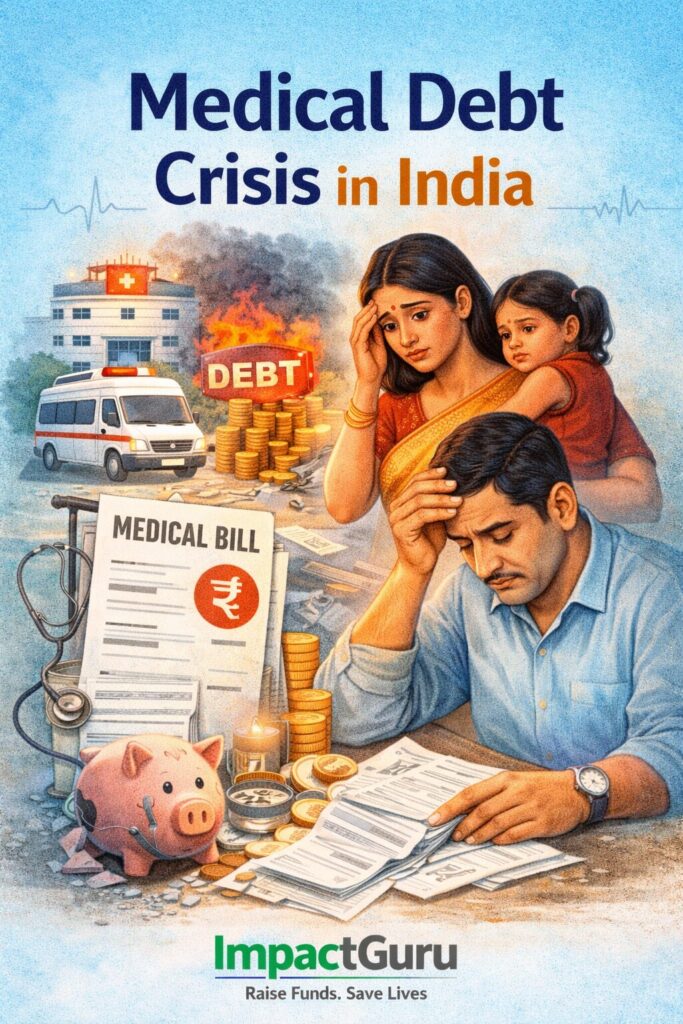
Medical debt is the single largest driver of household poverty in India. Yet it rarely makes the front page, because it happens quietly, one family at a time, behind hospital doors and closed conversations.
Consider these realities: According to public health research and WHO estimates, catastrophic health expenditure, defined as out-of-pocket medical spending exceeding 10% of a household’s annual income, pushes over 63 million Indians into poverty every year. That is more than the entire population of the United Kingdom.
• India’s out-of-pocket health expenditure as a percentage of total health spending remains among the highest in the world, around 48–55%, compared to under 12% in most developed nations.
• Nearly 86% of rural Indians and 82% of urban Indians lack insurance coverage adequate for a major medical event, according to NSSO data.
• The average cost of cancer treatment in India ranges from Rs. 3 lakh to Rs. 25 lakh, depending on the type and stage, far beyond what most Indian families can absorb.
• Organ transplants — kidney, liver, heart, routinely cost between Rs. 10 lakh and Rs. 50 lakh, even in government hospitals.
These are not edge cases. These are the lived realities of the Indian middle class, the working poor, and even many upper-middle-class families who discover, often too late, that their savings and insurance are simply not enough.
Why Medical Debt Is Invisible And Why That Makes It Worse
Unlike other forms of poverty or crisis, medical debt carries a peculiar social invisibility. Families facing it rarely speak about it openly. There is shame involved, a sense that needing help is a form of failure. There is the exhaustion of caring for a critically ill family member while simultaneously trying to arrange finances. And there is the sheer complexity of navigating hospital billing, insurance claims, and loan applications simultaneously.
This invisibility has serious consequences. It means that people in crisis do not know what options exist. They do not know about medical crowdfunding platforms like ImpactGuru. They do not know that a fundraiser can be started in ten minutes and that funds can start arriving the same day. They suffer alone when they do not have to.
The most dangerous thing about medical debt in India is not the debt itself; it is the silence around it. Breaking that silence is one of ImpactGuru’s most important missions.
What Is Medical Crowdfunding and Why Does It Work in India?
Medical crowdfunding is the process of raising money online from a large network of donors, friends, family, colleagues, and compassionate strangers, to fund medical treatment, surgery, hospitalisation, or ongoing care.
India is uniquely suited to crowdfunding for several reasons. We are a deeply communal society. The instinct to come together and help, ‘mil ke dena’ is embedded in our culture. What crowdfunding does is take that instinct and amplify it using technology, reaching not just your immediate circle but your entire extended network across cities and even countries.
On ImpactGuru, India’s leading medical crowdfunding and online fundraising platform, the process is straightforward:
1. Create a fundraiser page explaining the patient’s condition, treatment needed, and the amount required.
2. Add medical documents to establish credibility and transparency.
3. Share the fundraiser link via WhatsApp, Instagram, Facebook, and email.
4. Donors contribute through UPI, net banking, credit or debit card, or international payment gateways.
5. Funds are disbursed directly to the hospital or to the patient’s bank account.
The entire process, from creating a fundraiser to receiving the first donation, can happen within hours. In a medical emergency, hours matter.
The Hidden Costs Nobody Talks About
When most people think about medical expenses, they think about the hospital bill. But the true cost of a major medical event is far greater. Consider what families actually spend:
• Hospital admission fees, surgery costs, and post-operative care
• Chemotherapy or radiation cycles, each costing Rs. 50,000 to Rs. 2 lakh
• Medications, especially imported or specialised drugs, that insurance rarely covers in full
• Travel and accommodation for families coming from smaller towns to metro hospitals
• Loss of income when the patient or primary caregiver cannot work during treatment
• Rehabilitation, physiotherapy, and long-term follow-up care
Crowdfunding on a trusted donation platform like ImpactGuru allows families to raise funds for all of these costs, not just the headline surgery figure. We have seen fundraisers cover everything from ICU bills to post-chemotherapy nutrition support.
What ImpactGuru Is Doing About Medical Debt
When Khushboo Jain, Vikas Kaul, and I founded ImpactGuru, we made three core commitments that guide everything we do.
First: Zero platform fee for medical fundraisers. We believe that a family whose child is fighting cancer should not have to pay a commission on the donations they receive. ImpactGuru operates at 0% platform fee for medical crowdfunding campaigns.
Second: Transparency at every step. Every fundraiser on ImpactGuru is reviewed by our verification team. Medical documents are checked. Fund utilisation is tracked and reported to donors. This transparency is what makes ImpactGuru India’s most trusted crowdfunding platform.
Third: Active fundraising support. We do not just build a platform and step back. Our team actively helps campaigners craft their stories, optimise their outreach, and navigate the emotional and logistical challenges of running a fundraiser during a medical crisis.

Since our founding, ImpactGuru has helped raise funds for over one lakh patients across India, for cancer, organ transplants, rare diseases, cardiac surgeries, neurological conditions, and more. The total funds raised represent thousands of families who got the treatment they needed.
The Road Ahead: Making Medical Crowdfunding Mainstream
We are at an inflection point in India’s healthcare financing story. Government schemes are expanding. Insurance penetration is growing. But the gap between what people can afford and what treatment costs remains enormous, and it will remain so for years, leading to a medical debt crisis in India.
Medical crowdfunding is not a permanent solution to India’s healthcare financing problem. But it is the most immediate, accessible, and human solution available right now. It does not require paperwork, a credit score, or a relationship with a bank. It requires a story, a network, and the courage to ask.
Start your medical fundraiser at ImpactGuru today — 0% platform fee, verified by India’s most trusted crowdfunding platform. Visit www.impactguru.com
About the Author
Piyush Jain
Co-Founder, ImpactGuru — India’s Leading Medical Crowdfunding Platform