
‘I don’t want to burden people.’ ‘What will people think?’ ‘We should manage on our own.’ These are the thoughts that reflect the deep-rooted medical crowdfunding stigma in India, often costing families more delay, more suffering, and more financial strain. This blog is about dismantling them.
Table of Contents
The Conversation I Have Too Often
At least once a week, I hear a version of the same conversation. A family is referred to ImpactGuru by a hospital social worker or a friend. The patient has a serious diagnosis. The treatment cost is far beyond what they can manage. But when I talk to them about starting a medical crowdfunding campaign, the response is almost always the same:
‘We are not that type of family.’ Or: ‘What will our relatives say?’ Or most painfully: ‘We should be able to handle this ourselves.’
And sometimes, tragically, treatment is delayed or compromised while the family spends weeks exhausting every possible private option, because the idea of asking the public for help feels like a form of failure they cannot face.
I want to talk about why this happens, why it is understandable, and why overcoming it is one of the most important things a family in a medical crisis can do.
Read More: What Is Crowdfunding? A Comprehensive Guide (2026 Update)
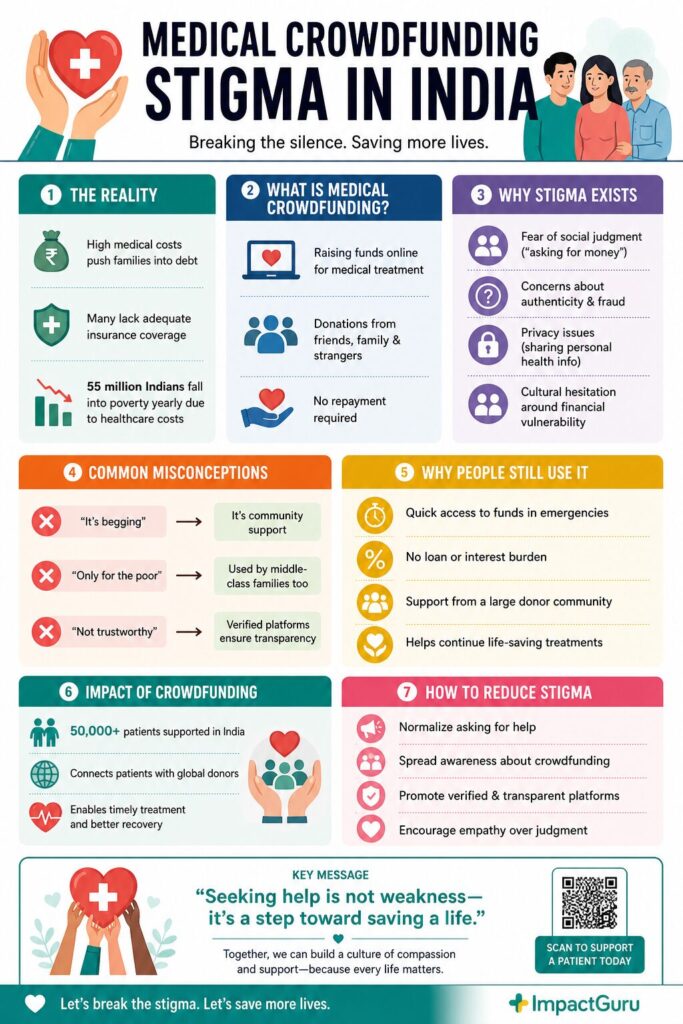
Where the Guilt Comes From
The reluctance to ask for help publicly is deeply rooted in the medical crowdfunding stigma in India. It has deep cultural and psychological roots that deserve to be understood rather than dismissed.
Self-reliance as identity: For many Indian families, particularly those who have worked hard to achieve middle-class stability, financial self-reliance is a core part of identity. The idea that ‘we manage our own problems’ is tied up with dignity, pride, and a sense of who the family is. Asking for help publicly feels like a betrayal of that identity.
Fear of judgment: Indian social environments — whether physical communities or digital ones — can be intensely judgmental. Families worry about being seen as poor, irresponsible, or failures. They worry about relatives who will gossip, neighbours who will pity, colleagues who will see them differently.
Guilt about the patient: Family members often feel guilty about the illness itself — as if they could have prevented it, as if they are somehow responsible. Adding a public ask for help can feel like compound exposure: revealing both the illness and the financial vulnerability simultaneously.
Cultural messaging around receiving: Many Indians have grown up with clear cultural messages about giving — that it is noble, virtuous, expected. But the cultural messaging around receiving is far more ambiguous. Receiving charity, in particular, carries connotations of inadequacy that giving never does.
Why These Feelings, Though Understandable, Are Costing Lives
Let me be direct: the medical crowdfunding stigma in India is costing patients their lives and their health.
When families spend three weeks exhausting private options, borrowing from relatives, selling assets, negotiating with banks, before considering crowdfunding, they lose three weeks of treatment time. For many cancers, three weeks is not a trivial delay.
When families start a crowdfunding campaign but do so half-heartedly, a minimal story, shared reluctantly with a small circle, because they are embarrassed to ask broadly, they raise a fraction of what they need.
When families refuse crowdfunding entirely and take high-interest loans instead, they often emerge from a medical crisis into a debt crisis, paying back borrowed money for years at rates that keep them financially vulnerable.
The medical system does not judge your financial need. Your community does not judge your medical needs. The only one doing the judging is usually the voice in your own head — and it is wrong.
What Actually Happens When You Start an ImpactGuru Campaign
Here is what the evidence, from thousands of fundraisers on our medical crowdfunding platform, actually shows about how communities respond to a family in need:
• The overwhelming majority of responses are positive, warm, and generous. The judgment that families fear rarely materialises at scale.
• Many donors explicitly express admiration for the courage of the family in sharing their situation. ‘It takes strength to ask for help’ is one of the most common sentiments in campaign comments.
• Relationships are often strengthened, not damaged, by a public fundraiser. Distant friends reconnect. Old colleagues rediscover a connection. Strangers become advocates.
• Families consistently report that the experience of seeing their community rally around them was one of the most moving experiences of their lives, something they would not trade even in retrospect.
The fear of asking is rarely matched by the reality of asking. The gap between what people expect when they share a fundraiser and what actually happens is almost always positive.
Reframing the Ask: It Is Not Charity – It Is Community
One of the most powerful ways to overcome the medical crowdfunding stigma in India is to reframe this: you are not asking for charity. You are inviting your community to participate in a fight that matters to all of them.
Your friends, colleagues, and family members want to help when someone they care about is in crisis. The problem is they often do not know how. A medical crowdfunding campaign on ImpactGuru gives them a specific, meaningful, and immediate action they can take. You are not burdening them. You are empowering them.
Think of it from the donor’s perspective. If a close colleague were facing a medical crisis and did not tell you, did not give you the chance to help, how would you feel? Most people would feel shut out — sad that they did not know, frustrated that they could not help.
By starting a fundraiser, you are giving the people who love you the gift of being able to act. That is not a weakness. That is generosity.
Practical Ways to Start Even When It Feels Hard
Let someone else write the story: If writing about yourself or your family member feels too exposing, ask a close friend or family member to write the campaign description. Many of the most powerful fundraisers on ImpactGuru were written by friends of the patient, not by the patient themselves.
Start with your innermost circle: You do not have to go fully public immediately. Start by sharing with 5–10 people you completely trust. Their early donations create the social proof that makes subsequent broader sharing feel safer and more validated.
Reframe the story as fighting, not suffering: The most successful fundraisers are not stories of victimhood; they are stories of fight. ‘My father is fighting liver cancer, and we are fighting with him’ is a very different emotional proposition than ‘my father is sick and we cannot afford treatment.’ One invites participation; the other invites pity.
Remember who this is for: Every time the voice in your head says ‘I can’t ask for help,’ replace it with: ‘My child (or parent or spouse) needs this treatment. The embarrassment I feel is mine to bear. The treatment they need is theirs to have.’
You have nothing to be ashamed of. A medical emergency is not a moral failure. Asking for help is not a weakness. Starting a campaign on ImpactGuru is one of the bravest things a family in crisis can do. Visit www.impactguru.com
Read More: Guide to Crowdfunding for Medical Treatment in India

Conclusion
Medical crowdfunding stigma in India is real, but it is gradually decreasing as awareness grows. In times of medical emergencies, seeking help is not a sign of weakness—it’s a step toward survival and recovery.
By changing perceptions, increasing awareness, and promoting transparency, we can create a more supportive environment where people feel empowered to ask for help without fear.
FAQs
Yes, most platforms use verification systems to ensure transparency and security.
Due to fear of judgment, social stigma, and lack of awareness.
No, it should complement insurance, not replace it.
While some may, awareness is improving and acceptance is growing.
Be transparent, share widely, and keep donors updated.