
Table of Contents
- Quick Summary
- Introduction
- Is Medical Crowdfunding Safe in India?
- Why Medical Crowdfunding Exists in India: The Numbers Behind the Need
- Is Medical Crowdfunding Legal in India?
- What Makes a Medical Crowdfunding Platform Safe? The Verification Standard
- How ImpactGuru Ensures Safety: A Closer Look
- 7 Red Flags: How to Identify a Fraudulent Medical Campaign
- How to Donate Safely on Any Fundraising Platform in India
- Does India Need Stronger Regulation for Medical Crowdfunding?
- Conclusion
- FAQs
Quick Summary
- Is medical crowdfunding safe in India? Yes, medical crowdfunding can be safe when campaigns are hosted on verified fundraising platforms that use KYC checks, hospital verification, and transparent fund disbursal systems.
- Donation-based medical crowdfunding is fully legal in India and is widely used to raise funds online for surgeries, cancer treatment, transplants, and emergency care.
- Risks such as fake campaigns, manipulated medical documents, and unclear fund usage do exist, which makes platform verification standards extremely important for both donors and patients.
- Safer online crowdfunding sites typically offer direct hospital disbursement, fraud monitoring, document validation, and clear refund or reporting mechanisms.
- Medical Crowdfunding Platforms like ImpactGuru help families fundraise online through verified medical campaigns, donor support systems, and structured safety checks designed to improve transparency and trust.
Introduction
Medical crowdfunding in India has become something far bigger than a fundraising trend. It has quietly turned into a lifeline for millions of families who have nowhere else to turn when a cancer diagnosis, organ transplant, or rare disease strips them of every rupee they own. In 2025 alone, medical fundraising campaigns in India received nearly $630 million in contributions, and the sector is growing by 25% every year (JAMA Network Open, 2025).
But alongside these stories of hope come hard questions that donors, patients, and families deserve honest answers to. Are donations actually reaching patients? Can medical documents be faked? Is the platform you are using legally accountable? And most simply: Is medical crowdfunding safe in India?
This guide breaks down the legal status, risks, verification standards, and safety practices that matter most for both donors and patients
Is Medical Crowdfunding Safe in India?
Yes, medical crowdfunding in India can be safe when campaigns are hosted on verified fundraising platforms that follow strong verification, transparency, and fund disbursal practices.
Today, many online crowdfunding sites in India use KYC checks, hospital document verification, fraud monitoring systems, and secure payment gateways to improve trust for both donors and patients. Some platforms also support direct-to-hospital fund transfers and ongoing campaign monitoring to reduce misuse.
At the same time, risks such as fake campaigns, manipulated medical documents, misleading fundraising goals, and unclear fund usage do exist. This is why the safety of medical crowdfunding depends heavily on how responsibly a fundraising platform operates and how carefully a campaign is verified.
Ahead in this guide, we will break down the biggest red flags donors should watch for, what a safe medical crowdfunding campaign actually looks like, how verified fundraising platforms in India protect donations, and the practical steps both donors and patients can take to fundraise online more safely and transparently.
Why Medical Crowdfunding Exists in India: The Numbers Behind the Need
To understand why medical crowdfunding has exploded in India, you need to understand the healthcare financing crisis that makes it necessary.
Healthcare costs push approximately 55 million Indians into poverty every single year. Around 17% of Indian households spend more than 10% of their total income on health, meeting the clinical definition of catastrophic health expenditure. Out-of-pocket spending still accounts for over 39.4% of India’s total healthcare expenditure, one of the highest ratios in the world.
At the same time, an estimated 40 crore Indians, the so-called “missing middle,” fall outside both the Ayushman Bharat-PMJAY scheme and private health insurance. NITI Aayog’s 2021 health insurance report describes this group in precise terms: they are neither poor enough to qualify for government schemes nor financially stable enough to sustain private insurance premiums. For these families, a single hospitalisation can wipe out generational savings, trigger asset sales, and lead to borrowing from moneylenders at predatory interest rates.
This gap is what medical crowdfunding aims to fill in India.
Read More : How Can I Raise Funds Online for Medical Treatment?
Is Medical Crowdfunding Legal in India?
Yes. Donation-based medical crowdfunding is fully legal in India.
The government of India has formally classified crowdfunding into five types:
| Type of Crowdfunding | Meaning | Legal Status in India |
| Donation-Based Crowdfunding | People donate money to support a cause without expecting anything in return. Commonly used for medical treatment on platforms like ImpactGuru, Ketto, and Milaap. | Legal |
| Pre-Order Crowdfunding | Supporters contribute money in advance to receive a product or service once it launches. | Legal |
| Reward Crowdfunding | Contributors receive non-financial rewards, gifts, or perks in exchange for funding a project. | Legal |
| Debt Crowdfunding | Individuals lend money to borrowers with the expectation of repayment, usually with interest. | Legal |
| Equity-Based Crowdfunding | Investors receive ownership or equity in a company in exchange for funding. | Currently prohibited under SEBI regulations |
Medical crowdfunding platforms in India operate under the framework of the Information Technology Act, the Foreign Contribution Regulation Act (for international donations), and the Reserve Bank of India’s payment gateway guidelines. Campaigns must comply with KYC (Know Your Customer) requirements for fund disbursal, and platforms are required to maintain records of transactions.
What Makes a Medical Crowdfunding Platform Safe? The Verification Standard
The difference between a safe and an unsafe medical crowdfunding experience in India almost always comes down to platform-level verification and fund disbursal practices. Here is what rigorous verification looks like, and what you should check before donating.
Identity Verification (KYC): The fundraiser’s government-issued ID (Aadhaar, PAN, driving licence) must be verified before any funds are released. Platforms that disburse without KYC verification create conditions where funds can be redirected.
Medical Document Validation: Legitimate platforms verify not just that documents exist, but that they are authentic. This means cross-checking hospital estimates, diagnostic reports, and treatment plans directly with the treating hospital rather than relying solely on documents submitted by the campaign organiser.
Direct-to-Hospital Disbursement: The single most powerful trust signal in medical crowdfunding is when funds are transferred directly to the hospital’s billing department rather than to the patient’s personal bank account. This mechanism eliminates the possibility of fund diversion and gives donors clear evidence of where the money went. Milaap notes this as a disbursement option on specific campaigns; ImpactGuru has made direct hospital transfers a central feature of its verification model.
Continuous Campaign Monitoring: Verification should not end when a campaign goes live. Responsible platforms monitor for anomalies, sudden changes in medical narrative, inconsistencies between documents submitted at different points, or campaigns that raise far beyond stated targets without updated treatment documentation.
Fraud Refund Policy: Any platform operating responsibly should have a clear, published policy on what happens when a campaign is found to be fraudulent. The policy should specify whether donors receive full refunds, the timeline for that process, and who bears accountability if funds have already been disbursed.
How ImpactGuru Ensures Safety: A Closer Look
ImpactGuru is one of India’s best crowdfunding platforms for medical treatment and has built its trust infrastructure around the exact gaps that critics of the industry identify.
- AI-Powered Document Fraud Detection: Every campaign submitted to ImpactGuru is processed through an AI document intelligence system. Using OCR (optical character recognition) and machine learning, the platform scans diagnosis reports, hospital estimates, and prescriptions for signs of forgery, inconsistency, or tampering before any human review begins. This layer catches manipulated documents that manual review might miss, particularly at scale.
- Human Verification Team: AI screening is followed by a trained human verification team that handles cases requiring contextual judgment. The combination of machine-speed detection and human-quality assessment is the most robust approach available in the Indian market today.
- Direct Hospital Disbursements: Funds raised on ImpactGuru can be transferred directly to the treating hospital’s billing department. This is not optional or campaign-specific; it is a structural commitment to ensuring that donations stay within the clinical ecosystem and are spent on what donors intended.
- Hospital Network Partnerships: ImpactGuru maintains direct relationships with major hospital chains across India. This enables real-time verification of treatment costs and patient status, reducing the window for document fabrication.
- Transparent Fund Tracking: Donors receive updates on campaign progress, treatment milestones, and fund utilisation. Campaign organisers are required to post progress reports. This ongoing accountability loop addresses the core concern raised in documented fraud cases: donors finding out too late that something went wrong.
- Multilingual Accessibility: Campaign pages and donation flows are available in Hindi, Tamil, Telugu, Bengali, Marathi, Kannada, and Gujarati, ensuring that verification standards apply equally to families across India, not just urban English-speaking households.
With a donor community of over 36 lakh and a 0% platform fee option, ImpactGuru stands among the most accessible and verifiable fundraising platforms in India.
7 Red Flags: How to Identify a Fraudulent Medical Campaign
Whether you are donating to a campaign on any online crowdfunding site or deciding whether to share one, these seven signals should make you pause and verify further.
1. No named treating hospital: Legitimate campaigns name the hospital, the treating doctor, and the department. Vague references to “a hospital in Delhi” are a warning sign.
2. Documents cannot be cross-verified: If you cannot find the hospital in a directory, if the letterhead looks inconsistent, or if the patient ID number format does not match standard formats for the claimed institution, investigate before donating.
3. The campaign was created very recently and is requesting urgent transfers: Manufactured urgency, “must raise in 48 hours or patient will die,” is a common pressure tactic in fraudulent campaigns. Real urgent cases exist, but legitimate platforms verify these before they go live.
4. The fundraiser has no social media presence or personal network: Genuine campaigns are typically shared extensively by family and friends. A campaign with very few organic shares and no visible social connection to the patient deserves scrutiny.
5. No platform verification badge: Platforms like ImpactGuru display verification status. Campaigns without verification status on a platform that offers it have not been cleared.
6. The target amount is vague or does not match the procedure: A bone marrow transplant in India typically costs between ₹10 lakh and ₹40 lakh, depending on the hospital and complexity. If a campaign’s target is dramatically misaligned with known procedure costs, ask for a detailed hospital estimate.
7. No updates after funds are raised: Once a campaign reaches its goal, the organiser should provide treatment updates, discharge summaries, or bills. Campaigns that go silent after fund collection is complete are a documented pattern in Indian crowdfunding fraud cases.
How to Donate Safely on Any Fundraising Platform in India
Following these steps will dramatically reduce your risk as a donor, regardless of which online donation platform you use.
- Donate through registered platforms only: Use established fundraising platforms in India with published KYC and verification policies, not campaigns shared directly on WhatsApp or Facebook with no platform oversight.
- Check for a verification badge: Look for explicit confirmation that the platform’s trust team has verified the campaign.
- Prefer direct hospital disbursement: When the option exists, choose campaigns that disburse funds directly to the hospital, not to a personal account.
- Read the refund policy before donating: Understand what happens to your money if the treatment is cancelled or the campaign is found to be fraudulent.
- Ask for updates: If you have donated a significant amount, you are entitled to ask the campaign organiser for a treatment update. Genuine campaigns will respond.
- Report suspicious campaigns: All legitimate platforms have a reporting mechanism. Use it. This protects future donors and, in verified fraud cases, initiates refund processes.
Does India Need Stronger Regulation for Medical Crowdfunding?
Researchers from the Indian Journal of Public Health (2024), IIT Bombay, and the Central University of Tamil Nadu have all argued that India needs a stronger regulatory framework for medical crowdfunding.
Key recommendations include:
- Clearer disclosure of platform fees
- Mandatory reporting when treatments are cancelled
- Refund mechanisms for fraudulent campaigns
- A formal grievance system for disputes between donors, hospitals, and fundraising platforms.
At present, no dedicated regulatory framework exists for medical crowdfunding in India. This does not automatically make crowdfunding unsafe, but it does mean that donor and patient safety depend heavily on the verification standards, transparency practices, and accountability systems followed by individual platforms.
Read More : Best Crowdfunding Platforms in India– Honest Comparison (2026)
Conclusion
Medical crowdfunding in India is safe when it is done on the right platform, with the right verification standards in place. It is not universally safe, and that distinction matters enormously. In an environment of rising healthcare costs and millions of uninsured people, medical crowdfunding helps bridge the financial gap for families facing medical emergencies.
In this situation, the responsibility falls on three parties simultaneously:
- Platforms must maintain rigorous verification systems, publish transparent fee structures, and build refund mechanisms that actually work.
- Donors must choose verified platforms, look for trust signals, and report suspicious campaigns.
- Regulators must close the legal gap that currently places all accountability on voluntary platform practice rather than statutory obligation.
ImpactGuru was built on the understanding that compassion alone is not enough without accountability. Features such as AI-powered fraud detection, direct hospital disbursements, and human verification teams reflect the kind of safety and transparency standards medical crowdfunding platforms in India should strive to maintain.
If you need to fundraise online for medical treatment, or if you want to donate to a verified medical campaign, start with a platform that treats verification as a non-negotiable, not as an optional feature.
FAQs
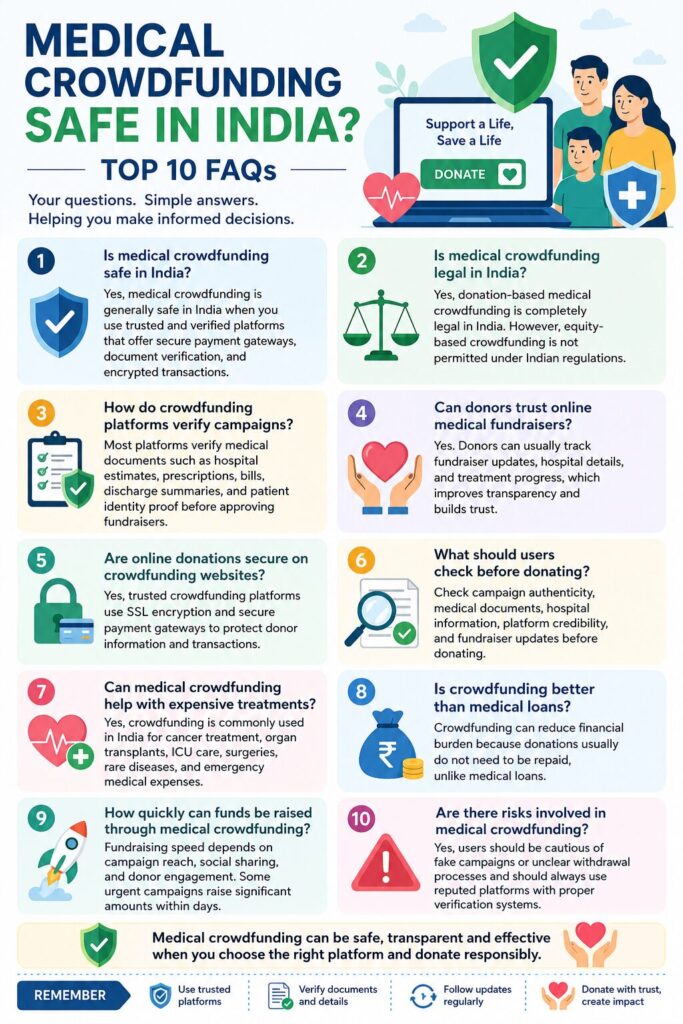
Yes, medical crowdfunding is generally safe in India when you use trusted and verified platforms that offer secure payment gateways, document verification, and encrypted transactions.
Yes, donation-based medical crowdfunding is completely legal in India. However, equity-based crowdfunding is not permitted under Indian regulations.
Most platforms verify medical documents such as hospital estimates, prescriptions, bills, discharge summaries, and patient identity proof before approving fundraisers.
Donors can usually track fundraiser updates, hospital details, and treatment progress, which improves transparency and trust.
Trusted crowdfunding platforms use SSL encryption and secure payment gateways to protect donor information and transactions.
Users should check campaign authenticity, medical documents, hospital information, platform credibility, and fundraiser updates before donating.