

Table of Contents
- Quick Summary
- Introduction
- Why Can Leukemia Treatment Be Expensive?
- How to Raise Money for Leukemia Treatment in India
- How to Start a Fundraiser and Raise Money for Leukemia Treatment on ImpactGuru
- How to Make Your Leukemia Fundraiser More Effective
- What If the Fundraiser Does Not Reach Its Target?
- How ImpactGuru Can Help Families Raise Money for Leukemia Treatment
- Conclusion
- FAQs
Quick Summary
- Leukemia treatment can involve chemotherapy, targeted medicines, hospitalisation, supportive care and, in some cases, a bone marrow transplant.
- Health insurance, government assistance, charitable organisations and medical crowdfunding can help families manage treatment expenses.
- Online fundraising allows patients and their families to share their medical needs with a wider network of potential donors.
- A clear fundraiser, supported by medical reports, treatment estimates, and regular updates, can help people understand the patient’s needs.
- ImpactGuru helps patients and families raise funds online for eligible medical expenses through crowdfunding.
Introduction
A diagnosis of leukemia can bring fear, uncertainty and an overwhelming financial burden to a family, and many have to Raise Money for Leukemia Treatment within days. Alongside consultations and treatment decisions, patients and their loved ones may suddenly have to figure out how to Raise Money for Leukemia Treatment to cover hospital bills, medicines and ongoing care.
Leukemia is a cancer of the blood-forming tissues, including the bone marrow. Treatment depends on the type of leukemia, the patient’s age, overall health and how the disease responds to treatment. Some patients may need prolonged chemotherapy, while others may require targeted medicines, intensive hospital care or a bone marrow transplant.
For families without sufficient savings or health insurance, these expenses can become difficult to manage. Understanding how to Raise Money for Leukemia Treatment can help patients explore different sources of financial support instead of relying on a single option. This guide walks through the most practical ways to Raise Money for Leukemia Treatment in India.
From government assistance and charitable organizations to medical crowdfunding, there are several ways to Raise Money for Leukemia Treatment. The right combination depends on the patient’s treatment plan, eligibility and financial circumstances.
Read More: Leukemia—Patient Version
Why Can Leukemia Treatment Be Expensive?
Leukemia treatment costs vary considerably. The total amount depends on the diagnosis, treatment protocol, hospital, medicines, duration of care and whether complications arise.
Some of the major expenses families may need to plan for include:
- Chemotherapy: Treatment may require multiple cycles, regular hospital visits, medicines and laboratory tests.
- Targeted therapy: Certain patients may need specialised medicines based on the type and characteristics of their leukemia.
- Hospitalisation: Intensive treatment, infections or other complications may require inpatient care.
- Blood and platelet transfusions: Some patients need transfusions during treatment, depending on their blood counts and clinical condition.
- Bone marrow transplant: Also called a stem cell transplant, this may be recommended for selected patients. The process can involve donor evaluation, conditioning treatment, hospitalisation and prolonged follow-up.
- Supportive care: Antibiotics, other prescribed medicines, diagnostic tests and monitoring can add to the overall expense.
- Travel and accommodation: Families travelling to another city for specialised treatment may also face transport, lodging and food costs.
Not every patient requires all these treatments. Ask the treating haematologist or oncologist for an itemised estimate based on the patient’s specific medical needs. This estimate can help the family calculate the funding gap and decide how much financial assistance to seek.
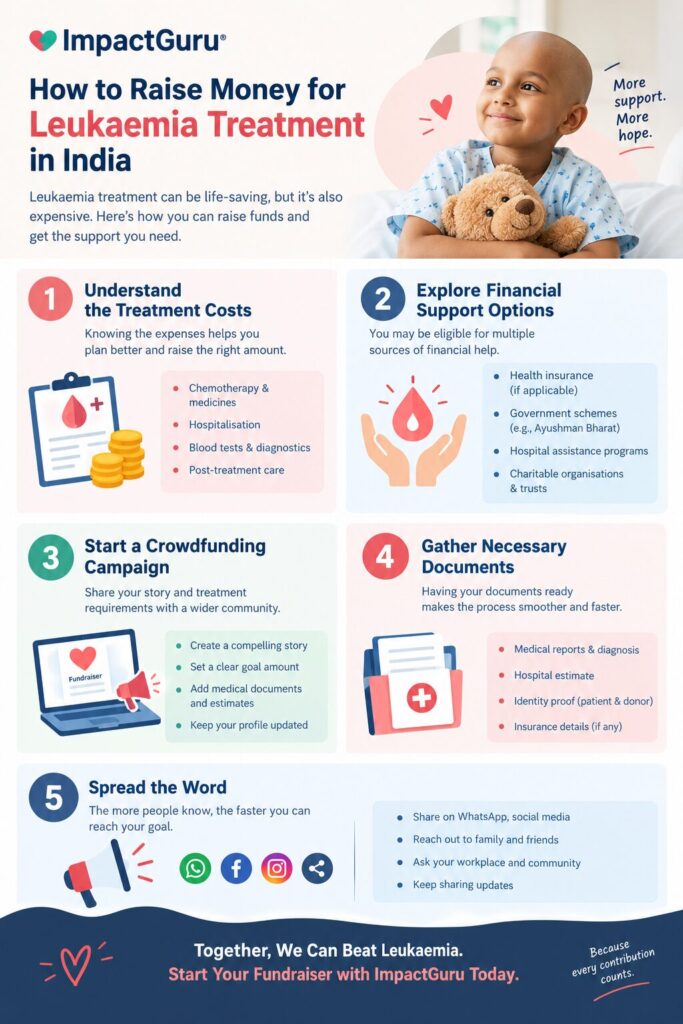
How to Raise Money for Leukemia Treatment in India
Families can explore several funding options simultaneously. Some sources may cover only a portion of the expenses, so combining available support can make a meaningful difference.
Check Health Insurance Coverage
If the patient has health insurance, contact the insurer to understand the policy’s coverage for leukemia treatment. Depending on the policy, benefits may include hospitalisation, chemotherapy, eligible medicines and other covered services.
Before starting treatment or submitting a claim, check:
- Whether the hospital is part of the insurer’s network.
- Whether pre-authorisation is required for cashless treatment.
- The policy’s sum insured, exclusions, co-payment and sub-limits.
- Whether outpatient treatment, medicines and follow-up care are covered.
- Which documents are required for reimbursement.
Do not assume that every expense will be covered. Request written clarification wherever possible, and ask the hospital’s insurance desk to help explain the process.
Explore Government Financial Assistance
Eligible patients may be able to apply for government assistance to help cover cancer treatment expenses.
The Health Minister’s Cancer Patient Fund (HMCPF), under the Rashtriya Arogya Nidhi scheme, provides one-time financial assistance of up to ₹15 lakh for eligible cancer patients, subject to the applicable criteria and approvals. Assistance is intended for treatment at specified government cancer centres, state cancer institutes and other eligible government hospitals with cancer treatment facilities. The approved amount is released to the treating hospital or institute rather than directly to the patient. Check the current eligibility requirements and application process with the hospital’s social work department or the relevant government office. Source: Press Information Bureau.
Patients and families can also explore their state government’s Chief Minister’s Relief Fund and other state-level illness assistance schemes. Availability, eligibility and application procedures differ by state.
To begin, speak to the hospital’s medical social worker or administrative department. They may help identify suitable schemes and explain the documents required, which can include medical certificates, income proof, ration card details and a hospital treatment estimate.
For additional information, visit the ICMR–National Institute of Cancer Prevention and Research financial aid resource.
Contact Charitable Organisations and Cancer Support Groups
Some charitable trusts, non-governmental organisations and cancer support groups offer financial help to eligible patients. Depending on their programmes, they may support diagnostic tests, medicines, hospital bills, travel or parts of the treatment cost.
Start by asking the treating hospital whether it works with any charitable organisations or patient assistance programmes. You can also contact cancer-focused non-profits and local community trusts directly.
When approaching an organisation, keep the patient’s medical records, doctor’s letter, estimated expenses and relevant income documents ready. Ask about eligibility, the amount of assistance available, the application timeline and whether funds are paid to the hospital or the family.
Since charitable funding may be limited, apply to suitable organisations early and keep track of each application’s status.
Start a Medical Crowdfunding Campaign
Medical crowdfunding is one way to raise money online by inviting donations from friends, relatives, colleagues, community members and other people willing to support the patient.
A fundraiser explains the patient’s diagnosis, the treatment recommended by the doctor, the estimated expenses, and the amount still required. Supporters can contribute according to their capacity and share the appeal with others.
For families researching how to Raise Money for Leukemia Treatment, crowdfunding can offer a practical way to reach people beyond their immediate social circle. It can be especially useful when treatment expenses are substantial, and other financial resources are insufficient.
However, crowdfunding does not guarantee that the full target will be reached. Its results depend on factors such as the urgency and clarity of the appeal, the size of the sharing network, donor response and the time available.
Ask the Hospital About Payment Options
Some hospitals may offer financial counselling, payment arrangements or referrals to assistance programmes. Ask the billing department whether staged payments are possible or whether the hospital has a charitable fund for eligible patients.
If treatment is being planned at more than one hospital, compare written estimates and clarify what each estimate includes. Do not delay urgent medical care while comparing costs; discuss safe and clinically appropriate options with the treating doctor.
Give Hope, Make a Difference ❤️
Start a leukemia fundraiser with ImpactGuru today.
How to Start a Fundraiser and Raise Money for Leukemia Treatment on ImpactGuru
ImpactGuru is an online crowdfunding platform that helps individuals and families raise money for medical treatment through donations. Families can create a fundraiser, provide supporting documents and share their appeal with potential donors to raise money for various treatment, including leukemia.
Here is how to approach the process.
Step 1: Create a Fundraiser
Visit ImpactGuru and begin setting up a medical fundraiser. Provide the required campaigner and patient details, along with a clear title explaining the purpose of the appeal.
Step 2: Explain the Patient’s Condition
Write a straightforward story describing the patient’s leukemia diagnosis, current condition and doctor-recommended treatment. Explain why financial assistance is needed and what the funds will help pay for.
Avoid vague claims or unsupported medical statements. A specific, honest account can help potential donors understand the family’s circumstances.
Step 3: Upload Supporting Documents
Prepare the documents requested by the platform. These may include:
- The patient’s medical reports and diagnosis.
- A doctor’s letter or treatment recommendation.
- Hospital bills and a treatment cost estimate.
- Required identity documents for the patient and campaigner.
- Relevant hospital details and other verification documents.
Ensure that the information is accurate and up to date. The platform may request additional documentation during verification.
Step 4: Set a Realistic Fundraising Goal
Calculate the amount required using the hospital’s estimate. Account for the expenses the fundraiser is intended to cover and subtract any confirmed insurance coverage, assistance or other available funds.
If the treatment plan changes, update the campaign details and explain the reason for the revised requirement.
Step 5: Share the Fundraiser Widely
Once the fundraiser is live, share its link through WhatsApp, social media, email and personal networks. Ask friends and relatives to share it with their own contacts.
ImpactGuru’s fundraising guidance recommends sharing the appeal actively and keeping donors informed about the patient’s progress. Read its fundraising FAQs for further guidance on setting up and promoting a campaign.
Review the platform’s current terms, verification requirements and applicable fees before proceeding.
How to Make Your Leukemia Fundraiser More Effective
A fundraiser needs more than a donation link. People should be able to understand the patient’s condition, the urgency of the treatment and the purpose of the financial appeal.
These steps can help communicate the need clearly.
Tell the Patient’s Story Honestly
Explain the diagnosis and treatment plan in simple language. If the patient is a child, share the story from a parent’s perspective where appropriate. If the patient is an adult, include their own voice when possible.
Avoid exaggerating the condition or promising a particular outcome. Medical treatment and recovery can vary, and the appeal should reflect the information provided by the treating team.
Explain Where the Money Will Go
Break down the requested amount into meaningful expenses, such as chemotherapy, medicines, hospitalisation or a recommended transplant. Use the hospital’s estimate wherever possible.
This helps donors understand why the amount is required and how their contributions may support treatment.
Use Relevant Photos and Documents
Choose a respectful photograph of the patient, if the patient or family is comfortable sharing one. Medical documents can help establish the need for assistance, but remove or protect information that should not be publicly disclosed.
Only publish personal and medical details with appropriate consent.
Share Regular Updates
Keep donors informed about important changes, such as treatment milestones, revised estimates or funds already received. If the medical plan changes, explain the change and update the funding requirement.
Regular communication helps maintain trust and lets supporters know how the campaign is progressing.
Make Sharing Easy
Along with the fundraiser link, write a short message explaining why the patient needs help and how people can contribute. Ask supporters to forward the appeal even if they cannot donate themselves.
A person who cannot contribute financially may still help the fundraiser reach someone who can.
What If the Fundraiser Does Not Reach Its Target?
Not every fundraiser reaches its full goal immediately. If donations are lower than expected, review the campaign and consider the next steps.
- Check the funding gap: Update the amount required based on the latest hospital estimate and funds already received.
- Expand your network: Ask trusted relatives, friends, colleagues and community groups to share the appeal.
- Follow up on assistance applications: Contact government departments, charities and hospital support teams to check pending applications.
- Discuss payment options: Ask the hospital whether staged payments or other arrangements are available.
- Keep the fundraiser updated: Explain any changes in treatment expenses and continue sharing verified information.
If the patient requires urgent treatment, contact the treating team to discuss the safest way to proceed while financial assistance is being arranged. Do not postpone medically necessary care solely to wait for crowdfunding donations.
How ImpactGuru Can Help Families Raise Money for Leukemia Treatment
ImpactGuru connects people seeking financial assistance with potential donors through online fundraising. Families can use the platform to share a medical appeal, submit supporting documents and communicate their fundraising needs.
For patients undergoing leukemia treatment, this may provide another avenue to seek support and raise treatment money alongside insurance, government schemes, and charitable assistance.
The platform does not itself guarantee that the entire amount will be raised. The money comes from donors, and the amount collected depends on the response to the campaign. Families should review the current fundraising plans, fees, verification process and withdrawal conditions before starting.
Visit ImpactGuru’s medical fundraising page to learn more about creating and managing a medical fundraiser.
Conclusion
A leukemia diagnosis can bring considerable emotional and financial pressure, especially when treatment involves repeated hospital visits, prolonged chemotherapy or a transplant. Families may not be able to meet every expense through savings or insurance alone.
Understanding how to Raise Money for Leukemia Treatment can help patients explore available support, from government schemes and charitable organisations to medical crowdfunding. Gathering the necessary documents, explaining the treatment requirement clearly and keeping supporters informed can help families approach fundraising in a more organised way.
For families who need additional financial support, a medical fundraiser on ImpactGuru can provide an opportunity to reach potential donors and seek contributions towards treatment expenses. While fundraising cannot guarantee the amount required, it can be one part of a broader effort to arrange financial assistance and support the patient’s care.
FAQs
Families can explore health insurance, government assistance schemes, charitable organisations, hospital support programmes and medical crowdfunding. The most suitable options depend on the patient’s eligibility, treatment plan and financial needs.
Yes. A medical crowdfunding campaign can help raise donations towards chemotherapy and other eligible treatment expenses. Include the doctor’s recommendation, relevant medical reports and a hospital estimate to explain the need clearly.
Crowdfunding may help families raise money towards a bone marrow transplant when it is recommended by the treating team. The campaign should explain the estimated transplant expenses and any additional costs identified by the hospital.
Eligible patients may qualify for cancer assistance schemes such as the Health Minister’s Cancer Patient Fund under Rashtriya Arogya Nidhi. Eligibility, approved amounts and treatment-centre requirements apply, so families should confirm the latest rules with the treating hospital or relevant government authority.
Commonly requested documents include medical reports, a doctor’s letter, hospital estimates or invoices, hospital contact details and the required identity documents of the patient and campaigner. The platform may request additional documents during verification.
Donation-based crowdfunding contributions are generally donations rather than loans, so recipients do not repay donors as they would repay borrowed money. However, families should review the platform’s terms and ensure that all funds are used and reported in accordance with the campaign’s stated purpose and applicable requirements.