

Table of Contents
- Quick Summary
- Introduction
- Understanding How Disaster Relief Funding Works in India
- Step 1: If You Want to Donate – Choose an Established, Vetted Organization
- Step 2: If You’re Organizing a Community Fundraiser – Do It Safely and Transparently
- Step 3: Watch for Fraud – It Spikes After Every Major Disaster
- If Your Need Is Specifically Medical Treatment Resulting From a Disaster
- Conclusion
- Frequently Asked Questions
Quick Summary
- If you’re trying to raise money for flood or disaster relief in India, the fastest official channels are the PM National Relief Fund and your state’s Chief Minister’s Relief Fund, both 80G tax-deductible.
- Government funds like SDRF and NDRF are already flowing to affected states, but these are government-to-government mechanisms, not channels the public donates to directly.
- Established NGOs, Goonj, SEEDS, Indian Red Cross Society, and Habitat for Humanity India, have decades of on-the-ground disaster response experience.
- Fraud spikes noticeably after major disasters, so always verify an NGO’s registration, FCRA status, and 80G certificate before donating.
- If the need is a specific hospital bill from a disaster-related injury or illness, that’s a distinct medical need better suited to a medical crowdfunding platform like ImpactGuru.
Introduction
India’s 2026 southwest monsoon has already triggered flooding across several states, with the central government approving an advance release of over ₹2,117 crore from the State Disaster Response Fund to support affected states in Himachal Pradesh, Odisha, Nagaland, Arunachal Pradesh, Assam, and Gujarat. Whether you’re personally affected by a flood or disaster and need to raise money for flood or disaster relief in India, or you want to organize a fundraiser to help others, or you’re simply trying to figure out where a donation will actually do the most good, this guide walks through exactly how disaster relief funding works in India: the government mechanisms already in motion, the established NGOs equipped to respond at scale, how to organize a safe and effective community fundraiser, and, importantly, a clear, honest note on what kind of fundraising need medical crowdfunding platforms are actually built for.
One thing worth being upfront about: this guide covers disaster relief broadly, shelter, food, rebuilding, and community recovery. If your specific need is funding medical treatment for an injury or illness resulting from a flood or disaster, that’s a distinct and narrower need, and it’s addressed separately near the end of this guide, since it’s handled differently from general relief fundraising.
Read More : Best Crowdfunding Platforms in 2026
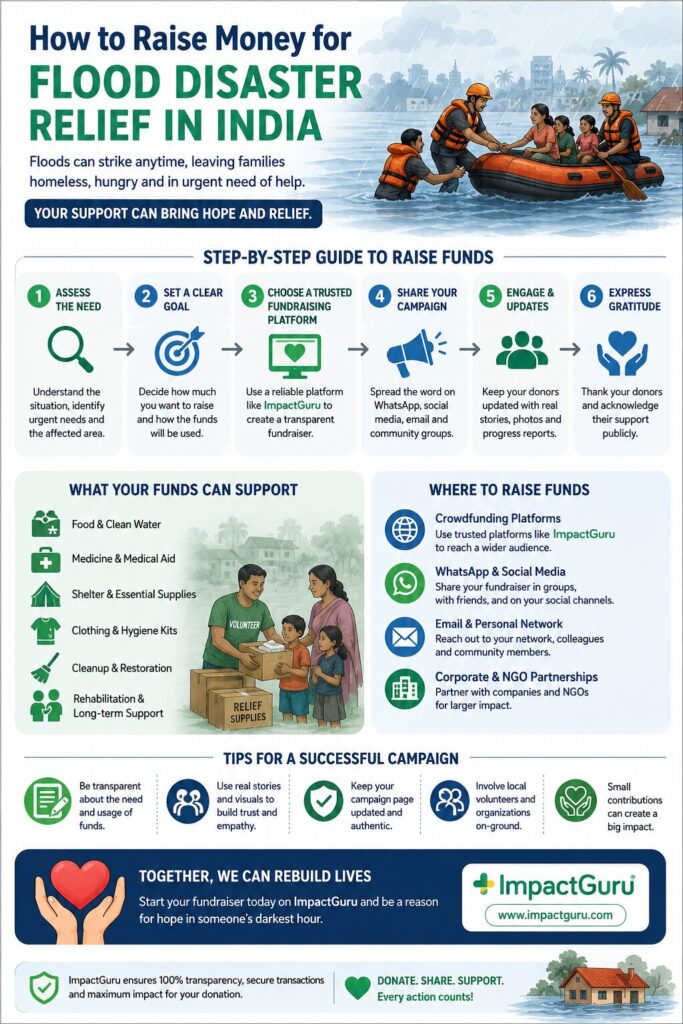
Understanding How Disaster Relief Funding Works in India
Disaster relief in India flows through several parallel channels simultaneously, and understanding the difference matters both for someone trying to get help and for someone trying to give it effectively.
| Fund / Mechanism | How It Works | How to Contribute or Access It |
| State Disaster Response Fund (SDRF) | The primary fund each state government draws on to respond to a notified disaster (floods, cyclones, landslides, etc.); replenished centrally, with additional NDRF top-ups approved for severe events | This is a government-to-government mechanism, not something individuals donate to directly — relevant mainly as context for how official relief is already being funded and disbursed in an affected state |
| National Disaster Response Fund (NDRF) | Supplements a state’s SDRF for disasters classified as ‘severe,’ released after an Inter-Ministerial Central Team (IMCT) assessment | Same as above — a government fund, not a public donation channel; relevant context for understanding the scale of official response already underway |
| Prime Minister’s National Relief Fund (PMNRF) | Accepts public contributions and uses them to provide immediate relief to families of those killed in natural calamities, and to accident and riot victims | Individuals can contribute directly via the official PMNRF portal (pmnrf.gov.in); contributions are eligible for 100% tax deduction under Section 80G |
| State Chief Minister’s Relief Funds | Most states maintain their own CM’s Relief Fund for state-specific disaster response, accepting public donations | Contribute via the official portal of the relevant state government; also typically 80G-eligible |
A few things worth understanding about how this system actually functions in a live disaster:
- Government response is often already substantial and fast-moving. In the 2024–25 financial year alone, the central government released over ₹18,000 crore to 27 states through the SDRF, alongside additional NDRF top-ups for the most severely affected states — official relief infrastructure, including NDRF rescue teams and logistics support, typically deploys within days of a major event being declared.
- These government funds don’t reach individuals directly in the way a donation to an NGO or relief fund does, they’re channeled through state governments for infrastructure, rescue operations, and often compensation schemes for affected families, which vary by state and disaster severity.
- Compensation for deaths, injury, or property loss in a declared disaster is sometimes available through state government schemes, check with your local district administration or state disaster management authority for what’s specifically available in your state and situation.
Step 1: If You Want to Donate – Choose an Established, Vetted Organization
For most people wanting to help after a flood or disaster, the most effective action is contributing to an organization with existing on-the-ground infrastructure and disaster response experience, rather than starting something new from scratch.
| Organization | What It Provides | Notes |
| Goonj | Relief material (ration, tarpaulins, hygiene kits) in the immediate aftermath, followed by longer-term rehabilitation — rebuilding roads, schools, and livelihoods through its ‘Dignity for Work’ model | Over 25 years of disaster response experience across more than 40 disasters in India; accepts both material and monetary donations |
| SEEDS (Sustainable Environment and Ecological Development Society) | Direct flood relief (ration kits, safe drinking water, shelter kits, cash support) plus rebuilding resilient community infrastructure and housing | Around 20 years of disaster management experience; also works on disaster preparedness and mitigation, not just response |
| Indian Red Cross Society | Emergency relief, medical assistance, shelter, and rehabilitation support during natural disasters | India’s oldest and largest disaster response humanitarian organization, with branches across the country |
| Habitat for Humanity India | Post-disaster shelter and housing reconstruction support | Particularly relevant for the rebuilding phase once immediate relief needs have been addressed |
| Rapid Response | On-the-ground relief including food, drinking water, and medical assistance, often in less-covered regions like Assam and Bihar | Award-winning organization structured around clear, itemised donation options (e.g., a specific amount for meals, ration, or shelter kits) |
| GiveIndia | An aggregator platform that curates and vets multiple disaster-response NGO campaigns during major events, letting donors give to a coordinated pool or choose a specific vetted NGO | Useful starting point if you want to donate but aren’t sure which specific organization to choose |
Before donating to any organization, particularly ones you haven’t heard of before a specific disaster, it’s worth taking a moment to verify: check for FCRA registration if the organization is soliciting foreign contributions, confirm 80G tax-exemption status if that matters to you, and look for a track record that predates the current disaster, this single check filters out a large share of the opportunistic, short-lived collection efforts that tend to appear immediately after major floods.
Step 2: If You’re Organizing a Community Fundraiser – Do It Safely and Transparently
If you want to raise money for flood relief in India through your own community, workplace, or social network, a few practices make a real difference to both effectiveness and trust. Many people respond to a disaster by organizing a local collection through a workplace, a residential community, a religious institution, or a social media appeal. This can be genuinely effective, but a few practices make a real difference to both effectiveness and trust:
- Partner with or channel funds through an established NGO already active in the affected area, rather than personally collecting and distributing cash — this both improves effectiveness (established NGOs have logistics and local knowledge you likely don’t) and protects you from being wrongly suspected of misusing funds.
- Be specific about what the funds will be used for (e.g., “ration kits for 50 families in [specific district]” rather than a vague “help flood victims”), specific, itemised asks consistently raise more and build more donor trust.
- Keep and share a simple record of funds collected and how they were used or transferred, even informally, a short update with photos or a receipt from the partner NGO goes a long way toward sustaining donor trust for any future appeals.
- Be cautious about collecting and holding large sums personally — routing donations directly to a registered NGO’s official donation channel is both safer and more transparent than acting as an intermediary holding cash or having funds transferred to a personal account.
Step 3: Watch for Fraud – It Spikes After Every Major Disaster
Because fraud spikes so predictably after every major disaster, anyone trying to raise money for flood relief in India or donate to someone who is needs to build in a quick verification habit before sending funds. A few practical checks:
- Verify an organization’s official donation page directly on its own website rather than through a shared link or forwarded message, which can be spoofed.
- Be wary of individual social media appeals asking for direct UPI or bank transfers without any organizational backing or verifiable track record, especially ones that surface within hours of a disaster being reported.
- Check for a registered NGO’s official registration number, FCRA status (if relevant), and 80G certificate, legitimate organizations display these prominently and will readily share them if asked.
- When in doubt, donate through an aggregator like GiveIndia that has already vetted the organizations it lists, rather than an unfamiliar standalone appeal.
Read More : How to Run a Successful Crowdfunding Campaign in India?
If Your Need Is Specifically Medical Treatment Resulting From a Disaster
It’s worth being clear and specific here: general disaster relief, shelter, food, replacing lost belongings, rebuilding a home- is a different category of need from funding a hospital bill, and it’s handled through different channels. Platforms built around medical crowdfunding, including ImpactGuru, are specifically structured for treatment costs: hospital admission, surgery, medication, and recovery, not general disaster relief like shelter kits or home reconstruction, which is better served by the established relief NGOs and government mechanisms described above.
That said, disasters do cause medical emergencies directly, injuries during a flood or landslide, infections from contaminated flood water, or a chronic condition (like dialysis or ongoing medication) disrupted by displacement or a damaged local hospital. If you or a family member needs to fund hospital treatment for an injury or illness connected to a disaster, that specific medical cost is exactly the kind of need medical crowdfunding is built for:
- Gather your hospital’s written diagnosis and cost estimate for the specific injury or illness being treated, just as you would for any other medical fundraising need.
- Create a campaign that’s specific about both the medical need and its connection to the disaster; this context often strengthens donor understanding and response, since it clarifies why the treatment is needed now.
- Use a platform built for medical fundraising specifically; ImpactGuru, for instance, is structured around hospital documentation, medical verification, and treatment-cost campaigns, which suits a disaster-related injury or illness far better than a platform or appeal built for general relief material and shelter.
So while general efforts to raise money for flood relief in India should go through the relief NGOs and government funds covered above, a disaster-related hospital bill is the one exception where medical crowdfunding is the right tool instead.

Conclusion
Disaster relief funding in India works through several parallel tracks, and knowing which one applies to your situation makes all the difference. Government mechanisms like the SDRF and NDRF are already moving substantial money to affected states, but they aren’t channels the public donates through directly, for that, the PM National Relief Fund, state Chief Ministers’ Relief Funds, and established NGOs like Goonj, SEEDS, and the Indian Red Cross Society remain the most effective, verifiable ways to give or organize a community collection. If you’re personally trying to raise money for flood or disaster relief in India, lean on these established channels rather than starting from scratch, verify any organization’s registration and 80G/FCRA status before donating or fundraising in its name, and stay alert to the fraud that reliably spikes in the days after a major disaster. And if what you’re actually facing is a hospital bill for a disaster-related injury or illness rather than general relief needs like shelter or lost belongings, remember that’s a distinct situation, one that a medical crowdfunding platform like ImpactGuru is specifically built to support, separate from the broader relief effort covered in this guide.
Frequently Asked Questions
States draw on the State Disaster Response Fund (SDRF) for immediate response to a notified disaster, with the National Disaster Response Fund (NDRF) supplementing it for disasters assessed as ‘severe’ following an Inter-Ministerial Central Team review. As of August 2026, the central government has approved an advance release of over ₹2,117 crore from the SDRF to support states affected by the ongoing monsoon floods. These are government-to-government funds, not channels the public donates to directly.
You can contribute to the PM National Relief Fund or a state Chief Minister’s Relief Fund directly through their official government portals, both of which are tax-deductible under Section 80G. Alternatively, established disaster-response NGOs such as Goonj, SEEDS, and the Indian Red Cross Society accept direct donations and have on-the-ground infrastructure to deploy relief effectively.
There isn’t a single “best” NGO; it depends on what stage of relief you want to support. Goonj and SEEDS are well-regarded for both immediate relief material and longer-term rehabilitation; the Indian Red Cross Society has the broadest on-the-ground reach as India’s oldest disaster response organization; and Habitat for Humanity India specializes specifically in post-disaster housing reconstruction. GiveIndia is a useful starting point if you want a vetted, curated set of options rather than choosing one organization yourself.
Not really; medical crowdfunding platforms, including ImpactGuru, are built around hospital treatment costs (diagnosis, surgery, medication), not general relief needs like shelter, food, or rebuilding a home. For general disaster relief, established relief NGOs or official government relief funds are the appropriate channel. If the disaster has caused a specific injury or illness requiring hospital treatment, that medical cost is a distinct need that medical crowdfunding is genuinely built to support.
Check for a registered NGO’s official registration number, FCRA status (required to accept foreign contributions), and 80G certificate, and verify them directly on the organization’s website rather than through a forwarded link. Be especially cautious of individual social media appeals for direct bank or UPI transfers that surface within hours of a disaster, without any organizational backing or prior track record; fraud and impersonation of legitimate relief efforts are well-documented patterns after major Indian disasters.
Yes, contributions to the PM National Relief Fund and most state Chief Ministers’ Relief Funds are eligible for a 100% deduction under Section 80G of the Income-tax Act. Donations to registered NGOs with valid 80G certification are also generally tax-deductible, though the deduction percentage can vary by organization; check the specific NGO’s 80G status before donating if this matters to you.