

Table of Contents
Key Takeaways
- If you need to raise money for a liver transplant in India, expect costs between ₹18–35 lakh; living-donor transplants sit at the lower end, and deceased-donor or complex (e.g., HCC-related) cases at the higher end.
- Medical crowdfunding is currently the fastest way to raise large amounts (lakhs of rupees) without taking on debt or paying it back.
- Donations to registered crowdfunding platforms are often eligible for tax deduction under Section 80G of the Income Tax Act.
- Combining crowdfunding + insurance + hospital financial aid + government schemes gives you the highest chance of covering the full cost quickly.
- Platforms like ImpactGuru specialize in medical fundraising and can get a campaign live within minutes, with verification support that builds donor trust.
Introduction
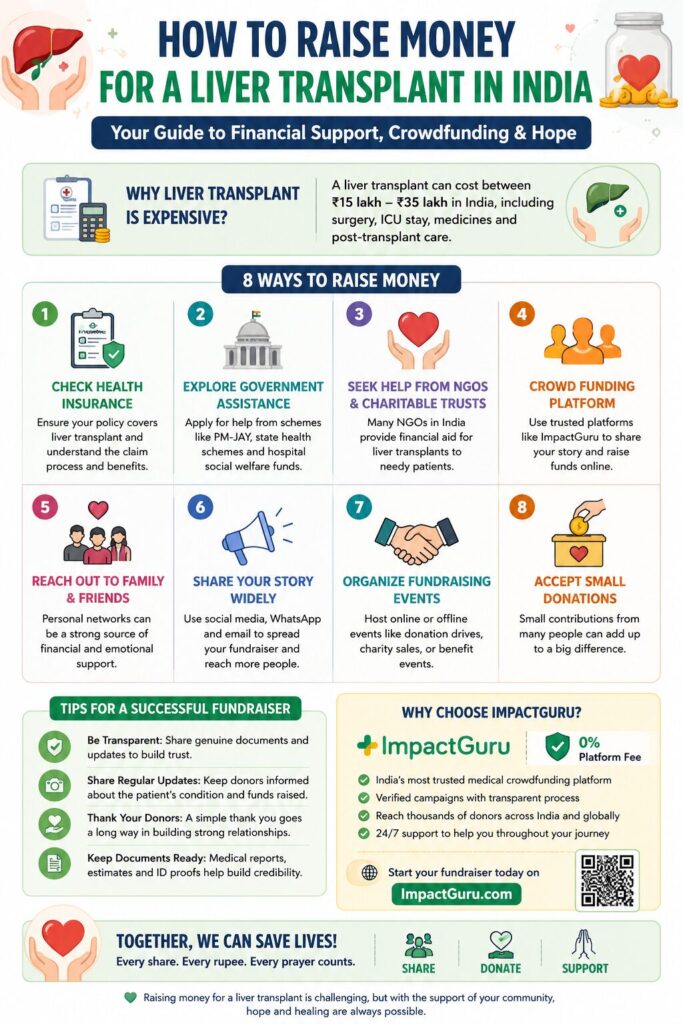
A liver transplant can cost anywhere between ₹18 lakh and ₹35 lakh (approximately $22,000–$45,000) in India, depending on the hospital, the donor type (living vs. deceased), and post-operative care needs. For most Indian families, that figure exceeds what savings, salary, or even health insurance can cover on its own. The good news: thousands of families raise this exact amount every year, not through loans that trap them in debt, but through medical crowdfunding, government schemes, hospital aid programs, and community support.
This guide walks through every legitimate way to raise money for a liver transplant in India, with a practical, step-by-step plan you can start today.
Understanding the Real Cost of a Liver Transplant in India
Before you start fundraising, it helps to know what you’re raising for. Based on current data from leading transplant centers, costs generally break down as follows:
| Transplant Type | Approximate Cost (INR) | Approximate Cost (USD) |
| Living donor liver transplant | ₹18–25 lakh | $22,000–$30,000 |
| Deceased donor liver transplant | ₹25–35 lakh | $28,000–$45,000 |
| Complex cases (e.g., liver cancer/HCC) | ₹30–35 lakh+ | $35,000–$50,000+ |
This typically includes donor evaluation and surgery, recipient surgery, ICU and hospital stay, pre-op diagnostics, immunosuppressant medication, and early follow-up care. It usually does not include long-term post-transplant medication (which can run ₹15,000–₹30,000 per month for the first year) or travel and accommodation if you’re being treated away from home, so it’s wise to fundraise for a slightly higher target than the surgery quote alone.
Read More : Affordable Liver Transplant Options in India
Step-by-Step Guide on How to Raise Money for Liver Transplant in India
Step 1: Get an Accurate Cost Estimate From Your Hospital
Ask your transplant coordinator for a written cost estimate broken down by surgery, hospital stay, medication, and contingency. This document does two things:
- It tells you exactly how much to raise.
- It builds credibility with donors when you attach it to your fundraiser; verified documentation is one of the biggest factors in whether strangers choose to donate.
Step 2: Check What Insurance and Government Schemes Already Cover
Before turning to public fundraising, exhaust what’s already available to you:
- Private health insurance: Check whether your policy covers organ transplant (many standard policies exclude donor-side expenses even if they cover the recipient).
- Ayushman Bharat (PM-JAY): Covers liver transplant at empanelled hospitals for eligible low-income families, though coverage caps and hospital lists vary by state.
- State government schemes: Several states (e.g., Tamil Nadu’s CMCHIS, Rajasthan’s Mukhyamantri Chiranjeevi scheme) offer additional transplant coverage.
- Employer group insurance: If you or an immediate family member is salaried, check group health coverage limits.
- CSR and NGO grants: Organizations like the Indian Cancer Society, ACT Foundation, and various hospital-linked trusts occasionally fund partial transplant costs, usually as a supplement to, not a replacement for, crowdfunding.
Whatever these cover, subtract it from your total; the remaining “funding gap” is your crowdfunding target.
Step 3: Start a Medical Crowdfunding Campaign
For most families, the funding gap after insurance and government aid still runs into several lakhs of rupees. This is where online medical crowdfunding has become the single most effective tool in India, because it lets you tap into donors far beyond your immediate circle: extended family, colleagues, alumni networks, social media followers, and even strangers moved by your story.
Why Crowdfunding Works Better Than a Loan
- No repayment, no interest: unlike a personal or medical loan, funds raised through donations don’t need to be paid back.
- Speed: campaigns can go live within minutes and start receiving donations the same day.
- Reach: a well-shared campaign can reach thousands of potential donors through social sharing, far more than any single lender’s approval process.
- Tax benefit for donors: contributions to campaigns run through registered charitable structures are often eligible for deduction under Section 80G, which encourages larger donations.
Choosing the Right Crowdfunding Platform
Not all crowdfunding platforms are built the same way, and for a medical emergency, the differences matter. Look for:
- A 0% platform fee model, so more of what’s raised reaches the patient.
- Fast verification and approval, since medical timelines don’t allow for delays.
- Dedicated medical fundraising expertise, teams that understand transplant documentation, hospital billing formats, and how to structure a compelling, trustworthy campaign.
- A track record specifically with organ transplant cases, not just general fundraising.
ImpactGuru is one of the platforms built specifically around this use case. Founded in 2014, it has supported large-scale medical fundraising, including transplant cases, with a 0% platform-fee option, document verification support, and campaign specialists who help structure and promote fundraisers so they reach donors faster. For a liver transplant specifically, this kind of dedicated support can matter: transplant campaigns need clear medical documentation, believable cost breakdowns, and consistent updates to keep donor trust high through what is often a multi-week fundraising window.
How to Set Up a Liver Transplant Fundraiser (Step-by-Step)
- Gather your documents: hospital cost estimate, diagnosis reports, ID proof, and bank account details for fund transfer.
- Create the campaign: Most platforms, including ImpactGuru, let you set this up in under 10 minutes; add the patient’s story, the diagnosis, and the amount needed.
- Add photos and a clear, honest narrative: Campaigns with a face, a real story, and specific details (hospital name, doctor, timeline) consistently raise more than vague appeals.
- Get verified: The platform will typically confirm your medical documents and identity; this step is what makes donors comfortable giving to a stranger.
- Share widely and immediately: WhatsApp groups, family circles, workplace networks, alumni groups, and social media. The first 48 hours often set the pace for the whole campaign.
- Post regular updates: Every update (surgery date confirmed, pre-op tests done, surgery successful) re-engages past donors and encourages new shares.
- Withdraw funds as they come in: Reputable platforms allow rolling withdrawals so you can pay hospital bills as money arrives, rather than waiting for the full target.
Tips to Raise More, Faster
- Set a realistic but slightly padded target to account for post-transplant medication and follow-up.
- Ask 5–10 close contacts to donate first; early momentum makes a campaign look credible to new visitors.
- Use a short video if possible; video appeals tend to convert better than text alone.
- Loop in local community organizations, religious groups, or employers, who often match or boost employee/member fundraisers.
- Keep the campaign page updated at every milestone; stalled campaigns lose donor confidence quickly.
Step 4: Explore Additional and Parallel Support
Crowdfunding doesn’t have to be your only channel; many families run it alongside:
- Hospital financial counseling desks, which sometimes offer EMI options or discounted packages for transplant patients.
- NGOs focused on liver disease and transplant support, some of which offer partial grants or help with medication costs after surgery.
- Corporate CSR desks, especially if the patient or a family member is employed at a larger company.
- Local media and community fundraisers (temple/mosque/church drives, RWA collections), which work well in smaller towns.
A Note on Trust and Verification
Because medical crowdfunding involves real money from real donors, it’s worth being transparent from day one: use your real name and photo, upload actual hospital documents, and keep your campaign updated with genuine progress. This isn’t just good practice for donor trust; reputable platforms will verify these details before releasing funds, which protects both you and your donors.
Read More : Liver Transplant Donor Criteria: Complete Guide for India (2026)
Conclusion
Raising money for a liver transplant in India can feel overwhelming, but timely action and the right financial support can make lifesaving treatment possible. By combining personal savings, health insurance, government assistance, charitable organizations, and medical crowdfunding, families can reduce the financial burden and focus on the patient’s recovery. Creating a transparent fundraiser, sharing your story widely, and keeping donors updated can significantly improve your chances of reaching your fundraising goal. Medical Crowdfunding Platforms like ImpactGuru have helped thousands of patients access urgent liver transplant treatment by connecting them with generous donors across India and around the world. Remember, asking for help is a step toward healing, and with the support of your community, a successful liver transplant can become a reality.
Frequently Asked Questions
The fastest way to raise money for a liver transplant is to combine medical crowdfunding with insurance claims, government schemes like Ayushman Bharat, and hospital financial aid, crowdfunding alone can often cover the largest share of the gap within a few weeks.
Costs generally range from ₹18 lakh to ₹35 lakh (roughly $22,000–$45,000), depending on whether it’s a living or deceased donor transplant, the hospital, and case complexity.
Yes. Donation-based crowdfunding for medical and personal causes is legal in India. Equity-based crowdfunding is restricted by SEBI, but platforms that facilitate donations for medical treatment operate within existing regulatory frameworks.
No. Funds raised through donation-based medical crowdfunding are gifts from donors and do not need to be repaid, unlike a personal or medical loan.
On platforms like ImpactGuru, a campaign can go live within minutes of submission, and donations can start coming in the same day, though verification of documents is required before funds are released to your bank account.
Often yes, contributions made through campaigns structured under a registered charitable entity are typically eligible for deduction under Section 80G of the Income Tax Act. Check the specific platform’s tax-receipt process, as this varies by campaign structure.
Most platforms allow rolling or partial withdrawals, so funds already raised can be used toward hospital bills even before the full target is met. It’s also worth combining crowdfunding with insurance, government schemes, and NGO support to close any remaining gap.
Look for a platform with specific experience in organ transplant campaigns, fast document verification, a low or 0% fee structure, and dedicated fundraising support. ImpactGuru is one such platform built around medical crowdfunding, including transplant cases.