
UPI did not just change how Indians pay; it changed how Indians think about money. I believe the future of medical crowdfunding in India is on the same trajectory. By 2030, asking your network for help with a medical emergency will be as natural and stigma-free as scanning a QR code.
Table of Contents
- A Prediction Worth Making
- Force 1: The Healthcare Financing Gap Is Getting Wider, Not Narrower
- Force 2: Digital India Has Created the Infrastructure for Crowdfunding at Scale
- Force 3: The Stigma of Asking for Help Is Dissolving
- Force 4: The Diaspora Effect Is Massively Underutilised
- Force 5: AI and Data Are Making Fundraising Dramatically More Effective
- What India Will Look Like in 2030
- The Role of ImpactGuru in Making This Future Real
- FAQs
A Prediction Worth Making
Bold predictions are easy to make and easy to dismiss. So let me explain exactly why I believe that medical crowdfunding in India will become a mainstream, normalised behaviour within the next five years, and why ImpactGuru is positioned to lead that transformation.
The argument is not primarily about technology, although technology is a crucial enabler in future of medical crowdfunding in India. The argument is about the convergence of several powerful social, economic, and demographic forces that are reshaping how Indians relate to healthcare, money, and community.
Force 1: The Healthcare Financing Gap Is Getting Wider, Not Narrower
India’s healthcare system is improving. More hospitals are being built. More doctors are being trained. Government schemes like Ayushman Bharat are extending coverage to millions. These are genuine achievements.
But the cost of advanced medical treatment is rising faster than incomes, insurance coverage, or government support. New cancer drugs cost lakhs per cycle. Immunotherapy treatments that were experimental five years ago are now standard of care, at prices that bear no relationship to the average Indian income.
This means that even as India gets richer and more insured, the gap between what treatment costs and what people can afford will remain large, and for complex, high-cost conditions, it may actually grow. Medical crowdfunding is not a stopgap for a problem that is about to be solved. It is a permanent part of the healthcare financing ecosystem.
Force 2: Digital India Has Created the Infrastructure for Crowdfunding at Scale
Ten years ago, medical crowdfunding at scale was not possible in India. Internet penetration was low. Smartphone ownership was limited. Online payments were complex and mistrusted. Most Indians had never made an online transaction.
Today, India has over 900 million internet users. UPI processes over 15 billion transactions a month. WhatsApp has over 500 million Indian users. Instagram and YouTube have created a culture of digital storytelling that makes the narrative fundraiser, the campaign page with a patient’s story and photos, completely natural to a vast and growing audience.
The infrastructure for medical crowdfunding on a massive scale now exists. ImpactGuru is built on top of it.
Force 3: The Stigma of Asking for Help Is Dissolving
When we launched ImpactGuru, one of the biggest barriers we faced was cultural: many Indians found it deeply uncomfortable to ask for financial help publicly, even for a medical emergency. It felt like admitting poverty. It felt like burdening others. It felt undignified.
That attitude has shifted dramatically, particularly among urban and semi-urban Indians under forty. Social media has normalised public vulnerability. Seeing others share their struggles, and seeing the outpouring of support that follows, has made asking for help feel less like weakness and more like community engagement.
The generation now entering their peak earning and family formation years, the millennials and Gen Z, who grew up with social media, have a fundamentally different relationship with public fundraising. For them, starting a campaign on a medical crowdfunding platform is no different from organising a community WhatsApp group for a neighbourhood emergency.
Stigma is the biggest silent killer in medical crowdfunding. As it dissolves, and it is dissolving, the growth of platforms like ImpactGuru will accelerate dramatically.
Force 4: The Diaspora Effect Is Massively Underutilised
India has one of the world’s largest diaspora populations, over 32 million Indians living abroad, including significant communities in the US, UK, Canada, Australia, the UAE, and Singapore. These communities have higher average incomes than most Indians in India, deep emotional connections to their families and communities back home, and a strong cultural tradition of supporting relatives in need.
Medical crowdfunding taps this diaspora in a way that traditional fundraising never could. A campaign for a patient in a small town in UP can reach that patient’s cousin in New Jersey within seconds of being shared on WhatsApp. International donors can contribute seamlessly through ImpactGuru’s international payment gateway.
We have seen fundraisers where 40–50% of total donations came from overseas. As diaspora communities become more digitally sophisticated and as awareness of platforms like ImpactGuru grows internationally, this channel will become even more powerful.
Force 5: AI and Data Are Making Fundraising Dramatically More Effective
One of the most exciting developments at ImpactGuru is the application of artificial intelligence and machine learning to improve fundraising outcomes for patients. Vikas Kaul’s technology team has been building tools that analyse successful campaign patterns and give real-time recommendations to campaigners.
These tools can predict, based on the first 24 hours of a campaign’s performance, what the likely final outcome will be, and intervene with targeted suggestions to improve results. They can identify which donor segments are most likely to give to which types of campaigns. They can optimise the timing and content of update posts to maximise re-engagement from existing donors.
As these AI capabilities mature, the success rate for medical fundraisers on ImpactGuru will increase significantly, which will in turn drive more families to the platform, creating a virtuous cycle of growth and impact.

What India Will Look Like in 2030
Here is the future medical crowdfunding in India I am working toward and believe we are building:
• Medical crowdfunding is taught in financial literacy programmes in schools and colleges as a standard tool in healthcare planning.
• Hospitals have dedicated ImpactGuru integration points, when a patient cannot afford treatment, the hospital proactively helps them start a fundraiser on the spot.
• Employers include ImpactGuru awareness in their employee wellness programmes, so employees know how to help colleagues facing medical crises.
• The Indian diaspora has a well-established culture of supporting ImpactGuru campaigns from overseas, as normal as sending a Diwali gift.
• AI-powered fundraising assistants help every patient create and optimise their campaign in their preferred language, including Hindi, Tamil, Telugu, Bengali, and other major Indian languages.
None of this is far-fetched. The trajectory is clear. The technology exists or is being built. The cultural shift is underway. The infrastructure is in place.
The Role of ImpactGuru in Making This Future Real
We do not just want to ride the wave of medical crowdfunding’s growth in India. We want to drive it. That means continued investment in platform quality, verification standards, and donor trust. It means aggressive expansion of our hospital and NGO partnerships. It means building the most effective, accessible, multilingual medical fundraising tools in the world.
It also means advocacy, making the case to policymakers, healthcare administrators, and corporate India that medical crowdfunding is not a fringe activity but a critical component of a functional healthcare financing system.
UPI changed India. Not because it was a great product, although it was, but because it solved a real problem at the right moment in India’s development. Medical crowdfunding, through platforms like ImpactGuru, can do the same for healthcare financing. The problem is real. The moment is now. And the platform is ready.
FAQs
Medical crowdfunding is a way to raise money online for healthcare expenses through small donations from a large number of people. It helps patients cover costs like surgeries, treatments, and hospital bills when funds are limited.
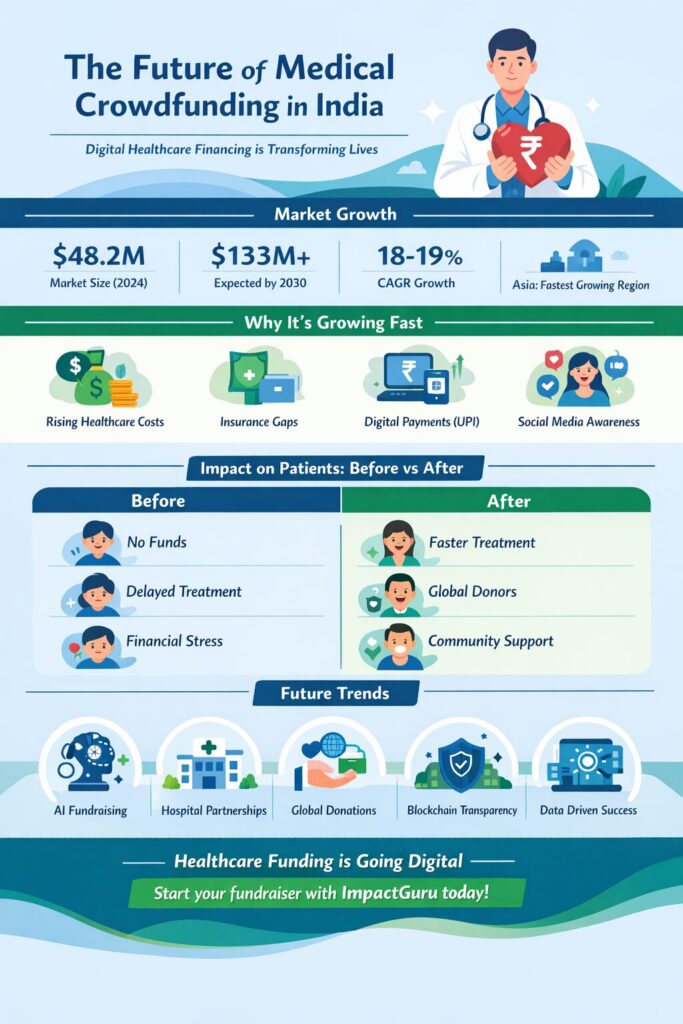
It is growing due to rising healthcare costs, gaps in insurance coverage, and increased digital adoption. In fact, medical crowdfunding usage in India is increasing by around 25% annually.
The future looks strong, with the Indian crowdfunding market expected to grow from $48.2M in 2024 to over $133M by 2030, driven by technology and increasing awareness.
It enables faster access to treatment by connecting patients with donors globally. It also provides emotional support through community engagement and reduces financial stress during emergencies.
Yes, trusted platforms ensure transparency, secure payments, and verified campaigns, making it a reliable way to raise funds for medical needs when managed properly.