
show_reviewer]
Table of Contents
- Quick Summary
- Introduction
- What Are Cramps on the Right Side of Your Abdomen?
- What Causes Cramps on the Right Side of the Abdomen?
- Cramps on the Right Side in Females: Causes and Treatment
- Sharp Pain on the Right Side of Your Stomach: What Does It Mean?
- Is Right-Side Abdominal Pain Serious or Normal? When to Worry
- Cost of Diagnosing Abdominal Pain in India (2026)
- Treatment Costs for Common Right-Side Abdominal Conditions in India
- How to Afford Treatment for Abdominal Conditions in India
- Conclusion
- FAQs
Quick Summary
- Cramps on the right side of your abdomen can originate from over a dozen different organs, and where exactly you feel it matters as much as how it feels.
- The upper right region houses the liver, gallbladder, and right kidney; the lower right is home to the appendix, colon, and (in women) the right ovary and fallopian tube.
- While many causes are harmless, such as gas, muscle strain, and constipation, some, like appendicitis and kidney stones, require urgent medical attention.
- Women face additional causes, including ovulation pain, ovarian cysts, and endometriosis, that are frequently misdiagnosed as digestive issues.
Introduction
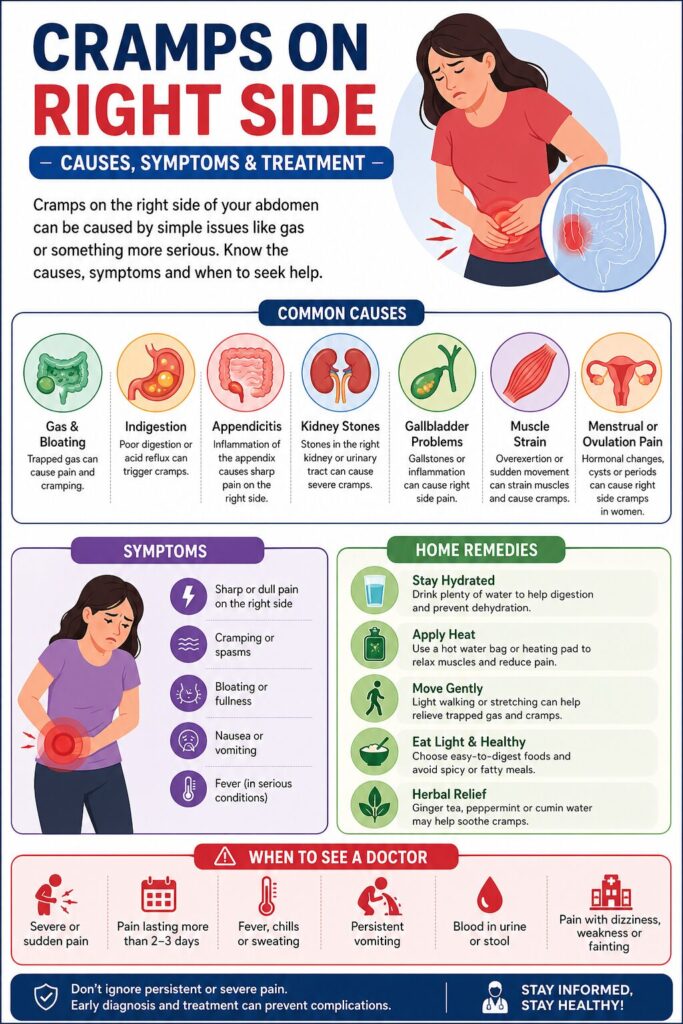
Cramps on right side of the abdomen are a common health concern that can range from mild discomfort to severe pain, depending on the underlying cause. This type of pain may originate from various organs located on the right side, such as the appendix, liver, gallbladder, intestines, or kidneys. In many cases, cramps on right side are caused by simple issues like gas, indigestion, or muscle strain, but they can also signal more serious conditions such as appendicitis, kidney stones, or gallbladder problems.
Understanding the exact reason behind cramps on right side is essential for proper treatment and timely medical care. In this guide, we will explore the meaning, causes, symptoms, and treatment options to help you identify when it’s harmless and when you should seek medical attention.
What Are Cramps on the Right Side of Your Abdomen?
Cramps on the right side are pain or spasms felt anywhere between your lower right ribcage and your right hip. They can be sharp, dull, burning, or wave-like, and they are caused by irritation, inflammation, or obstruction in one or more of the several organs located in that region. The cause depends significantly on where exactly the pain is and what accompanies it.
The word “cramp” is often used loosely to describe any abdominal discomfort, but medically, it refers to a pain that contracts and releases, often in waves. This wave-like quality is actually a clue. Hollow organs, such as the intestine, gallbladder, and ureter, produce cramping pain when they contract against a blockage. Solid organs and inflamed tissues tend to produce steadier, more constant pain.
Your right abdomen is not one organ. It is a neighbourhood of several:
- Upper Right Quadrant: Liver, gallbladder, bile ducts, upper portion of the small intestine, right portion of the large intestine, right kidney (located toward the back)
- Lower Right Quadrant: Appendix, ascending colon, lower small intestine, right ureter, and, in women, the right ovary and fallopian tube
This geography is the first key to understanding your pain. A cramp under your right ribcage after a fatty meal is a very different story from a cramp near your right hip that worsens when you walk. Both are “right side cramps,” but they point toward completely different organs and conditions.
What Causes Cramps on the Right Side of the Abdomen?
The most common causes of right-side abdominal cramps include appendicitis, gallstones, kidney stones, irritable bowel syndrome (IBS), intestinal gas, and, in women, ovarian cysts and menstrual pain. Most cases are not emergencies, but certain combinations of symptoms should never be ignored
The table below maps the most common causes to their location, pain type, and associated symptoms, so you can identify what may apply to your situation:
| Condition | Where You Feel It | Pain Type | Common Associated Symptoms |
| Appendicitis | Lower right, near the hip | Starts near the navel, shifts right; worsens with movement | Fever, nausea, vomiting, loss of appetite |
| Gallstones / Gallbladder inflammation | Upper right, under ribs | Wave-like, gripping; often after fatty meals | Nausea, bloating, and pain radiating to the right shoulder or back |
| Kidney Stones | Right flank / lower right | Severe, comes in waves; may radiate to the groin | Painful urination, blood in urine, nausea |
| Intestinal Gas | Anywhere on the right side | Bloating, shifting pressure | Burping, flatulence, relief after passing gas |
| Irritable Bowel Syndrome (IBS) | Lower right or central abdomen | Crampy, comes and goes | Alternating constipation and diarrhoea, bloating |
| Constipation | Lower right or central | Dull pressure or cramping | Infrequent bowel movements, straining |
| Hernia (Inguinal) | Lower right, near groin | Dull ache; worse with lifting or straining | Visible bulge in the groin area (more common in men) |
| Kidney Infection (Pyelonephritis) | The right flank can radiate front | Dull to moderate ache | Fever, chills, painful urination, cloudy urine |
| Liver conditions (Hepatitis, fatty liver) | Upper right, under ribs | Dull ache, heaviness, pressure | Fatigue, jaundice (yellowing of eyes/skin), nausea |
| Muscle strain / abdominal wall pain | Anywhere on the right side | Sharp at a specific spot; worsens with movement or touch | No digestive symptoms; pain reproduced by pressing the area |
| Crohn’s Disease | Lower right (most commonly) | Crampy, recurring | Chronic diarrhoea, weight loss, fatigue |
| Ovarian cyst (women) | Lower right | Sharp, sudden, or dull and persistent | Bloating, irregular periods, and pain during intercourse |
| Ovulation pain / Mittelschmerz (women) | Lower right or left | Short, sharp, or achy | Mid-cycle, lasts minutes to hours, no other symptoms |
| Endometriosis (women) | Lower right and pelvic | Cyclical cramping, often severe | Heavy periods, pain during intercourse, and infertility |
Upper Right Cramps: What They Usually Mean
Pain in the upper right quadrant, beneath the ribs, most commonly points to the gallbladder or liver. Gallbladder colic is the classic culprit: a cramping, gripping sensation that builds after a meal (especially one rich in fat) and then eases. It can radiate to the right shoulder or between the shoulder blades. Many people dismiss this as indigestion for months before seeking a diagnosis.
Liver-related pain tends to be steadier, a dull heaviness rather than waves of cramping. Conditions like hepatitis, fatty liver disease (non-alcoholic fatty liver disease is increasingly common in urban India), or liver inflammation all sit in this region.
Gas trapped in the large intestine can also accumulate in the upper right, producing a pressure-like discomfort that shifts and eventually passes.
Lower Right Cramps: What They Usually Mean
The lower right quadrant deserves more attention because this is where the appendix lives. Appendicitis classically begins as a vague, crampy pain near the navel that migrates to the lower right over 12–24 hours. As inflammation increases, the pain becomes sharper and more localised. This pattern, migration of pain plus fever plus nausea, is a combination that should prompt you to seek care urgently, not wait and see.
However, lower right cramps are far more frequently caused by intestinal gas, IBS, constipation, or, in women, ovarian or reproductive causes. The key differentiator is progression: appendicitis gets consistently worse over hours; gas and IBS fluctuate and often improve with passing gas or a bowel movement.
Kidney stones in the right ureter produce a very distinctive type of cramp, extraordinarily severe waves of pain that radiate from the right flank into the groin, often accompanied by an urgent need to urinate or visible blood in the urine. This pain is hard to mistake for anything else once experienced.
Right Flank Pain: Kidneys and Beyond
Pain in the right side of your back between the lower ribs and the hip, the “flank,” most commonly suggests the right kidney. Whether it is a kidney stone, a kidney infection (pyelonephritis), or a urinary tract infection that has travelled upward, flank pain tends to be deep and aching, sometimes accompanied by urinary symptoms.
Muscle strain from lifting, twisting, or prolonged poor posture can also produce right flank discomfort that is often mistaken for a kidney problem. A simple differentiator: musculoskeletal pain typically worsens when you press the area or change position; kidney pain is usually unaffected by touch and more constant.
Cramps on the Right Side in Females: Causes and Treatment
In women, cramps on the right side of the abdomen are frequently caused by reproductive system conditions, not just digestive ones. Ovulation pain, ovarian cysts, endometriosis, and ectopic pregnancy can all produce right side cramps that are often misdiagnosed as IBS or appendicitis. Understanding the difference can prevent years of delayed treatment.
This is the section most generic medical blogs skip or reduce to two bullet points. It deserves much more than that.
According to research, endometriosis alone affects approximately 42–43 million women in India, and the average time from onset of symptoms to correct diagnosis in Indian women is 6.3 years. During those years, women are routinely told their pain is “normal period discomfort,” that it will improve after marriage, or that nothing shows up on a scan. Meanwhile, nearly 1 in 4 Indian women is affected by ovarian cysts.
If you are a woman experiencing recurring cramps on your right side, especially pain that follows a monthly period, the cause is very likely gynaecological, not gastrointestinal.
Ovulation Pain (Mittelschmerz)
This is one of the most common and least discussed causes of one-sided lower abdominal cramps in women. Around the middle of your menstrual cycle, approximately day 14 in a 28-day cycle, the ovary releases an egg. When this happens on the right side, it produces a sharp or achy sensation in the lower right abdomen.
- What it feels like: A sudden, short-lived twinge or a dull ache on one side. It typically lasts anywhere from a few minutes to a few hours, rarely longer than a day.
- How to identify it: It occurs mid-cycle (not at the time of your period), does not come with fever or nausea, and resolves on its own. It alternates sides from month to month as ovulation switches ovaries.
- When to worry: Ovulation pain that lasts more than 24 hours, becomes severe, or is accompanied by bleeding is not normal and should be evaluated.
Ovarian Cysts
Ovarian cysts are fluid-filled sacs that form on or within the ovary. Most are functional cysts, meaning they form as a normal part of the menstrual cycle and dissolve on their own within one to three months. However, larger cysts or ruptured cysts can produce significant pain.
- What it feels like: A dull, ongoing ache or pressure in the lower right abdomen, sometimes with bloating or a sense of fullness. A ruptured cyst produces sudden, sharp, severe pain, often described as the worst pain of your life in that moment, and requires immediate medical attention.
- Associated symptoms: Bloating, irregular or painful periods, pain during intercourse, frequent urination, or difficulty with bowel movements.
- Important distinction from appendicitis: Ovarian cyst pain typically has a gradual onset and may be linked to your cycle. Appendicitis pain progressively worsens over hours, begins near the navel, migrates to the right, and comes with fever and loss of appetite. If you are unsure, always seek medical evaluation; do not try to self-diagnose.
Endometriosis
Endometriosis is a condition in which tissue similar to the uterine lining grows outside the uterus, on the ovaries, fallopian tubes, intestines, or other pelvic structures. When it involves the right ovary or right fallopian tube, the pain is felt distinctly on the right side.
This condition affects approximately 10% of women of reproductive age in India, yet takes an average of over 6 years to diagnose, primarily because pain during menstruation has long been normalised in Indian society and because symptoms overlap with IBS, ovarian cysts, and pelvic inflammatory disease.
- What it feels like: Severe cramping that tends to worsen significantly during menstruation, but can persist throughout the month. Pain during intercourse, during bowel movements, or while urinating during your period is also common.
- The key differentiator: Unlike regular period pain, endometriosis pain typically does not fully resolve between cycles, gets worse over time rather than better, and is often out of proportion to what a scan shows, because standard ultrasounds frequently miss it.
- Treatment in India: Hormonal therapies (oral contraceptives, GnRH agonists) help manage symptoms. Laparoscopic surgery to remove endometrial tissue is the definitive treatment and typically costs ₹80,000 to ₹1.5 lakh or more in private hospitals in India.
Ectopic Pregnancy: A Medical Emergency
An ectopic pregnancy occurs when a fertilised egg implants outside the uterus, most commonly in the fallopian tube. If the implantation is in the right fallopian tube, the pain is felt sharply on the lower right side.
- This is a medical emergency. A ruptured ectopic pregnancy can cause life-threatening internal bleeding within minutes.
- Warning signs: Sharp, sudden lower right abdominal pain in a woman who may be pregnant (even if she does not yet know), accompanied by vaginal bleeding, dizziness, shoulder tip pain, or feeling faint. Go to the emergency room immediately.
Pelvic Inflammatory Disease (PID)
PID is an infection of the reproductive organs, often a complication of untreated STIs, that causes lower abdominal pain, sometimes more pronounced on one side depending on which structures are most inflamed. It can cause dull to moderate cramping, unusual vaginal discharge, fever, and pain during intercourse.
Female Right Side Cramps: Quick Differentiation Guide
| Condition | Timing | Pain Type | Key Differentiator |
| Ovulation pain | Mid-cycle | Brief, sharp, or achy | Lasts minutes to hours; alternates sides monthly |
| Ovarian cyst | Any time may worsen with the cycle | Dull ache or sudden sharp (if ruptured) | Bloating, irregular periods; rupture = severe, sudden pain |
| Endometriosis | Worsens during menstruation | Severe, cyclical cramping | Doesn’t fully resolve; pain during sex or bowel movements |
| Ectopic pregnancy | Early pregnancy, sudden | Severe, sharp | Vaginal bleeding, dizziness, EMERGENCY |
| PID | Ongoing | Dull to moderate | Fever, discharge, pain during intercourse |
| Appendicitis | Suddenly, progressive | Migrating, worsening | Starts near navel, moves right; fever, nausea — EMERGENCY |
Sharp Pain on the Right Side of Your Stomach: What Does It Mean?
A sharp pain on the right side, as opposed to a dull ache or cramping, usually signals something more acute: a gallstone episode, a kidney stone passing, early-stage appendicitis, a ruptured ovarian cyst, or a muscle/nerve issue. The severity alone does not determine seriousness, but sharp pain that worsens over time, doesn’t resolve within hours, or comes with fever should always be medically evaluated.
The character of your pain, not just its location, is a key diagnostic clue. Here is how to read it:
- Sharp and stabbing under the right ribs after eating: Points strongly to the gallbladder. The gallbladder contracts after a meal and, if a stone temporarily blocks the outflow, produces an intense gripping or stabbing sensation beneath the right ribcage. This can radiate to the right shoulder blade.
- Sharp, severe pain that radiates from the right flank toward the groin: This is the signature presentation of a kidney stone moving through the right ureter. The pain comes in waves of extraordinary intensity and is typically accompanied by an urgent or painful need to urinate.
- Sharp pain near the navel that moves to the lower right and gets worse over hours: This is the classic appendicitis pattern. Do not wait. Seek emergency care.
- Sudden sharp pain in the lower right in a woman: Could be a ruptured ovarian cyst or, if she is or could be pregnant, an ectopic pregnancy. Both require immediate evaluation.
- Sharp, localised pain that worsens when you press a specific spot or twist your body: More likely to be a musculoskeletal issue, an abdominal muscle strain, a rib injury, or nerve irritation. This type of pain has no digestive or urinary symptoms alongside it and is often tied to a recent physical activity.
- Sharp pain that comes and goes rapidly and is relieved by passing gas or a bowel movement: Most likely intestinal gas or IBS-related spasm. Uncomfortable but not dangerous.
Is Right-Side Abdominal Pain Serious or Normal? When to Worry
Most right side abdominal pain is not a medical emergency; gas, constipation, IBS, and mild muscle strain account for the majority of cases and resolve on their own. However, certain combinations of symptoms are genuine red flags that require immediate medical attention. The key is knowing which pattern you are dealing with.
Pain intensity is a poor indicator of seriousness. A kidney stone can produce excruciating pain that passes on its own, while early appendicitis can begin as a mild, ignorable ache before becoming life-threatening. What matters is the pattern, location, progression, and what comes with it.
Usually Not an Emergency (Monitor at Home)
- Pain that comes and goes is relieved by passing gas or having a bowel movement, and there is no fever.
- Mild cramping in the lower right that is clearly tied to your menstrual cycle and improves within 1–2 days
- A dull, shifting discomfort after a large or spicy meal with bloating and no fever
- Muscle soreness on the right side after exercise, lifting, or an unusual physical movement, especially if pressing the spot reproduces the pain
- Mild constipation-related pressure that improves after a bowel movement
See a Doctor Within 24–48 Hours (Not an Emergency, But Don’t Ignore)
- Right side pain that has persisted for more than 2–3 days without improvement
- Recurring cramps in the same location over several weeks or months
- Pain associated with changes in your bowel habits, new constipation, diarrhoea, or alternating between both
- Mild pain accompanied by unexplained fatigue, weight loss, or loss of appetite
- Right side pain with urinary symptoms, pain while urinating, frequent urination, or cloudy urine, which may indicate a kidney or urinary tract issue
- In case of women, right-sided pain that correlates with your cycle but is getting progressively worse month after month
Go to the Emergency Room Immediately
These are genuine red flags. Do not wait, do not take a painkiller and sleep it off, and do not drive yourself if the pain is severe:
1. Pain that begins near the navel and migrates to the lower right, worsening steadily over several hours, is the classic appendicitis progression. If this is accompanied by fever, nausea, vomiting, and loss of appetite, treat it as an emergency.
2. Sudden, severe pain in the lower right abdomen in a woman who is or may be pregnant, an ectopic pregnancy can rupture rapidly and cause fatal internal bleeding.
3. Excruciating right flank pain radiating toward the groin, with blood in the urine, a kidney stone may be obstructing the ureter and causing hydronephrosis if left untreated.
4. Right side pain with a rigid or board-like abdomen rigidity indicates peritonitis (infection spreading into the abdominal cavity), which is a surgical emergency.
5. Upper right pain with yellowing of the skin or whites of the eyes (jaundice) indicates a biliary or liver emergency such as acute cholangitis, which can become life-threatening rapidly.
6. Sudden, sharp pain with vaginal bleeding and dizziness indicates an ectopic pregnancy or ruptured ovarian cyst with internal bleeding.
7. Pain so severe that it prevents you from standing straight, sitting still, or eating or drinking, regardless of cause, this level of pain requires emergency evaluation.
8. Any right side abdominal pain in a child under 10 that progressively worsens over hours, children have a higher risk of appendix rupture and may not articulate their pain clearly.
A Note on Pain Tolerance and Delayed Diagnosis in India
One pattern that leads to avoidable complications in India is the tendency, particularly among women, to tolerate abdominal pain for far longer than is safe, either because it has been dismissed by family or doctors before, or because seeking care feels financially out of reach. Both are understandable. Neither is without risk.
If you have been told your pain is “just stress” or “normal for your age” and it keeps returning, you deserve a proper investigation. Trust the pattern of your body, not just a single dismissal.
Cost of Diagnosing Abdominal Pain in India (2026)
Getting a diagnosis for right-side abdominal pain in India typically costs between ₹500 and ₹8,000, depending on the tests your doctor orders. Most cases start with a physical exam, a basic blood test, and an ultrasound, which together can confirm or rule out the most common causes within a day.
One of the most common reasons people in India delay seeking care for abdominal pain is the assumption that even finding out what is wrong will be expensive. In reality, diagnosis is often the most affordable part of the process. Here is what to expect:
| Diagnostic Test | What It Detects | Approximate Cost in India |
| Doctor consultation (GP/specialist) | Initial assessment, referral | ₹300 – ₹1,500 |
| Complete Blood Count (CBC) | Infection, inflammation, anaemia | ₹200 – ₹600 |
| Urine routine test | Kidney infection, UTI, kidney stones | ₹100 – ₹300 |
| Abdominal ultrasound | Gallstones, kidney stones, appendix, cysts, liver | ₹1,200 – ₹2,500 |
| CT scan abdomen (plain) | Appendicitis, hernia, masses, complex pain | ₹2,500 – ₹5,500 |
| CT scan abdomen (with contrast/CECT) | Detailed vascular and organ imaging | ₹3,600 – ₹7,200 |
| Pelvic ultrasound (women) | Ovarian cysts, endometriosis, reproductive organs | ₹800 – ₹2,000 |
| Liver function tests (LFT) | Liver inflammation, hepatitis | ₹400 – ₹900 |
Medical Disclaimer: The information provided in this article is intended for general informational and educational purposes only. It is not a substitute for professional medical advice, diagnosis, or treatment.
Treatment Costs for Common Right-Side Abdominal Conditions in India
Treatment costs in India vary widely by condition and hospital type. Most conditions causing right-sided cramps are treatable at costs ranging from ₹500 (medication for IBS or UTI) to ₹1.5 lakh or more for surgical procedures. Knowing the range in advance helps with planning and helps you ask the right questions.
| Condition | Treatment Type | Approximate Cost (Private Hospital) |
| Gas / IBS / Constipation | Medication, dietary changes | ₹500 – ₹3,000 |
| Urinary Tract Infection | Antibiotics (1–2 week course) | ₹500 – ₹2,000 |
| Kidney Stones (small, passed naturally) | Medication + hydration | ₹2,000 – ₹8,000 |
| Kidney Stones (requiring surgery, ESWL/URSL) | Minimally invasive procedure | ₹30,000 – ₹95,000 |
| Appendicitis (appendectomy) | Laparoscopic or open surgery | ₹17,000 – ₹1,70,000 |
| Gallstones (laparoscopic cholecystectomy) | Surgical removal of the gallbladder | ₹45,000 – ₹1,50,000 |
| Inguinal Hernia repair (laparoscopic) | Surgery | ₹45,000 – ₹1,25,000 |
| Ovarian Cyst removal (laparoscopic) | Surgery | ₹40,000 – ₹1,20,000 |
| Endometriosis (laparoscopic surgery) | Surgery + hormonal therapy | ₹80,000 – ₹1,50,000+ |
| Liver/Kidney infection | Hospitalisation + IV antibiotics | ₹15,000 – ₹60,000 |
If you are covered under PMJAY (Ayushman Bharat), many of the surgical procedures above are covered under the scheme up to ₹5 lakh per family per year.
How to Afford Treatment for Abdominal Conditions in India
Medical costs for abdominal conditions can range from manageable to genuinely overwhelming, particularly when a surgical emergency arrives without warning and without savings or insurance in place.
Most families in this situation face a familiar pressure: act fast, but the money is not there yet.
Here is a practical overview of the options available:
- Health Insurance: If you have an active policy, most surgical procedures for appendicitis, gallstones, kidney stones, and hernias are covered under standard inpatient hospitalisation benefits. Check your policy’s waiting periods for pre-existing conditions before assuming coverage.
- Ayushman Bharat – PMJAY: Eligible families (based on SECC data) can access cashless surgical care at empanelled hospitals. If you are unsure of your eligibility, check via the official PMJAY portal or at your nearest Common Service Centre.
- Hospital payment plans: Many private hospitals, especially mid-tier chains, offer EMI arrangements for planned surgeries. It is worth asking the billing department before assuming the full amount is needed upfront.
- Medical crowdfunding: For families without insurance, without PMJAY eligibility, or facing costs beyond what any single scheme covers, online medical fundraising has become a practical and increasingly common option across India.
- Platforms like ImpactGuru, one of India’s established medical crowdfunding platforms, allow individuals to raise funds from family, friends, colleagues, and the wider public for surgeries, hospitalisation costs, and post-operative care.
- Campaigns can be started in minutes, with no platform fee, and funds can be disbursed directly to hospitals in many cases. Over 50,000 patients have used the platform to get the financial help for medical treatment they needed without selling assets or taking high-interest loans.
- It is not an insurance replacement, but for those caught between a diagnosis and a bill they cannot immediately pay, it is a legitimate, dignified option worth knowing about.
- Free or subsidised care: Government district hospitals, AIIMS, and medical college hospitals provide treatment at a fraction of private costs. If your condition allows for a short wait, these are worth exploring, particularly for planned procedures.

Conclusion
Right side abdominal cramps are one of the most common reasons people search for health information online, and one of the most anxiety-inducing, because the list of possible causes ranges from gas to genuine emergencies.
The most useful thing this guide can leave you with is a simple framework: location + pattern + accompanying symptoms. Those three things together almost always point you in the right direction, toward reassurance, toward a scheduled appointment, or toward the emergency room.
Do not ignore recurring pain. Do not catastrophize a single episode of gas. And if cost is the reason you are putting off getting checked, know that options exist, and getting a diagnosis is almost always more affordable than most people fear.
FAQs
Cramps on the right side can be caused by gas, indigestion, muscle strain, kidney stones, appendicitis, or issues with organs like the liver or gallbladder.
Not always. Mild cramps may be due to gas or digestion issues, but severe or persistent pain could indicate conditions like appendicitis or gallstones.
This may happen due to gas buildup, indigestion, or gallbladder problems, especially after fatty meals.
Yes, menstrual cramps, ovulation pain, ovarian cysts, or endometriosis can cause right-side abdominal cramps.
Seek medical help if pain is severe, worsening, persistent, or accompanied by fever, vomiting, or blood in urine/stool.
Yes, trapped gas is a common cause and can lead to sharp or cramp-like pain that comes and goes.