


Table of Contents
- QUICK SUMMARY
- Introduction
- What Is an Organ Transplant and Why Is It Needed?
- Which Organs Can Be Transplanted in India?
- Types of Organ Donation in India
- Eligibility for Organ Transplant in India
- How to Apply for an Organ Transplant in India
- Documents Required for Organ Transplant in India
- How Long Is the Waiting List for Organ Transplant in India?
- Best Hospitals for Organ Transplant in India
- Organ Transplant Success Rate in India by Organ Type
- Risks and Complications of Organ Transplant
- Organ Transplant Recovery Time – What to Expect
- Understanding Organ Transplant Cost in India
- Organ Transplant Cost in India with Financial Help
- How to Raise Funds for Organ Transplant in India
- Best Crowdfunding Platform for Organ Transplant Patients in India
- Organ Donation in India – How You Can Help Save Lives
- Conclusion
- FAQs
QUICK SUMMARY
- Organ transplant in India is a life-saving procedure performed for kidney, liver, heart, and lung failure, governed by THOA 2011 and regulated through NOTTO.
- Eligibility depends on medical necessity, overall health and fitness, psychological readiness, and living donor criteria under Indian law.
- Waiting times range from months to years, depending on organ type and donor availability. Living donors significantly reduce the wait.
- Transplant costs in India range from ₹5 lakh (kidney) to ₹28 lakh (heart). Financial support is available through PM-JAY, NGOs, and crowdfunding.
Introduction
Receiving the news that you or someone you love needs an organ transplant can feel overwhelming. In a moment, your world narrows to a single question: what happens next?
The answer, while complex, is clearer than it may seem right now. India has a well-established organ transplant system, with specialised hospitals, experienced surgical teams, and a regulated national framework governed by the Transplantation of Human Organs and Tissues Act (THOA), 2011. Thousands of successful transplants are performed here every year, and outcomes at leading centres are comparable to international benchmarks.
This guide walks you through the entire transplant journey, from understanding what a transplant involves, to navigating the waiting list, managing costs, and finding financial support when you need it most. Whether you are a patient, a caregiver, or a family member trying to make sense of the road ahead, this is your starting point.
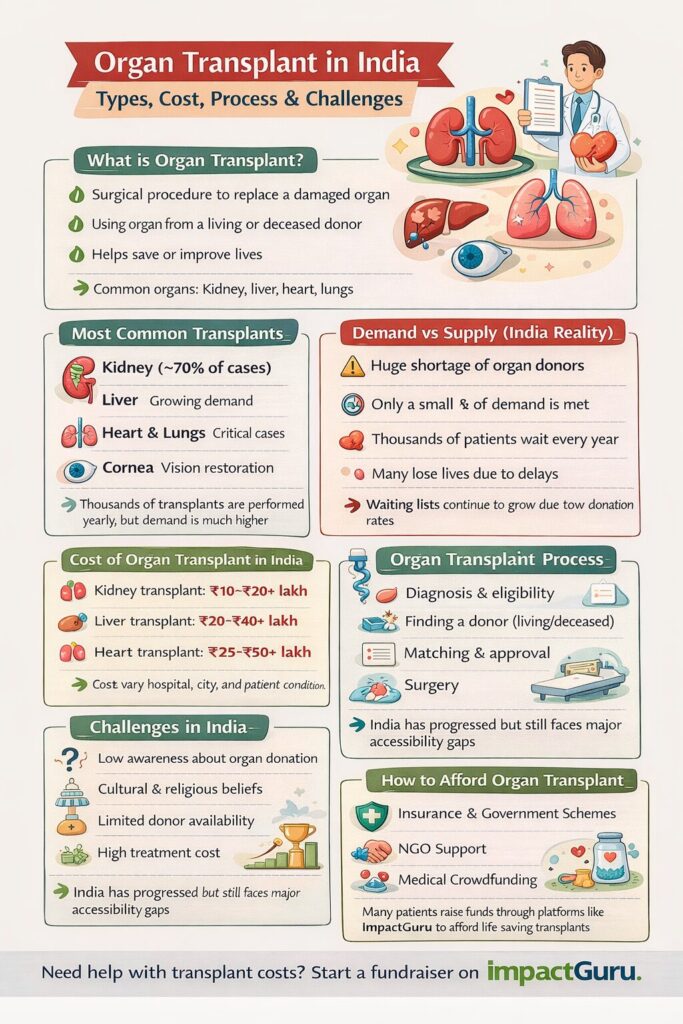
What Is an Organ Transplant and Why Is It Needed?
Quick Answer: An organ transplant is a surgical procedure that replaces a failing organ with a healthy one from a donor. It is recommended when no other treatment can restore adequate organ function.
An organ transplant is recommended when an organ has deteriorated to the point where no other treatment, medication, dialysis, surgery, or lifestyle changes can restore adequate function.
When Is a Transplant Needed?
Transplants become necessary in conditions such as:
- End-stage kidney disease (ESRD) – when the kidneys can no longer filter waste adequately
- Liver failure caused by cirrhosis, hepatitis, or acute liver damage
- Advanced heart failure that has not responded to medication or other interventions
- Severe lung disease, such as idiopathic pulmonary fibrosis (IPF) or COPD, in advanced stages
For many patients, transplantation is not just a treatment option; it is the only one.
Where Do Donor Organs Come From?
Donor organs come from two sources:
- living donors, typically a family member donating a kidney or part of their liver
- and deceased donors, the individuals who have consented to organ donation after death.
Both pathways are legally recognised and actively supported under India’s national organ sharing network, managed by the National Organ and Tissue Transplant Organisation (NOTTO) under the Ministry of Health and Family Welfare.
Which Organs Can Be Transplanted in India?
Quick Answer: India performs kidney, liver, heart, and lung transplants widely. Kidney transplants are the most common. Pancreas and intestinal transplants are rare. Cornea transplants are widely accessible and managed separately.
India performs transplants across a range of vital organs, with kidney and liver transplants being the most common. Each transplant type has its own eligibility criteria, waiting list dynamics, and recovery profile.
Kidney Transplant
Kidney transplant is the most frequently performed organ transplant in India. It is recommended for patients with end-stage renal disease (ESRD) who are on dialysis or approaching the need for it. Both living and deceased donor transplants are performed. Living donor kidney transplants generally offer shorter waiting times and stronger outcomes, making early identification of a suitable donor important.
Read More : Kidney Transplant in India — for a detailed guide on costs, eligibility, procedure, and hospitals.
Liver Transplant
India has developed particular strength in living donor liver transplantation (LDLT), where a healthy person donates a portion of their liver to the recipient. The liver’s remarkable ability to regenerate means both donor and recipient livers grow back to near-full size within months. Liver transplants are recommended for patients with cirrhosis, acute liver failure, or certain liver cancers where the disease has not spread beyond the liver.
Read More : on Liver Transplant in India, for the complete guide on donor criteria, LDLT, costs, and hospitals.
Heart Transplant
Heart transplants are performed for patients with end-stage heart failure who have not responded to other treatments, including medication and surgical interventions. Unlike kidney or liver transplants, hearts can only come from deceased donors, making donor availability the primary challenge. Patients are prioritised on the waiting list based on medical urgency, and those classified as high urgency may receive organs significantly faster than those on standard wait.
Read More : on Heart Transplant in India for costs, success rates, and leading hospitals.
Lung Transplant
Lung transplants are the least common transplant type in India, available at a limited number of highly specialised centres. They are recommended for patients with advanced-stage conditions such as idiopathic pulmonary fibrosis (IPF), chronic obstructive pulmonary disease (COPD), or pulmonary hypertension, where all other treatment options have been exhausted. Single and bilateral (double) lung transplants are both performed, with bilateral transplants carrying a higher cost and greater surgical complexity.
Read More : on Lung Transplant in India for centre locations, costs, and patient outcomes.
Other Transplants
Pancreas and intestinal transplants are rare in India and performed only at a handful of highly specialised centres, typically alongside kidney or liver transplants for patients with complex conditions. Cornea transplants are far more accessible, performed widely across the country, managed through separate eye banking networks, and have significantly shorter waiting periods than solid organ transplants.
Types of Organ Donation in India
Quick Answer: In India, organs can be donated through three pathways: after brain death (most common), through living donation (kidney or partial liver), or after cardiac death (emerging practice at select centres). A single brain-dead donor can save up to 8 lives.
Organ donation is the starting point of every transplant, and understanding the different ways donation can happen helps both patients and families make informed decisions. In India, there are three recognised pathways for organ donation, each with its own medical and legal framework.
Deceased Donation After Brain Death
The most common form of organ donation in India occurs after brain death, a condition where all brain activity has permanently and irreversibly ceased, even though the heart may continue beating with medical support. Brain death is legally recognised as death under the Transplantation of Human Organs and Tissues Act (THOA), 2011,and follows a strict certification protocol.
Living Donation
Living donation allows a healthy person to donate an organ, or part of one, to a patient in need, without waiting for a deceased donor. In India, two forms of living donation are widely practised:
- Kidney donation: A living donor can safely donate one kidney, with the remaining kidney continuing to function adequately for a normal life
- Partial liver donation: A portion of the liver, typically the right lobe, is donated to the recipient; both the donor’s and recipient’s livers regenerate over time.
Living donors must be
- Above 18 years of age
- Meet strict medical and psychological criteria, and qualify under the near-relative or Authorisation Committee provisions of THOA 2011.
Living donor transplants typically have shorter waiting times and stronger long-term outcomes than deceased donor transplants.
Donation After Cardiac Death
Donation after cardiac death (DCD), where organs are retrieved after the heart has stopped, rather than after brain death, is an emerging practice in India. It is currently limited to a small number of specialised centres but represents a growing pathway for expanding the donor pool and reducing waiting times for patients on the national list.
Quick Link : Check our Disease Cost Calculator
Eligibility for Organ Transplant in India
Quick Answer: Eligibility is determined through medical, psychological, and social evaluation. There is no fixed age limit. Living donors must be above 18, be a near relative, and provide voluntary consent under THOA 2011.
Not every patient with organ failure is automatically a transplant candidate. Before being listed on the national waiting list, every patient goes through a thorough evaluation process to determine whether they are medically, psychologically, and socially ready for transplantation. India’s transplant eligibility framework is governed by the Transplantation of Human Organs and Tissues Act (THOA), 2011.
Medical Eligibility
The primary criterion is medical necessity; the organ must have failed to a degree where transplantation is the only viable treatment. Beyond that, the patient must be healthy enough to survive major surgery and the lifelong immunosuppressant therapy that follows. Doctors evaluate heart function, lung capacity, kidney health (for non-kidney transplants), and the absence of active infections or untreated cancers.
There is no absolute age cut-off for organ transplants in India. Patients are assessed individually; children, adults, and elderly patients have all undergone successful transplants. However, older patients with multiple comorbidities may face a more rigorous evaluation before being listed.
Psychological and Social Assessment
Transplant centres conduct psychological evaluations to assess a patient’s understanding of the procedure, their commitment to post-operative care, and their support system at home. A strong caregiver network significantly improves recovery outcomes and is an important part of the overall transplant assessment, not a formality.
Living Donor Eligibility
If a living donor is involved, they undergo an equally thorough evaluation. Under THOA 2011, living donors must be above 18 years of age, be a near relative (as legally defined, including spouse, parent, sibling, child, grandparent, or grandchild), and demonstrate full informed consent without any commercial motive. Compatibility testing, blood group, tissue typing, and cross-match- is conducted before approval. Non-related donors require additional approval from a state-level Authorisation Committee.
How to Apply for an Organ Transplant in India
Quick Answer: The process begins with a specialist referral, followed by transplant centre evaluation, hospital committee approval, and NOTTO registration. Living donors bypass the waiting list entirely. Speed matters most for heart and lung transplants.
The transplant process in India follows a structured pathway, from your first specialist consultation to the surgery itself. While each hospital and organ type has its specific protocols, the broad journey looks like this:
- Specialist Referral – Your treating physician (nephrologist, hepatologist, cardiologist, or pulmonologist) determines that transplantation is the appropriate course of treatment and refers you to a recognised transplant centre.
- Transplant Centre Evaluation – The transplant team conducts a comprehensive medical, psychological, and social workup.
- Hospital Authorisation Committee Approval – Every transplant centre has a government-mandated Authorisation Committee that reviews and approves transplant cases, particularly for living donor transplants. This committee verifies the donor-recipient relationship and confirms no commercial exchange is involved.
- NOTTO / ROTTO Registration – Once cleared, the patient is registered on the national waiting list through NOTTO (national level), ROTTO (regional level), or SOTTO (state level), depending on the organ and location.
- Waiting and Monitoring – Patients remain under regular medical supervision while waiting. Their position on the list can change based on medical urgency. Living donor candidates bypass this wait entirely.
- Transplant Call and Surgery – When a suitable organ becomes available, the transplant team contacts the patient immediately. Speed is critical, particularly for heart and lung transplants where organ viability windows are narrow.
- Post-Operative Care – Recovery begins in the ICU and continues through hospitalisation and then at home. Long-term follow-up and lifelong medication are part of every transplant journey.
Read more about Organ Transplant Waiting List in India – for a deeper understanding of the waiting list process and how organs are allocated.
Documents Required for Organ Transplant in India
Quick Answer: Key documents include medical records, identity proof, relationship proof for living donors, hospital committee approval, and NOTTO registration confirmation. The NOTTO portal (notto.abdm.gov.in) is the authoritative source for updated requirements.
Preparing your documentation early can prevent delays in the authorisation and registration process. While exact requirements vary by hospital and organ type, the following are typically required across all transplant cases:
Medical Documents
- Complete medical history and diagnosis reports
- Recent investigation reports (blood tests, imaging, biopsy, where applicable)
- Treating physician’s referral letter confirming transplant necessity
Identity and Address Proof
- Aadhaar card, passport, or voter ID for both patient and donor
- Recent address proof, such as a utility bill or bank statement
Relationship Proof – Living Donor Cases
- Birth certificates,
- Marriage certificates
- Or other legal documents establishing the donor-recipient relationship as defined under THOA 2011
Hospital and Regulatory Documents
- Authorisation Committee approval letter
- NOTTO / ROTTO / SOTTO registration confirmation
- Donor consent forms (living donor cases)
- Declaration forms as required by the transplant centre
Financial Documents – Where Applicable
- Insurance pre-authorisation letters
- Hospital estimate letters, required for medical loans or crowdfunding campaigns
The National Organ and Tissue Transplant Organisation (NOTTO), under the Ministry of Health and Family Welfare, is the official body overseeing all transplant registrations and organ allocations in India. Their portal (notto.abdm.gov.in) is the authoritative source for updated documentation requirements.
How Long Is the Waiting List for Organ Transplant in India?
Quick Answer: Kidney wait times can be 1–5+ years. Liver waits vary; living donors bypass the list entirely. Heart and lung allocations are driven by urgency. NOTTO manages the national list through ROTTO and SOTTO networks across India.
The waiting list for organ transplants in India is managed through a three-tier network overseen by NOTTO:
- NOTTO – National Organ and Tissue Transplant Organisation (apex body, national level)
- ROTTO – Regional Organ and Tissue Transplant Organisations (6 regional hubs across India)
- SOTTO – State Organ and Tissue Transplant Organisations (state-level coordinators)
When a deceased donor organ becomes available, NOTTO’s allocation system matches it to the most suitable registered recipient based on blood group compatibility, body size, geographic proximity (to minimise organ transit time), time on the waiting list, and medical urgency.
Typical Waiting Times by Organ
- Kidney: Longest wait – can range from 1 to 5+ years in many states. Living donor transplants bypass this entirely.
- Liver: Varies widely. Cadaveric wait can be months to years; living donor liver transplants, which India performs with particular expertise, significantly reduce this.
- Heart: Months to years, but urgency status can accelerate allocation dramatically. High-priority patients are prioritised by the system.
- Lung: Highly variable; limited further by the small number of active lung transplant centres in India.
The Living Donor Advantage
For kidney and liver transplants, a compatible living donor effectively removes the waiting list from the equation. This is one of the most important decisions a transplant family can make early in the process, identifying a willing, eligible living donor can save months or years of waiting and significantly improve long-term outcomes.
Waiting is emotionally one of the hardest parts of the transplant journey. Staying in regular contact with your transplant coordinator, maintaining your health during the wait, and ensuring your contact details are always updated with your transplant centre are the most important practical steps you can take.
Best Hospitals for Organ Transplant in India
Quick Answer: India’s leading transplant centres include AIIMS Delhi, Apollo Hospitals, Medanta, Fortis, CMC Vellore, Global Hospitals, Kokilaben, and PGIMER Chandigarh. Mumbai, Delhi-NCR, Chennai, and Hyderabad are the primary transplant hubs.
Choosing the right transplant centre is one of the most consequential decisions a patient and family will make. The quality of surgical expertise, post-operative care, and long-term follow-up support varies significantly across institutions – and it directly affects outcomes.
What Defines a Top Transplant Centre
A high-quality transplant centre is characterised by several factors beyond surgical skill: a dedicated multidisciplinary team (surgeons, transplant coordinators, intensivists, nutritionists, and psychologists), a high-volume transplant programme (volume correlates strongly with better outcomes), accredited ICU infrastructure, a robust organ procurement network, and structured long-term follow-up protocols.
Some of India’s Well-Known Transplant Centres
The following institutions are among the most recognised for organ transplantation in India. This is not a ranking – each centre has particular strengths by organ type and geography:
- AIIMS, New Delhi – India’s premier public sector transplant centre; strong across kidney, liver, and heart
- Apollo Hospitals (Chennai, Delhi, Hyderabad) – high-volume private centre with comprehensive multi-organ programmes
- Medanta – The Medicity, Gurugram, is known particularly for liver and heart transplantation
- Fortis Memorial Research Institute, Gurugram – active kidney and liver transplant programme
- Christian Medical College (CMC), Vellore – one of India’s oldest and most respected transplant programmes
- Global Hospitals, Chennai and Mumbai – strong liver transplant volume, particularly LDLT
- Kokilaben Dhirubhai Ambani Hospital, Mumbai – comprehensive transplant programme with modern infrastructure
- PGIMER, Chandigarh – leading public sector centre in North India
India’s primary transplant hubs are Mumbai, Delhi-NCR, Chennai, and Hyderabad, where donor networks, surgical expertise, and post-operative support infrastructure are most developed. Patients in other cities often travel to these centres for transplantation.
If you have been evaluated at one centre, seeking a second opinion at another is always a reasonable and encouraged step, particularly for complex cases.
Read more on Best Hospitals for Organ Transplant in India, for detailed profiles by organ type, accreditation status, volume data, and how to get a consultation.
Organ Transplant Success Rate in India by Organ Type
Quick Answer: At India’s leading centres, approximate 1-year survival rates are 90–95% for kidney, 85–90% for liver, 80–85% for heart, and 70–80% for lung transplants, comparable to international benchmarks.
One of the first questions patients and families ask is: What are the chances of this working? The honest answer is that outcomes at India’s leading transplant centres are genuinely comparable to international benchmarks, and they continue to improve every year.
Understanding Success Rates
Transplant success is typically measured as patient survival rate and graft survival rate (how long the transplanted organ continues to function) at 1 year, 3 years, and 5 years post-surgery. These figures vary by organ, patient age, underlying condition, transplant centre volume, and adherence to post-operative care.
Approximate 1-year survival rates at leading Indian centres:
| Organ | Approximate 1-year survival rates | Key Note |
| Kidney | 90% – 95% | Living donor outcomes at the higher end |
| Liver | 85% – 90% | India’s LDLT outcomes especially strong |
| Heart | 80% – 85% | Influenced by pre-transplant condition |
| Lung | 70% – 80% | Most demanding post-operative management |
What Influences Your Outcome
Several factors beyond the surgery itself determine long-term success: the quality of donor-recipient matching, the experience and volume of the transplant centre, how well the patient manages their immunosuppressant medication, and the quality of follow-up care over the months and years after transplantation.
Patients who adhere strictly to their medication schedule, attend all follow-up appointments, and report complications early consistently show better long-term outcomes. The transplant surgery is the beginning of the journey, not the end.
Read more on Liver Transplant Success Rates in India.
Risks and Complications of Organ Transplant
Quick Answer: Key risks include organ rejection (acute and chronic), infection due to immunosuppressant medications, and long-term medication side effects. Most complications are manageable when detected early through regular monitoring.
Every major surgery carries risk, and organ transplantation, because of its complexity and the lifelong medical management it requires, carries a specific set of risks that every patient and family should understand clearly before proceeding. Being informed does not mean being afraid. It means being prepared.
Rejection – Acute and Chronic
Rejection occurs when the recipient’s immune system recognises the transplanted organ as foreign and attempts to attack it. Acute rejection can occur in the days or weeks following surgery and is managed with adjusted immunosuppressant medication, it is detectable early and treatable in most cases. Chronic rejection develops gradually over months or years and is a leading cause of long-term graft loss. Regular monitoring through blood tests and biopsies allows the transplant team to detect changes early and intervene effectively.
Infection Risk
Immunosuppressant medications, which are essential to prevent rejection, simultaneously reduce the body’s ability to fight infections. Transplant recipients are at higher risk for bacterial, viral, and fungal infections, particularly in the first year post-transplant. Preventive medications, careful hygiene protocols, and avoiding exposure to known infection sources are standard post-transplant precautions that become part of everyday life.
Medication Side Effects
Lifelong immunosuppressant therapy can carry side effects, including elevated blood pressure, increased blood sugar levels, kidney strain (in non-kidney transplant recipients), bone density loss, and a modestly elevated risk of certain cancers over the long term. These risks are actively managed through regular monitoring and medication adjustments, they are known, anticipated, and addressed by the transplant team throughout follow-up care.
Other Complications
Each organ transplant carries organ-specific risks, for example, biliary complications in liver transplants or primary graft dysfunction in lung transplants. Surgical complications such as bleeding, clotting, or vascular issues can occur in the immediate post-operative period. These are rare at high-volume centres but require prompt reporting when they do arise.
Knowing what to watch for, and reporting symptoms promptly to your transplant team, is the single most important thing a patient can do to protect their transplanted organ.
Organ Transplant Recovery Time – What to Expect
Quick Answer: Hospital recovery ranges from 2 weeks (kidney) to over a month (heart/lung). The first 3 months at home are the most critical. Most patients see significant quality-of-life improvement within 6 months. Lifelong medication and monitoring are part of the journey.
Recovery from an organ transplant is not a single event; it is a process that unfolds over months and, in many ways, continues for the rest of the patient’s life. Understanding what to expect at each stage helps patients and caregivers plan realistically and avoid unnecessary anxiety.
In-Hospital Recovery
The immediate post-operative period is spent in the ICU, where the transplant team monitors organ function, manages pain, and watches closely for early signs of rejection or complications. Typical ICU stays range from 2–5 days for kidney transplants to 7–14 days for more complex procedures like heart or lung transplants. The total hospital stay, including ward recovery, generally ranges from 2 weeks to over a month, depending on the organ and the patient’s progress.
Recovery at Home – Weeks 1 to 12
The first three months after returning home are the most critical. Activity is restricted, dietary changes are introduced, and the immunosuppressant medication regimen, which will continue for life, is carefully calibrated. Patients attend frequent outpatient follow-ups during this period, sometimes weekly. Fatigue is normal and expected; the body is adjusting to a new organ and a new medication baseline.
Long-Term Recovery – 6 Months and Beyond
Most patients see a significant improvement in quality of life within 6 months of transplantation. Many return to work, resume social activities, and report feeling better than they have in years. However, long-term recovery is not the absence of medical care; it is the integration of medical care into a new normal. Lifelong immunosuppressant medication, regular blood tests, annual reviews, and prompt reporting of any changes remain part of every transplant recipient’s life.
Emotional Recovery
The emotional dimension of transplant recovery is frequently underestimated. Patients may experience anxiety about rejection, grief over the difficulty of the journey, or, in the case of deceased donor transplants, complex feelings about the donor and their family. Caregivers often experience their own form of fatigue and stress. Counselling, peer support groups, and open communication with the transplant team are all valuable resources that patients should actively use, not treat as a last resort.
Understanding Organ Transplant Cost in India
Quick Answer: Costs range from ₹5–15 lakh (kidney) to ₹20–28 lakh (heart). Total cost includes surgery, ICU, lifelong immunosuppressants, and follow-up. Government hospitals can be 40–60% cheaper. PM-JAY covers eligible patients at empanelled hospitals.
Transplant costs vary significantly depending on the organ being transplanted, the type of donor (living or deceased), the hospital tier (government, trust, or private), the city, and the complexity of the individual case.
What is consistent across all transplant types is that the financial commitment is substantial, and it does not end with the surgery. The total cost of transplantation includes the pre-transplant evaluation, the surgery itself, ICU and hospitalisation, immunosuppressant medications (which are taken lifelong), and long-term follow-up care. Families who plan only for the surgery often find themselves unprepared for what comes after.
Approximate Cost Ranges at Private Hospitals
These are indicative ranges based on general market data. Actual costs at your chosen centre may differ:
| Organ | Approximate Cost Ranges at Private Hospitals | Donor Type |
| Kidney Transplant | ₹5 lakh – ₹15 lakh | Living or Deceased |
| Liver Transplant | ₹14 lakh – ₹30 lakh | Living or Deceased |
| Heart Transplant | ₹20 lakh – ₹28 lakh | Deceased Only |
| Lung Transplant | ₹13 lakh – ₹27 lakh | Deceased Only |
Government hospitals and charitable trust hospitals may offer significantly subsidised rates, sometimes 40–60% lower than private hospital costs, though waiting times and availability may differ.
Insurance Coverage
Health insurance coverage for organ transplants is growing in India, but it is still far from comprehensive. Most policies cover the surgical procedure but exclude the cost of immunosuppressant medications, pre-transplant evaluation, and long-term follow-up, which together can equal or exceed the surgical cost over time. Patients covered under PM-JAY (Ayushman Bharat) may be eligible for transplant coverage at empanelled hospitals — verifying your eligibility early is strongly recommended.
Organ Transplant Cost in India with Financial Help
Quick Answer: Financial support may be available through government schemes, hospital assistance, NGOs, medical loans, and medical crowdfunding.
Understanding the cost of an organ transplant is one part of the journey, managing it is often the bigger challenge. For many families in India, the gap between available funds and actual transplant costs can be significant.
Several financial support options can help bridge this gap:
Government Schemes
PM-JAY (Pradhan Mantri Jan Arogya Yojana) — Ayushman Bharat covers organ transplant procedures for eligible beneficiaries at empanelled hospitals. Coverage limits and eligible procedures vary — check your state’s health authority portal for current details.
Several state governments also run their own health assistance schemes. Tamil Nadu’s Chief Minister’s Comprehensive Health Insurance Scheme, Andhra Pradesh’s Dr. YSR Aarogyasri, and Rajasthan’s Mukhyamantri Chiranjeevi Yojana are among those that have covered transplant procedures for qualifying patients.
Hospital Payment Plans
Many major transplant centres offer structured payment plans or have tie-ups with financial institutions for medical loans. Speaking directly with the hospital’s patient services or financial counselling team early in the process can open options that are not always publicly advertised.
NGO and Charitable Trust Support
Several NGOs and charitable trusts in India provide financial assistance to transplant patients from economically weaker sections. Your transplant coordinator is usually the best first point of contact for identifying relevant organisations in your state.
Medical Loans
Medical loans from banks and NBFCs offer quick access to funds, sometimes within 24–48 hours of application. They are useful for bridging immediate payment gaps. However, they carry interest rates typically ranging from 10–18% per annum and must be repaid regardless of treatment outcome. For families already under financial stress, taking on debt for a long-duration treatment can compound difficulties over time.
Crowdfunding
Medical crowdfunding has emerged as one of the most widely used financial tools for transplant patients in India. Unlike loans, funds raised through crowdfunding do not need to be repaid, carry no interest burden, and can be mobilised quickly through a patient’s personal network, family, friends, colleagues, and community. Thousands of transplant patients across India have successfully funded their surgeries through online fundraising campaigns.
For a side-by-side comparison of medical loans and crowdfunding — including which option suits which situation — read our Medical Loans vs Crowdfunding for Transplant guide.
How to Raise Funds for Organ Transplant in India
For many families, fundraising becomes necessary once the full cost of transplant and long-term care is understood. Medical crowdfunding allows patients to raise contributions from family, friends, and the wider community without financial repayment obligations.
The process generally involves creating an online campaign, uploading medical documents for verification, and sharing the fundraiser across personal networks such as WhatsApp and social media.
For a step-by-step guide, including tips on writing campaigns and maximising reach, read How to Raise Funds for Organ Transplant in India.
Best Crowdfunding Platform for Organ Transplant Patients in India
Quick Answer: Choose a platform that offers medical verification, transparent fund management, dedicated support, and quick fund withdrawal.
Not all crowdfunding platforms are designed for medical needs, and choosing the right one can make a meaningful difference during a time-sensitive situation like an organ transplant.
What to Look For in a Platform
- Medical document verification
- Transparent fund handling
- Dedicated campaign support
- Quick and flexible fund withdrawal
- Experience with healthcare fundraising
Several platforms in India support medical crowdfunding. Platforms like ImpactGuru are widely used by transplant patients due to their focus on healthcare fundraising and support services.
To compare platforms and understand which one may suit your needs, read Best Crowdfunding Platform for Organ Transplant Patients.
Organ Donation in India – How You Can Help Save Lives
Quick Answer: You can register as an organ donor online through the NOTTO portal and inform your family of your decision. One donor can save up to 8 lives.
Every successful organ transplant begins with an act of generosity, a donor, or a donor’s family, choosing to give life to others during an incredibly difficult moment. Despite growing awareness, India continues to face a significant gap between the number of patients waiting for transplants and the number of available donors.
This gap directly impacts survival rates, especially for patients dependent on deceased donor organs such as the heart and lungs. Increasing organ donation rates remains one of the most critical needs in India’s transplant ecosystem.
How to Register as an Organ Donor in India
Registering as an organ donor is simple and can be done in a few steps:
- Sign up on the official NOTTO portal
- Receive a donor card
- Most importantly, inform your family about your decision
While registration is important, family consent at the time of donation plays a decisive role, which makes open conversations essential.
Living Donation (Giving While You Are Alive)
In addition to deceased donation, living donation allows individuals to donate a kidney or part of their liver to a family member in need.
Donors undergo detailed medical and psychological evaluations to ensure safety, and in many cases, living donor transplants lead to better outcomes due to shorter waiting times.
Common Myths About Organ Donation
- “Doctors won’t try as hard to save me if I’m a donor.”
This is false. The medical team treating you is completely separate from the transplant team. - “My religion does not allow organ donation.”
All major religions in India support organ donation as an act of compassion and service. - “I am too old to donate.”
There is no fixed age limit. Suitability is based on medical condition, not age alone.
One donor can save up to 8 lives, making organ donation one of the most powerful ways to help others.
Conclusion
An organ transplant is one of the most significant medical journeys a person and their family can face. It involves careful preparation, difficult decisions, and a long-term commitment to post-operative care. But it is also a journey that thousands of families in India navigate successfully every year, with the right information, the right medical team, and the right support system in place.
Understanding your options early makes a meaningful difference. Knowing which organ needs to be transplanted, whether a living donor is possible, which centre is best suited to your case, and how to plan for the full cost of treatment, including what comes after surgery, gives you a clearer path forward at a time when clarity matters most.
India’s transplant infrastructure, its hospitals, its surgeons, and its national organ allocation network continues to grow stronger. And for families navigating the financial side of this journey, multiple support pathways exist, from government schemes and hospital assistance to community fundraising. The most important step is to start the conversation early, with your medical team, with your family, and with the support systems available to you.
FAQs
An organ transplant is a surgical procedure where a damaged or failing organ is replaced with a healthy organ from a living or deceased donor to restore normal body function.
Commonly transplanted organs in India include the kidney, liver, heart, lungs, pancreas, and cornea. Kidney transplants are the most common.
The cost varies by organ and hospital. Kidney transplants cost around ₹10–₹20 lakh, liver transplants ₹20–₹40 lakh, and heart transplants ₹25–₹50 lakh or more.
The process includes diagnosis, finding a donor, compatibility testing, legal approvals, surgery, and long-term post-transplant care with medications.
Patients can manage costs through insurance, government schemes, NGO support, and medical crowdfunding platforms like ImpactGuru, which help raise funds for life-saving treatments.