

Medical & financial disclaimer: The figures in this article are indicative price ranges compiled from hospital billing patterns and public healthcare data. Actual costs depend on your specific diagnosis, hospital, and city. Always get a written cost estimate from your treating oncologist and hospital billing desk before planning finances.
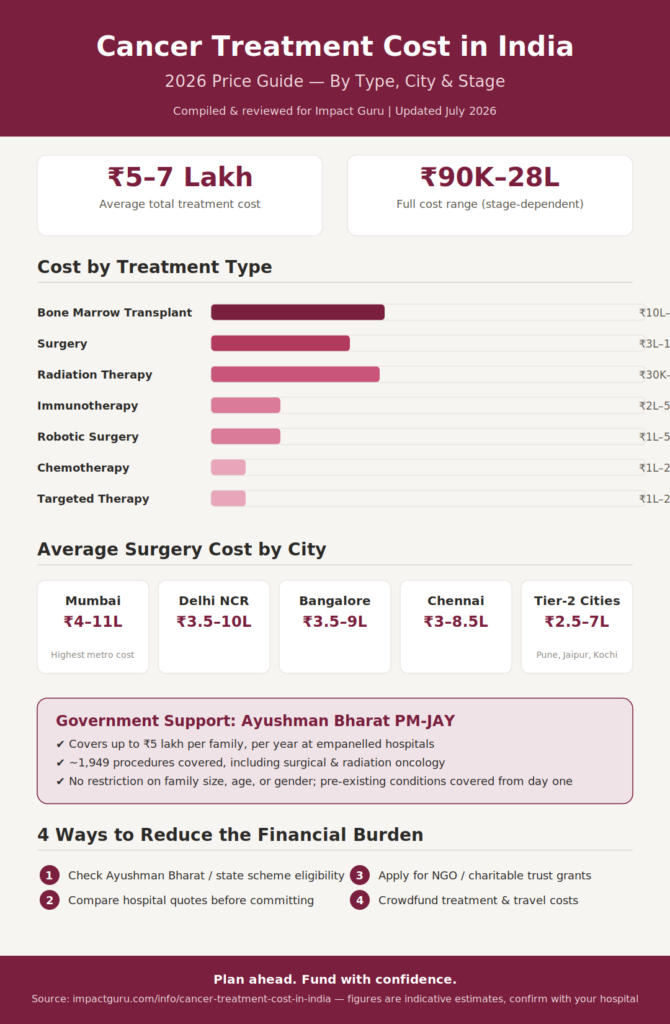
Cancer treatment in India typically costs between ₹90,000 and ₹28 lakh, with an average of around ₹5–7 lakh for a full course of treatment. The exact cost depends on the cancer type and stage, the treatment plan (surgery, chemotherapy, radiation, immunotherapy, or a combination), the hospital (private vs. government), and the city. Government schemes like Ayushman Bharat PM-JAY cover up to ₹5 lakh per family per year for eligible patients at empanelled hospitals, which can offset a significant portion of this cost.
Table of Contents
- Quick Summary
- Introduction
- Cost of Cancer Treatment by Type
- Factors That Affect Cancer Treatment Cost in India
- City-Wise Cost Comparison
- Cost Breakdown by Treatment Type
- Does Insurance or Ayushman Bharat Cover Cancer Treatment?
- Pre-Treatment Expenses
- Post-Treatment Expenses
- How to Reduce the Cost of Cancer Treatment
- Conclusion
- FAQs
Quick Summary
- Average total cost: ₹5–7 lakh; range: ₹90,000–₹28 lakh
- Surgery: ₹3–11 lakh | Chemotherapy: ₹1–2 lakh | Radiation: ₹30,000–₹10 lakh
- Bone marrow transplant is the costliest single procedure: ₹10–25 lakh
- Private hospitals in metro cities (Mumbai, Delhi, Bangalore, Chennai) cost 30–60% more than tier-2 cities or government hospitals
- Ayushman Bharat PM-JAY covers cancer surgery, chemotherapy, and radiation up to ₹5 lakh/family/year for eligible households at empanelled hospitals
- Crowdfunding, NGO grants, and hospital discount schemes can close the remaining funding gap
Introduction
A cancer diagnosis brings enough uncertainty on its own — and for most Indian families, the cancer treatment cost in India is one of the first and biggest questions that follows. Whether you’re planning for a parent’s chemotherapy, a family member’s surgery, or a full multi-modality treatment plan, understanding the cancer treatment cost in India upfront can make the difference between scrambling for funds mid-treatment and having a clear financial plan in place from day one.
The cancer treatment cost in India varies widely — anywhere from ₹90,000 for early-stage, single-modality care to over ₹28 lakh for advanced, multi-modality treatment involving surgery, chemotherapy, radiation, or a bone marrow transplant. On average, most patients and families can expect to spend around ₹5–7 lakh for a full course of treatment, though the final number depends heavily on the type and stage of cancer, the hospital you choose, the city you’re treated in, and whether you have insurance or government scheme coverage.
This guide breaks down the cancer treatment cost in India by treatment type, city, and stage — along with what insurance, Ayushman Bharat, and other support options can cover — so you can plan with real numbers instead of guesswork.
Cost of Cancer Treatment by Type
| Treatment Type | Cost Range (₹) | Typical Duration |
|---|---|---|
| Surgery | 3 lakh – 11 lakh | 1 procedure + hospital stay |
| Chemotherapy (full course) | 1 lakh – 2 lakh | 4–8 cycles over 3–6 months |
| Radiation Therapy | 30,000 – 10 lakh | 15–35 sessions |
| Targeted Therapy | 1 lakh – 2 lakh | Ongoing, per treatment cycle |
| Immunotherapy | 2 lakh – 5 lakh | Ongoing, per treatment cycle |
| Robotic Surgery | 1 lakh – 5 lakh | 1 procedure + recovery |
| Bone Marrow Transplant | 10 lakh – 25 lakh | 4–6 week hospital stay |
Factors That Affect Cancer Treatment Cost in India
Several variables shift the total bill up or down:
- Type and stage of cancer — Stage 1 or 2 cancers generally cost less to treat than Stage 3 or 4, which often need combination therapy (surgery + chemo + radiation).
- Type of treatment — Chemotherapy is usually cheaper per cycle than surgery, but a long chemo course can add up to more than a single surgery.
- Hospital type — Private hospitals in metro cities charge considerably more than government hospitals, regional cancer centres, or charitable institutions.
- City/location — Treatment in Mumbai, Delhi, Bangalore, or Chennai typically costs more than tier-2 cities due to higher overheads and specialist fees.
- Insurance and scheme coverage — Health insurance or government schemes like Ayushman Bharat can absorb a large share of the cost for eligible patients.
- Drug availability and brand — Generic drugs cost far less than patented/imported ones; some advanced immunotherapy drugs still need to be imported, which raises cost.
- Number of treatment cycles/sessions — More cycles of chemo or more radiation sessions directly increase the bill.
City-Wise Cost Comparison
| City | Avg. Surgery Cost | Avg. Chemotherapy (per cycle) | Avg. Radiation (full course) |
|---|---|---|---|
| Mumbai | ₹4–11 lakh | ₹25,000–50,000 | ₹1.5–8 lakh |
| Delhi NCR | ₹3.5–10 lakh | ₹20,000–45,000 | ₹1.5–7 lakh |
| Bangalore | ₹3.5–9 lakh | ₹20,000–40,000 | ₹1.2–6.5 lakh |
| Chennai | ₹3–8.5 lakh | ₹18,000–40,000 | ₹1–6 lakh |
| Tier-2 cities (e.g., Pune, Jaipur, Kochi) | ₹2.5–7 lakh | ₹15,000–35,000 | ₹80,000–5 lakh |
Cost Breakdown by Treatment Type
1. Surgery Surgery removes the tumor and, where needed, surrounding affected tissue. Cost depends on cancer type, surgical complexity, and hospital stay length. Range: ₹3–11 lakh.
2. Chemotherapy Chemotherapy uses drugs to kill or slow cancer cells, usually given in cycles alongside other treatments. Cost depends on the drug regimen and number of cycles. Range: ₹1–2 lakh for a full course.
3. Radiation Therapy High-energy radiation targets and shrinks tumors. Cost depends on the radiation technology used (conventional vs. IMRT/IGRT/proton therapy) and number of sessions. Range: ₹30,000–₹10 lakh.
4. Immunotherapy Immunotherapy drugs help the immune system fight cancer cells directly and are often used for cancers that don’t respond well to conventional treatment. Range: ₹2–5 lakh per treatment cycle.
5. Targeted Therapy These drugs target specific genetic mutations in cancer cells rather than all fast-dividing cells, often with fewer side effects than chemotherapy. Range: ₹1–2 lakh per cycle.
6. Robotic Surgery A minimally invasive option used for procedures like prostatectomy, nephrectomy, and gastrectomy, offering more precision and faster recovery than open surgery. Range: ₹1–5 lakh.
7. Bone Marrow Transplant (BMT) Used for blood cancers like leukemia, lymphoma, and multiple myeloma. This is the most expensive standard cancer procedure due to the extended hospital stay, donor matching, and post-transplant care. Range: ₹10–25 lakh.

Does Insurance or Ayushman Bharat Cover Cancer Treatment?
Yes — this is one of the biggest ways families reduce out-of-pocket cost:
- Ayushman Bharat PM-JAY, the Indian government’s flagship health insurance scheme, provides a cover of about ₹5 lakh per family per year for treatment at empanelled hospitals, with no restriction on family size, age, or gender, and pre-existing conditions covered from day one. The scheme covers roughly 1,949 procedures across specialties including medical oncology, radiation oncology, and surgical oncology.
- Coverage for cancer specifically is among the most-used categories under the scheme, given how catastrophic oncology costs can be for lower-income families, with patients eligible for up to ₹5 lakh per year and some states offering additional support for high-cost cases.
- Some state-level top-up schemes (e.g., MJPJAY in Maharashtra) extend additional coverage beyond the central scheme for specific patient categories.
- Private health insurance typically covers hospitalization, surgery, and chemotherapy per your policy’s sum insured, sub-limits, and waiting period for pre-existing illness — always check your policy’s oncology-specific exclusions before treatment.
- If you don’t have insurance or PM-JAY eligibility, crowdfunding, hospital charity funds, and NGO grants (covered below) can help close the gap.
Note: PM-JAY eligibility is based on the Socio-Economic and Caste Census (SECC) database — check eligibility at pmjay.gov.in or by calling the Ayushman Bharat helpline 14555.
Pre-Treatment Expenses
Before treatment begins, patients typically incur:
| Expense | Cost Range (₹) |
|---|---|
| Diagnostic tests (CT, MRI, PET scan, biopsy, blood work) | 500 – 25,000 per test |
| Pre-treatment medications | 100 – 10,000 |
| Specialist consultation fees | 500 – 5,000 per visit |
| Travel, lodging, and meals | Varies by city and duration |
These costs are often underestimated but can add up to a significant sum before the core treatment even starts — particularly for patients traveling from smaller towns to metro hospitals for specialist opinions.
Post-Treatment Expenses
After the primary treatment, ongoing costs include:
- Hospital bills for the treatment stay itself (room charges, nursing, doctor’s fees)
- Medication costs, which vary by drug type, dosage, and pharmacy
- Follow-up visits to monitor recovery and check for recurrence
- Laboratory tests for ongoing monitoring
- Supportive care — physiotherapy, occupational therapy, home nursing, and medical equipment where needed
Keeping a running log of these costs helps families plan more accurately than budgeting for the “main treatment” alone.
Read More : How Do I Raise Funds for Cancer Treatment in India?
How to Reduce the Cost of Cancer Treatment
- Compare hospitals and treatment plans before committing — costs for the same procedure can vary by lakhs between hospitals in the same city.
- Ask hospitals directly about discount or subsidy schemes for eligible patients.
- Check Ayushman Bharat and state scheme eligibility even if you assume you won’t qualify — eligibility criteria are broader than most people expect.
- Apply for NGO and charitable trust grants — many cancer-focused foundations offer partial or full medication funding for eligible patients.
- Consider clinical trials, where available, which can provide access to newer treatments at little or no cost under medical supervision.
- Use a health insurance policy if you have one, and understand its oncology sub-limits before treatment starts.
- Crowdfund the treatment cost — platforms like Impact Guru let families raise funds from their network and the public specifically for medical bills, travel, and related expenses.
How India Compares Globally
Cancer treatment in India costs a fraction of what it does in the US, UK, or Australia — largely due to lower labour costs, wider availability of generic drugs, and lower equipment/infrastructure overheads. Comparable treatment abroad can run from USD 5,000 to USD 1,00,000+, driven up by advanced technology, specialist fees, and higher facility costs. This cost gap is one reason India has become a hub for medical tourism in oncology care.
Conclusion
Cancer treatment cost in India varies enormously — from under a lakh for a single-modality early-stage treatment to over ₹25 lakh for complex, multi-modality care like a bone marrow transplant. The good news is that costs are far lower than in Western countries, and multiple support systems — Ayushman Bharat, state schemes, NGO grants, and crowdfunding — exist to help bridge the gap. The most important step for any family is getting a written cost estimate from the treating hospital early, checking scheme/insurance eligibility immediately, and building a financial plan before treatment begins rather than during a crisis.
FAQs
Typically surgery, chemotherapy, radiation therapy, targeted therapy, immunotherapy, and — for blood cancers — bone marrow transplant, plus pre- and post-treatment diagnostics and follow-up care.
Yes. Eligible families get up to ₹5 lakh per year at empanelled hospitals, covering cancer surgery, chemotherapy, and radiation oncology packages, subject to eligibility under the SECC database.
Cost depends on cancer type and stage, the treatment combination required, the hospital (private vs. government), the city, and how many treatment cycles or sessions are needed.
Yes — diagnostic tests, specialist consultations, medications, travel, lodging, and follow-up visits can add a significant amount on top of the core treatment cost.
Yes, many families in India use crowdfunding platforms to raise funds specifically for cancer treatment, often combining it with insurance and government scheme coverage to fully fund care.
Sources referenced: National Health Authority (Ayushman Bharat PM-JAY), Government of India state health scheme portals. Figures are compiled estimates for informational purposes — always confirm current costs and coverage with your hospital and scheme administrator.
Have questions about funding your own or a loved one’s cancer treatment? Start a fundraiser or explore patient care guides to plan your next step.